
Understanding exactly how bag limits work ensures you sustainably harvest game and fish while avoiding heavy fines and license suspensions. This five-step process covers pre-trip geographic boundary verification, field identification, tallying daily caps, physical tagging, and tracking long-term freezer possession. Following this operational loop takes minutes but is the single most critical factor in legal, ethical outdoor recreation.
Before You Start
- Time Required: 15 minutes of pre-trip research; 2–5 minutes per harvest in the field.
- Difficulty: Intermediate (requires strict attention to legal detail and geographic positioning).
- Typical Cost: $15–$40 for resident small game/fishing; $20–$100+ for resident big game tags; $100–$1,200+ for non-resident licenses.
- Tools & Materials Checklist:
- Physical paper license and species-specific tags.
- Ballpoint pen (ink will not run when wet).
- Zip ties or string (for attaching tags to carcasses).
- Certified rigid measuring board (for fish) or flexible measuring tape (for antlers/horns).
- GPS mapping application (e.g., onX Maps) with offline topographic maps downloaded.
- Prerequisites: You must hold a valid state hunting or fishing license, and any necessary secondary conservation stamps (e.g., Federal Migratory Bird Hunting Stamp), purchased before entering the field.
Step 1: Verify Regional Licenses and Topographic Boundaries
Look up the exact daily, possession, and seasonal limits for your specific geographic management unit before you leave home.
State wildlife agencies divide land and water into specific zones (e.g., Game Management Units or specific watersheds). A bag limit can drop from 5 animals to 1 simply by crossing an invisible topographic boundary. Review the regional licensing requirements and cross-reference them with a digital scouting app like onX Maps. Download the map for offline use so you know exactly where unit borders lie.
Success Checkpoint: You’ll know it worked when you have a written gear checklist that includes the specific daily, possession, and size limits for the exact GPS coordinates you intend to hunt or fish.
Common Mistake: Assuming statewide limits apply everywhere. Specialized state parks, high-pressure rivers, or specific counties frequently have localized macro-caps or micro-limits that override the statewide regulation booklet.
Step 2: Identify and Measure the Harvest Before Field Dressing
Confirm the exact species, biological sex, and physical size of the animal the moment it is recovered, before making any cuts.
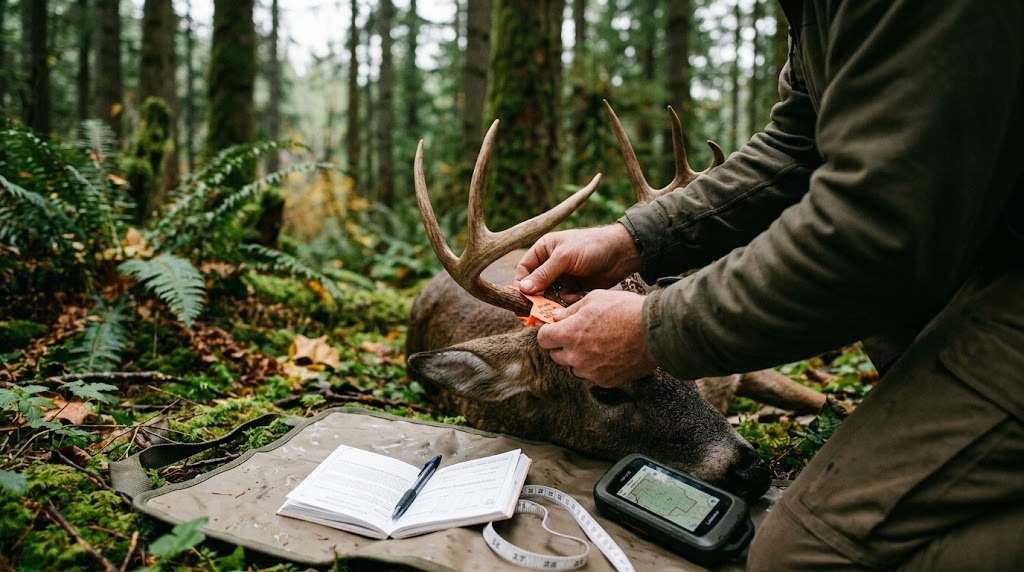
For big game like white-tailed deer, verify sex-specific limits and antler restrictions. If your zone requires a minimum of 3 points on one side, ensure each point measures at least 1 inch from base to tip before moving the animal. For fish, lay the specimen flat on a certified measuring board with the mouth closed and pinch the tail to get the “Total Length.”
Success Checkpoint: You’ll know it worked when the animal’s physical measurements perfectly match the legal slot limit or minimum size limit for that specific species.
Common Mistake: Field dressing a bird, fish, or big game animal in a way that removes the head, skin, or sex organs before transport. You must leave “proof of sex” and species identity naturally attached to the meat until it reaches your final residence.
Step 3: Tally Your Current Daily and Possession Counts
Add this specific harvest to your running tally for the calendar day to ensure it fits within your legal allowance.
A Daily Bag Limit dictates the maximum number of a single species you can keep in one calendar day (strictly 12:00 AM to 11:59 PM). Calculate your current daily total. If you are targeting an Aggregate Limit (e.g., a mix of duck species), ensure this single animal does not push the total mixed bag over the cap. Next, calculate your Possession Limit—the total number of that species you currently have in your physical custody, including what is already in your cooler, truck, or home freezer.
Success Checkpoint: You’ll know it worked when adding the number “1” to your current daily and possession logs keeps you at or below the legal maximums.
Common Mistake: The “Party Fishing/Hunting” trap. If the daily limit is 5, you must stop harvesting the moment you take your 5th animal. You cannot legally harvest a 6th animal to fill the tag of a friend standing next to you unless explicit “vessel limit” regulations apply.
Step 4: Validate and Tag the Harvest Immediately
Physically notch your paper tag or submit a digital E-Check before moving the carcass a single inch.
For big game, pull out your paper tag and ballpoint pen. Completely cut out or punch the exact month and day of the kill on the tag. Fill out the time and county, then secure the tag to the animal (typically the antler base or hind leg) using a zip tie. If your state uses electronic tagging, open the agency app, input the harvest details, and write the generated confirmation number on a piece of paper to keep with the animal.
Success Checkpoint: You’ll know it worked when the animal has a legally binding date, time, and tracking identifier physically attached to it before you begin dragging or packing it out.
Common Mistake: Relying solely on a smartphone for an E-Check in the backcountry. If you lose cell signal, you cannot legally move the animal. Always carry a pen and a paper harvest record as a manual backup.
Step 5: Transport, Process, and Log Game for Storage
Package the animal legally for transit and update your home freezer inventory.
When transporting fish or game on public roads, ensure the packaging complies with transit laws (e.g., storing fish fillets with a 1-inch patch of skin attached for species identification). Once home, label the processed meat with the date and species. Add this volume to your household possession tracker. To free up legal space for your next trip, you must fully consume the meat, discard it, or officially gift it to another person.
Success Checkpoint: You’ll know it worked when your freezer inventory accurately reflects your current possession limit, protecting you in the event of a game warden inspection.
Common Mistake: The Freezer Accumulation Error. Hunters and anglers frequently forget that frozen, smoked, or processed game from previous trips counts permanently against their legal possession limit until it is gone.
Common Mistakes and How to Fix Them
- Inadvertent Double-Hooking: You hook two fish simultaneously on a multi-lure rig, but you only have one daily limit slot left.
The Fix: You must choose the healthier fish to keep. Unhook the second fish while it is still in the water and release it immediately. - The “Double-Dipping” Calendar Error: You catch a limit of trout in the morning, drop them at home, and return to fish the afternoon.
The Fix: Stop fishing. Your daily limit is tied to the 24-hour calendar day. Shifting locations or emptying your cooler does not reset your daily tally. Wait until 12:00 AM. - Culling and High-Grading: You have a legal limit of fish in your livewell, catch a bigger one, and throw a smaller, stressed fish back to make room.
The Fix: Never do this. Once a fish is placed in a livewell or on a stringer, it is legally “reduced to possession.” If you catch a larger fish after limiting out, you must release the large fish immediately. - Harvesting a Sub-Legal Animal: You misjudge an antler point or a bird species in flight and harvest an illegal animal.
The Fix: Do not abandon the carcass (wanton waste is a severe crime). Field dress the animal to preserve the meat, contact the local game warden immediately, and self-report the mistake. Wardens heavily favor honest self-reporting over discovering abandoned game.
Variations Based on Harvest Structure
Slot Limits vs. Minimum Size Limits
If pursuing species with a “Protected Slot Limit” (e.g., Red Drum or Trout), the rules reverse. A minimum size limit requires you to release small animals. A protected slot requires you to keep the small table-fare and the massive trophies, but explicitly demands you release the prime-breeding mid-sized adults (e.g., everything between 14 and 21 inches must go back).
Single-Species vs. Aggregate Limits
When managing closely related species (like waterfowl or panfish), states use Aggregate Limits. Your total daily bag might be 6 ducks in aggregate, but within that 6, a sub-limit dictates you can only have a maximum of 2 Mallards and 1 Pintail. You must aggressively track both the macro-number and the micro-number simultaneously.
Typical License Costs and Timeframes
Bag limits operate within strict calendar timeframes defined by biological cycles. Spring turkey seasons run for a narrow 3-to-4 week window to protect nesting hens, while small game seasons run for 4-to-5 months.
- Resident Licenses: Typically range from $15 to $40 annually for basic small game and fishing. Big game tags add $20 to $100 per species.
- Non-Resident Licenses: General access costs $100 to $300. Premium out-of-state big game tags (Elk, Moose) range from $300 to $1,200+ and often require applying through limited quota lottery draws months in advance.
Frequently Asked Questions
Does catch-and-release fishing count against my daily bag limit? No. As long as the fish is immediately released back into the water unharmed without being placed in a livewell, bucket, or stringer, it does not count toward your daily bag limit.
How do I legally give away game to reset my possession limit? You must provide the recipient with a signed Wildlife Resource Document (or a handwritten note) detailing your name, license number, the species, date of harvest, and your signature. Once transferred, those animals count against their possession limit, not yours.
Do bag limits apply on private property? Yes. Wildlife is held in public trust by the state, regardless of whose land it resides on. State bag limits, season dates, and tagging requirements apply universally to both public and private land harvests.
What happens if I cross state lines with a full possession limit? You must abide by the possession limit of the state you are currently standing in, and you must carry the valid license from the state where the harvest occurred to prove the origin of the game during interstate transit.
Having a precise grasp of how bag limits work transforms a stressful regulatory maze into a simple, repeatable checklist. By verifying your boundaries, measuring meticulously, and tracking your possession limits, you ensure a lifetime of ethical, consequence-free harvests.