
Effective first aid tips for hunters focus on managing high-energy ballistic trauma, deep lacerations, and fall-related orthopedic injuries in austere environments. Because wilderness medical response often takes 2 to 24 hours, hunters must rely on immediate tactical medicine protocols like MARCHE to stop catastrophic bleeding, prevent hypothermia, and stabilize casualties for extraction.
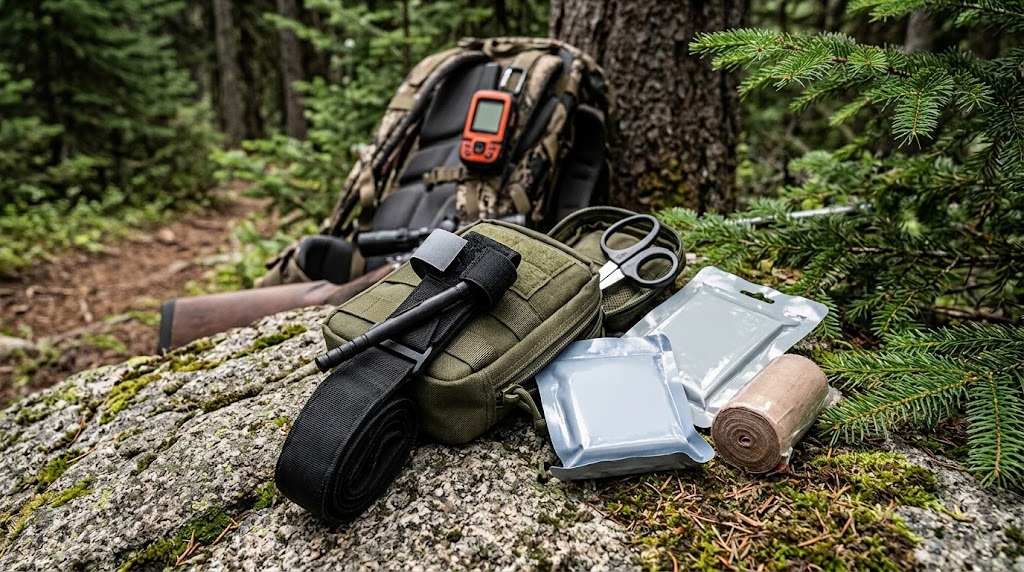
Key Facts / At a Glance
- 60 to 180 Seconds: The timeline before an unmanaged major arterial bleed (e.g., femoral artery) results in fatal exsanguination.
- 120 Minutes: The safe maximum window a windlass tourniquet can remain fully tightened on an extremity without inducing long-term ischemic tissue damage.
- 36% to 50%: The portion of all documented hunting accidents caused by falling from elevated treestands.
- < 95°F (35°C): The internal core temperature marking clinical hypothermia, which causes the blood’s clotting cascade to fail, accelerating blood loss.
What Are the Most Common Hunting Injuries?
The most common hunting injuries fall into three primary categories: elevated falls, ballistic or broadhead trauma, and environmental exposure. Unlike standard urban first aid, wilderness hunting injuries involve high kinetic energy and prolonged extraction times.
- Treestand Falls (Axial Trauma): Accounting for up to half of all hunting accidents, drops from 15 to 25 feet cause axial loading injuries to the spine, pelvis fractures, and traumatic brain injuries (TBI).
- Ballistic and Broadhead Lacerations: Accidental firearm discharges create cavitating wound tracks, while modern razor-sharp broadheads cause deep, clean lacerations that sever arteries with minimal resistance.
- Environmental Exposure: Hypothermia is the silent killer in trauma. Even in mild 60°F weather, a patient experiencing blood loss loses the ability to thermoregulate, rapidly dropping below the 95°F threshold.
How Do You Apply the MARCHE Protocol in the Field?
You apply the MARCHE protocol by triaging injuries in strict order of lethality, starting with massive bleeding before moving to airway and circulation. Standard civilian CPR is irrelevant in severe trauma; the casualty will bleed to death long before their heart stops from other causes.
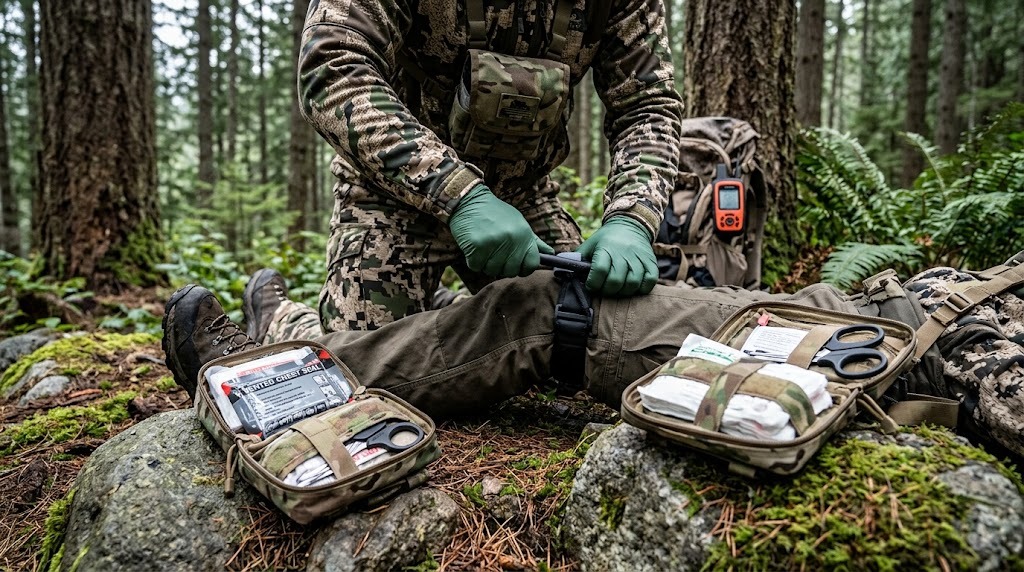
M – Massive Hemorrhage
Instantly apply a windlass tourniquet (like a CoTCCC-approved CAT or SOF-T) to extremities, or pack junctional wounds (groin, armpits) with hemostatic gauze. Place extremity tourniquets “high and tight” over clothing and twist the windlass rod until the distal pulse disappears entirely.
A – Airway
Establish structural patency using basic physical maneuvers. If the casualty is unconscious but breathing, place them in the recovery position (on their side) to prevent the tongue or pooled blood from obstructing the airway. If spinal injury is suspected from a fall, use the jaw-thrust maneuver to open the airway without moving the neck.
R – Respiration
Immediately treat open chest or torso trauma with a vented chest seal to prevent a tension pneumothorax. When an object penetrates the “box” (neck to navel), air can enter the chest cavity and collapse the lung. A vented seal allows trapped air to escape while preventing outside air from entering.
C – Circulation
Evaluate distal pulses, check capillary refill, and manage secondary, non-life-threatening bleeding. Apply pressure dressings (like an Israeli Bandage) to secure packed wounds and protect them from dirt and debris.
H – Hypothermia and Head Trauma
Heavily insulate the patient to prevent traumatic hypothermia, which actively causes blood clotting failure. Strip away wet clothing, wrap the casualty in a Mylar space blanket, and insulate them from the cold ground using a sleeping pad or backpack. Assess for traumatic brain injuries (TBI) if the casualty fell.
E – Eye Injuries and Evacuation
Cover eye lacerations with a rigid eye shield (never a pressure patch, which will extrude ocular contents). Begin coordinating emergency extraction immediately using a satellite communicator (e.g., Garmin inReach) or by sending a runner with exact GPS coordinates.
How Do You Treat Specific Hunting Traumas?
You treat specific hunting traumas by isolating the mechanism of injury and aggressively stabilizing the damage to survive the extraction window. You must clear and secure all nearby firearms before treating a gunshot victim to prevent secondary accidents.
Treating Gunshot and Broadhead Wounds
Cut away heavy hunting apparel to locate the exact wound track; do not guess through fabric. If the bleeding is from an arm or leg, immediately apply a tourniquet. If a broadhead arrow is impaled in the casualty, never pull it out. The broadhead acts as a plug holding back vascular bleeding. Cut the arrow shaft down if it hinders transport, pack gauze tightly around the entry point to stabilize it, and wrap it securely.
Treating Treestand Falls and Orthopedic Trauma
Prioritize manual cervical-spine tracking to prevent secondary spinal cord damage. Assess neurological responses by asking the casualty to move their fingers and toes. Immobilize suspected fractures using a moldable structural splint (like a SAM Splint), fixing the joints directly above and below the injury site. If a pelvic fracture is suspected, firmly bind the pelvis using a commercial pelvic binder or a tightly wrapped jacket to prevent massive internal bleeding.
Which Medical Loadout Should You Carry?
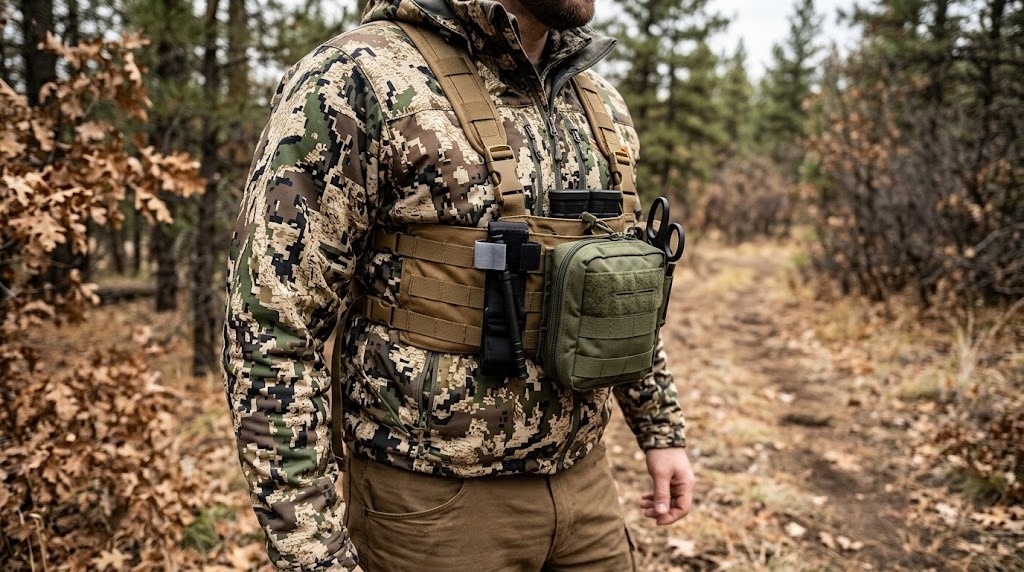
You should carry a medical loadout scaled to your distance from definitive medical care, with an Ultralight IFAK acting as your absolute minimum baseline. Never rely on a standard pharmacy first aid kit; band-aids and antibiotic ointment cannot treat ballistic trauma.
| Medical Kit Type | Best Used For | Key Components Included | Price Range & Lifespan |
| Ultralight Pocket IFAK | Day hunts, upland game, turkey | 1x Windlass Tourniquet, Compressed Gauze, 1x Vented Chest Seal, Nitrile Gloves | $45 – $75 3–5 Year Shelf Life |
| Backcountry Trauma Kit | Multi-day backcountry, elk/mule deer hunts | 2x Tourniquets, Hemostatic Gauze, SAM Splint, Space Blankets, Pressure Dressing, Shears | $120 – $250 3–5 Year Shelf Life |
| Basecamp / Truck Kit | Basecamps, waterfowl blinds, motorized vehicles | Extensive burn dressings, multi-person trauma supplies, rigid splints, OTC medications, stretcher | $200 – $450 5+ Year Shelf Life |
How to Choose Your Kit
- Choose the Ultralight IFAK if: You are hunting less than an hour from a road and carrying minimal gear. It provides exactly enough equipment to stop one catastrophic bleed.
- Choose the Backcountry Kit if: You are miles from a trailhead. A single tourniquet is rarely enough for lower-extremity trauma, and the SAM splint becomes mandatory for hike-outs.
- Skip the Basecamp Kit if: You are hunting on foot. At 3 to 5 pounds, this kit is strictly for vehicle staging.
What Are the Deadliest First Aid Mistakes Hunters Make?
The deadliest first aid mistakes hunters make involve improvised equipment and poor gear staging, which burn through the critical 60-second survival window for arterial bleeding.
- Applying Loose Tourniquets: Applying a tourniquet loosely stops venous return but allows high-pressure arterial blood to enter the limb. This paradoxically causes the wound to bleed faster, engorging the limb. Solution: Twist the windlass rod until all active bleeding stops completely. If bleeding continues, apply a second tourniquet directly above the first.
- Burying Medical Gear in the Pack: Storing a trauma kit deep inside a heavy backpack makes it impossible to retrieve during a sudden massive hemorrhage. Solution: Unbox your primary tourniquet and trauma shears and stage them externally on your bino harness, chest rig, or belt for instant, one-handed access.
- Relying on Belts as Improvised Tourniquets: Leather belts lack a windlass mechanical advantage. You cannot physically pull a belt tight enough to crush a femoral artery against the femur. Solution: Only carry CoTCCC-approved windlass tourniquets.
Frequently Asked Questions
What are the most important items in a hunter’s first aid kit?
The most critical items are a windlass tourniquet, hemostatic packing gauze (like QuikClot), a vented chest seal, a pressure dressing, and trauma shears. These components directly address the most immediate threats to life: massive hemorrhage and tension pneumothorax.
Can you remove a tourniquet in the wilderness?
No, you should never remove or loosen a tourniquet in the field once it is applied. Only a surgeon in a controlled hospital environment should remove a tourniquet. A tourniquet can safely remain tight on an extremity for up to 120 minutes without causing permanent tissue damage.
How do you treat a hunting dog with a first aid kit?
You can use human trauma supplies on hunting dogs, with minor adjustments. Standard tourniquets work on canine limbs, and hemostatic gauze is highly effective for boar or predator lacerations. However, dogs require specific canine-safe OTC medications; never give a dog human ibuprofen or acetaminophen, which are highly toxic to them.
What is the best way to signal for medical evacuation?
The most reliable method is utilizing a two-way satellite messenger with an SOS function. When triggering an SOS, immediately message the dispatcher with your exact coordinates, the nature of the trauma, the patient’s age, and current vitals. Never rely entirely on cell service in wilderness environments.