
If you get lost while hunting, immediately halt your movement, sit down, and execute the S.T.O.P. protocol: Stop, Think, Observe, and Plan. Your absolute priorities are stabilizing your heart rate, preserving core body heat, and establishing high-visibility signaling to assist Search and Rescue (SAR) operations.
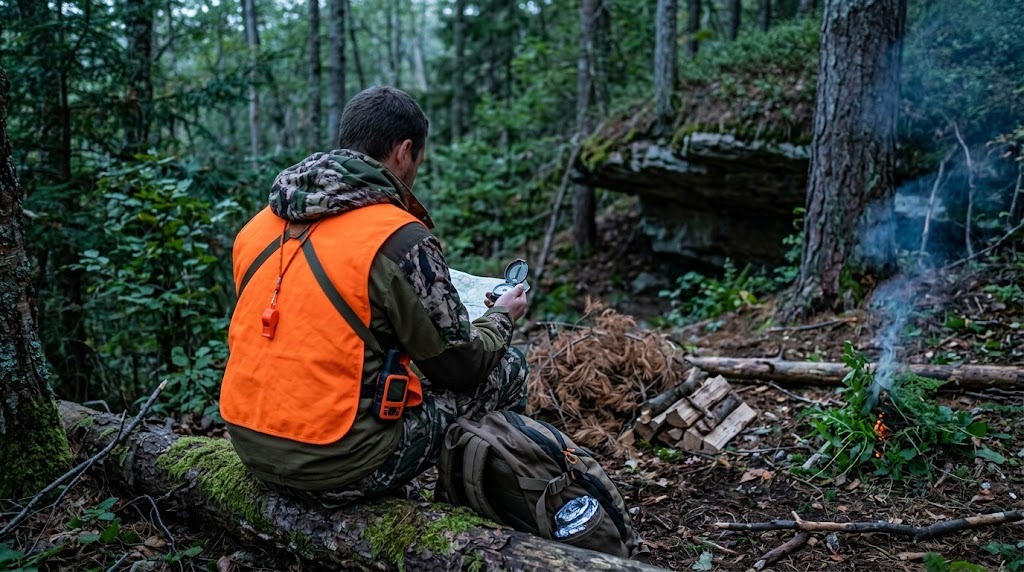
Key Facts / At a Glance:
- Over 80% of lost hunters who remain stationary are found by SAR teams within 24 to 48 hours.
- The Rule of Threes dictates prioritizing shelter and warmth (3 hours) over water (3 days) or food (3 weeks).
- Firing three rapid shots safely into an earthen backstop is the international auditory distress signal.
- Moving at night exponentially increases the risk of lower extremity injuries and deepens spatial disorientation.
- Personal Locator Beacons (PLBs) broadcast directly to 406 MHz military satellites and require zero cellular reception.
Before You Start: Emergency Survival Parameters
- Total Time: Survival mode lasts until rescue (typically 24–72 hours). Actionable shelter and fire preparation requires 2 hours of daylight.
- Difficulty: High psychological stress; moderate physical exertion.
- Prerequisites: Basic understanding of the Rule of Threes, a calm mindset, and the willingness to admit you are lost.
- Essential Gear to Keep on Your Person: High-decibel emergency whistle, fire-starting kit (lighter, storm matches, tinder), space blanket, metal cup, and a navigational device (compass, GPS, or satellite messenger).
How to Execute the S.T.O.P. Protocol
Step 1: Stop and Control Physiological Panic
Sit down on your pack or a log the exact moment you realize you are lost. Do not take another step. Close your eyes and execute 4-7-8 breathing (inhale for 4 seconds, hold for 7, exhale for 8) to trigger your parasympathetic nervous system.
- Specifics: Panic causes a rapid heart rate, tunnel vision, and a spike in cortisol, leading to irrational decisions known in SAR data as “lost person behavior”. You must burn time, not calories.
- Success Checkpoint: You will know it worked when your heart rate drops, your breathing slows, and the urge to “run just over the next ridge” subsides.
- Common Mistake: Continuing to walk faster while rationalizing that civilization is just over the next hill.
Step 2: Think and Establish Bearings
Analyze your situation calmly by recalling physical data. Retrace your steps mentally, not physically.
- Specifics: Recall your last known positive landmark, the direction of the wind when you started, and the position of the sun. Check your watch to calculate exactly how many hours of daylight remain. If your GPS or phone is dead, transition to your analog compass.
- Success Checkpoint: You have mentally mapped a rough timeline of your route and confirmed your remaining daylight hours.
- Common Mistake: Trusting your “gut feeling” over your analog compass. A compass does not lie; a panicked brain does.
Step 3: Observe Your Immediate Micro-Environment
Check your immediate 100-yard surroundings for resources before the sun sets.
- Specifics: Look for natural shelter topography (rock overhangs, large coniferous trees with low branches, fallen timber), hazards (dead widow-maker branches, cliffs), and fuel (dry pine needles, birch bark, dead-standing wood).
- Success Checkpoint: You have identified a flat, dry spot to sit out the night that is protected from the wind.
- Common Mistake: Choosing a shelter location at the very bottom of a deep ravine, where cold air settles and flash floods can occur.
Step 4: Plan Based on Daylight Remaining
Formulate a strict strategy based on the time of day.
- Specifics: If you have less than two hours of daylight remaining, completely abandon any navigation efforts. Dedicate 100% of your energy to gathering firewood, building a microclimate shelter, and preparing signals for the morning.
- Success Checkpoint: You have a pile of firewood waist-high and a windbreak constructed before darkness falls.
- Common Mistake: Waiting until dusk to start gathering firewood, resulting in injuries and insufficient fuel to last the night.
What Are the Best Emergency Signaling Devices?
When lost, your primary operational goal is assisting Search and Rescue teams in locating you. Visual and auditory signals bridge the gap between your location and the search grid.
| Gear Type | Typical Price | Battery / Lifespan | Pros | Cons |
| PLB (e.g., ACR ResQLink) | $300 – $450 | 5+ years (one-time use) | No subscription; utilizes 406 MHz COSPAS-SARSAT military satellites; 100-meter accuracy. | No two-way text communication; cannot send non-emergency updates. |
| Satellite Messenger (e.g., Garmin inReach) | $200 – $600 | 50 – 100 hours | Two-way texting; GPS mapping; allows communication with family and SAR. | Requires a monthly subscription ($12–$65/mo); requires routine charging. |
| Survival Whistle & Signal Mirror | $10 – $25 | Infinite | Ultra-lightweight; zero failure rate; highly effective at close range. | Limited by line-of-sight and audible distance; requires physical effort. |
Which Should You Choose?
- For the Backcountry / Wilderness Hunter: Invest in a Satellite Messenger. The ability to text SAR teams your exact medical condition and coordinate an extraction point is invaluable in deep wilderness.
- For the Solo / Senior Hunter: Carry a Personal Locator Beacon (PLB). PLBs offer a zero-fail, direct-to-military distress signal with no subscription required.
- For the Day Hunter (Public Land / State Parks): A survival whistle and mirror are mandatory, but a satellite messenger provides excellent peace of mind in areas with spotty cellular coverage.
How Do You Survive the Night?
Surviving an unplanned night in the woods is a battle against hypothermia, which can set in at temperatures as high as 50°F (10°C) if you are wet. Your primary adversary is conductive heat loss—the ground pulling heat directly from your body.
To survive, you must build a microclimate. Do not sit directly on the ground. Stack pine boughs, dry leaves, or your backpack to create at least four inches of insulation between you and the soil. If it begins to rain or snow, stop immediately to preserve dry clothing. Construct a simple debris hut using a fallen log and branches to trap your body heat. Build your fire no more than three feet from your shelter, utilizing a rock wall or thick log behind the fire to reflect heat back toward you.
Common Mistakes and How to Fix Them
- Following Downhill Terrain Blindly: It is a myth that following water downstream always leads to civilization. In rugged backcountry, following draws or canyons frequently funnels hunters into impassable cliffs, waterfalls, or dense swamps. How to fix it: Stay put on a visible ridge where SAR helicopters can spot you and radio signals can travel.
- Discarding Gear: Panicked hunters often shed heavy gear to walk faster. How to fix it: Never drop your backpack, extra clothing, or firearm. Even without ammunition, a firearm’s scope can be used as a monocular, and parts can be used for survival tasks.
- Wasting Ammunition for Signaling: Firing into the air randomly is dangerous and wastes your only auditory signal. How to fix it: Wait until you hear a low-flying aircraft, a vehicle engine, or human voices. Then, point your muzzle safely into an earthen backstop and fire exactly three times in rapid succession.
Frequently Asked Questions
How long does it take for Search and Rescue to start looking?
SAR initiation depends on your “Float Plan.” If you left a strict itinerary with family detailing your parking coordinates and return time, SAR can mobilize within hours of you missing your check-in. Without a plan, it can take 24 to 48 hours for anyone to notice you are missing.
Can I drink water from a stream if I am lost?
Do not drink unpurified water unless you are facing death from dehydration, which typically takes three days. In a 24-hour survival situation, drinking contaminated water can cause severe gastrointestinal distress, accelerating dehydration. Boil water in a metal cup or use purification tablets.
How does Search and Rescue actually track lost hunters?
SAR teams utilize a combination of helicopter FLIR (Forward Looking Infrared), trained scent-tracking canine units, cell phone forensics (pinging your last known tower connection), and statistical models based on “Lost Person Behavior” databases.
What should I do if I am injured while lost?
Address massive hemorrhage immediately using a tourniquet or direct pressure. If your mobility is compromised, it is critical that you deploy your PLB or satellite messenger immediately, build a fire for warmth, and do not attempt to drag yourself through rough terrain.