
Firearm safety for hunters is the strict system of physical handling protocols, mechanical device management, and situational awareness routines that prevent accidental discharges. This framework ensures firearms are safely transported, loaded, carried, fired, and stored without risking injury to the hunter, companions, or bystanders.
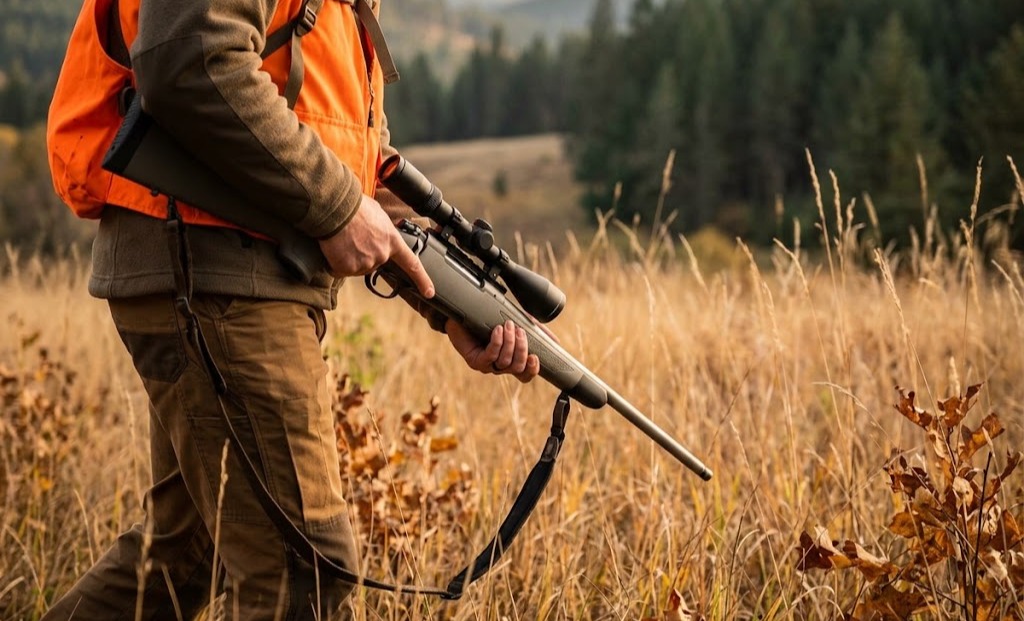
Key Facts / Quick Answer
- The Golden Rule: Always treat every firearm as if it is fully loaded and capable of firing.
- Muzzle Control: Never point the barrel at anything you do not intend to destroy; maintain a safe carry angle at all times.
- Trigger Discipline: Keep your index finger indexed along the receiver, outside the trigger guard, until your sights are on the target.
- Target Identification: Positively identify the game animal and ensure a clear backstop extending at least 100 yards beyond the target.
- Field Carriage: Firearms must be unloaded with the action open when crossing fences, climbing tree stands, or entering vehicles.
What Are the Four Core Rules of Firearm Safety?
The four core rules of firearm safety form an interdependent system where a failure in one rule is mitigated by adherence to the others. These rules apply universally, regardless of the firearm action, hunting environment, or hunter experience level.
1. Treat Every Firearm as if it is Loaded
Hunters must physically and visually clear a firearm every time it changes hands or is retrieved from storage. Mechanical indicators and extractors can fail, leaving a live round in the chamber. In practice, treating a gun as loaded means never trusting a previous safety check; you must open the action and inspect the chamber and magazine tube yourself.
2. Always Point the Muzzle in a Safe Direction
A safe direction dictates that if an accidental discharge occurs, the projectile will safely impact the ground or a specialized clearing trap, causing no human injury or property damage. Muzzle control must actively adapt to the terrain, the position of hunting partners, and the type of carry (e.g., trail, shoulder, or cradle carry).
3. Keep Your Finger Off the Trigger
Trigger discipline requires resting the index finger flat against the firearm’s frame or receiver above the trigger guard. The finger only enters the trigger guard after the mechanical safety is disengaged, the firearm is shouldered, and the hunter has actively decided to take the shot.
4. Be Sure of Your Target and Beyond
Hunters must identify their game with 100% certainty using binoculars, never the rifle scope, to avoid pointing a loaded weapon at a human. A hunter must also verify what lies directly behind the target. Rifle projectiles can easily travel over a mile, and shotgun slugs carry lethal energy well beyond 100 yards.
How Does the Step-by-Step Field Process Work?
Executing safe firearm handling requires sequential protocols from the moment you leave your vehicle to the moment you return. Adhering to this field workflow prevents accidents during the most vulnerable transitional moments of a hunt.
- Transporting: Keep firearms fully unloaded and secured in a hard or soft case until reaching the designated hunting boundary.
- Action Check: Open the action immediately upon uncasing to verify both the chamber and the magazine are empty.
- Loading: Insert ammunition only when actively entering the hunting environment and preparing to hunt.
- Safety Engagement: Keep the mechanical safety engaged (“ON”) at all times while walking, sitting, or tracking.
- Muzzle Control: Maintain a carry position appropriate for the group. For example, use a two-handed ready carry when walking point, or a shoulder carry when walking last in a line.
- Crossing Obstacles: Unload the chamber and open the action entirely before crossing fences, navigating steep ditches, or climbing into a tree stand.
- Firing: Disengage the safety only after the firearm is mounted to the shoulder and a confirmed target is acquired.
- Unloading: Empty the firearm completely, verifying visually and tactilely, before returning to camp or a vehicle.
Expert Insight: The majority of tree stand firearm accidents occur while climbing. Never carry a firearm up a ladder. Attach an unloaded firearm to a haul line, climb to the platform, secure your fall-arrest harness, and pull the unloaded firearm up to you.
Types of Mechanical Safeties and Limitations
Mechanical safeties physically block the trigger, hammer, or sear to prevent the firing pin from striking the ammunition primer. However, these are mechanical devices subject to wear, rust, and catastrophic failure upon heavy impact.
- Cross-Bolt Safety: A push-button mechanism positioned horizontally through or behind the trigger guard, commonly found on shotguns and rimfire rifles.
- Tang Safety: A sliding switch located on the upper metal strip behind the receiver, offering ambidextrous operation on break-action shotguns and many bolt-action rifles.
- Pivot/Lever Safety: A pivoting lever usually attached directly to the bolt shroud or receiver, common on centerfire bolt-action hunting rifles (e.g., the Mauser three-position safety).
- Hammer/Half-Cock: A notch on an external hammer that suspends it away from the firing pin. This is standard on traditional lever-action rifles and single-shot shotguns.
Relying solely on mechanical safeties is a critical failure of firearm safety for hunters. Safeties wear out, sears degrade, and a dropped rifle can discharge even with the safety fully engaged due to internal inertia.
How Do Hunters Manage Zones of Fire?
Managing zones of fire dictates the specific, safe shooting angles hunters maintain when navigating the field in groups. This spatial awareness prevents friendly fire during sudden game flushes.
When walking in a line, hunters establish a primary 45-degree zone of fire directly to their front. A hunter on the far left may only shoot safely to the left and center-left, while the hunter on the right shoots only right and center-right. No hunter ever swings their muzzle past the invisible 45-degree boundary separating them from their partner. If a bird flies behind the line, hunters must yell “No shot” and keep their muzzles pointed safely upward or forward.
What Happens During a Misfire or Hangfire?
A misfire or hangfire occurs when the trigger is pulled, the firing pin strikes, but the cartridge does not immediately detonate. Handling this safely prevents severe injury from delayed ignition.
When a firearm fails to fire, hunters must keep the muzzle pointed in a safe direction and wait a minimum of 30 seconds. A hangfire is a delayed ignition caused by a slow-burning primer; opening the action too quickly can cause the cartridge to explode outside the chamber, sending brass shrapnel into the hunter’s face. After 30 seconds, carefully open the action, extract the faulty cartridge, and inspect the barrel for obstructions before reloading.
Ammunition and Environmental Field Hazards
Proper ammunition matching and environmental awareness are critical components of in-field safety. Using the wrong ammunition can cause catastrophic barrel explosions.
The most dangerous ammunition mistake in hunting is the “12/20 burst.” If a 20-gauge shell is accidentally loaded into a 12-gauge shotgun, it will slip past the chamber and lodge in the barrel. When a 12-gauge shell is subsequently loaded behind it and fired, the obstructed barrel will violently explode. Furthermore, hunters must routinely check their barrels for mud, snow, or ice after a fall; even a small amount of debris will cause a barrel to rupture upon firing.
Storage Options, Hardware Security, and Costs
Safe storage isolates firearms from unauthorized users, children, and thieves while ensuring the weapons remain in pristine mechanical condition for the next hunt. Processing times for licenses and safety certifications often take up to 10 days, making proper storage planning a prerequisite for new hunters.
| Storage Option | Estimated Cost | Pros | Cons |
| Trigger / Cable Locks | $5 – $20 | Affordable, highly portable, standard for basic safety. | Does not prevent theft of the entire firearm; can trap moisture. |
| Soft/Hard Gun Cases | $20 – $150+ | Protects the physical finish; meets legal transit requirements. | Easily stolen; soft cases are easily cut; not secure against children. |
| Biometric Quick Safes | $100 – $300 | Rapid access (under 2 seconds); excellent for single handguns. | Requires batteries; sensors can fail with wet or dirty hands. |
| Heavy Steel Gun Safes | $500 – $3,000+ | Maximum theft deterrence, fireproof ratings, high capacity. | Expensive, highly immobile, requires dedicated floor support. |
| Hunter Safety Course | $15 – $40 | Mandatory legal requirement, provides 4–12 hours of vital education. | Requires advance scheduling; field days mandate physical attendance. |
What Are Common Firearm Handling Mistakes?
Even experienced hunters fall victim to complacency. Recognizing and correcting common handling errors is what separates a professional outdoorsman from a liability.
- Target Fixation: Using a rifle scope as a primary observation tool. Fix: Always use standalone binoculars to scout movement; a scope is an aiming device, not a spotting tool.
- Flagging Partners: Inadvertently allowing the muzzle to sweep across a companion while turning, climbing, or loading. Fix: Maintain active spatial awareness of your muzzle’s geometry relative to your partners at all times.
- Ammunition Left in the Magazine: Forgetting a round in the tubular magazine of a shotgun or lever-action rifle, even after clearing the chamber. Fix: Visually inspect both the chamber and the follower/tube every time the firearm is unloaded.
Expert Recommendations by Hunting Discipline
Different hunting disciplines require specialized safety adaptations based on terrain, movement, and the type of firearm utilized.
- Youth and Beginners: Novice hunters should utilize single-shot or bolt-action firearms with highly visible manual safeties (like tang safeties). These actions force deliberate, slow loading processes, allowing instructors to monitor the hunter’s mechanics easily.
- Big Game Rifle Hunters: Western hunters navigating steep terrain should master the three-position safety, which permits the bolt to open while the firing pin remains locked. High-quality slings must be used to ensure the muzzle points safely skyward while hiking over rocky ground.
- Waterfowl and Upland Hunters: Bird hunting involves rapid, reactionary shooting in tight groups. Upland hunters must master the two-handed ready carry, keeping the index finger indexed high on the receiver until the gun stock firmly meets the cheek.
Frequently Asked Questions About Firearm Safety for Hunters
What is the minimum safe distance for a hunting backstop?
A safe backstop should ideally be a solid berm or rising hill. For shotgun slugs and rifle rounds, you must ensure clear space for at least 100 to 500 yards beyond your target, as ricochets off water, rocks, or frozen ground can travel vast distances with lethal energy.
Why shouldn’t I use my rifle scope to identify game?
Pointing a rifle scope at an unidentified object violates the rule of never pointing a muzzle at anything you do not intend to shoot. If the movement turns out to be another hunter, you have just aimed a loaded weapon at a human. Always use binoculars.
Is blaze orange legally required for firearm safety?
Most jurisdictions require hunters to wear a minimum amount of blaze orange (often 400 to 500 square inches above the waist, plus a hat) during firearm seasons. This non-natural color alerts other hunters to your presence, drastically reducing accidental shootings in dense brush.
What is the safest way to carry a firearm over rough terrain?
When traversing mud, ice, or steep rocks, use the two-handed trail carry or sling the rifle securely across your back. If a fall is imminent, you must control the muzzle direction as you go down, ensuring it points away from yourself and your partners. Check the barrel for obstructions immediately after recovering.
How do you safely transport a hunting firearm in a vehicle?
Firearms must be completely unloaded (chamber and magazine empty), encased in a hard or soft case, and ideally placed in the trunk or rear storage area of the vehicle. Ammunition should be stored in a separate, closed container away from the firearm to comply with transit laws.