
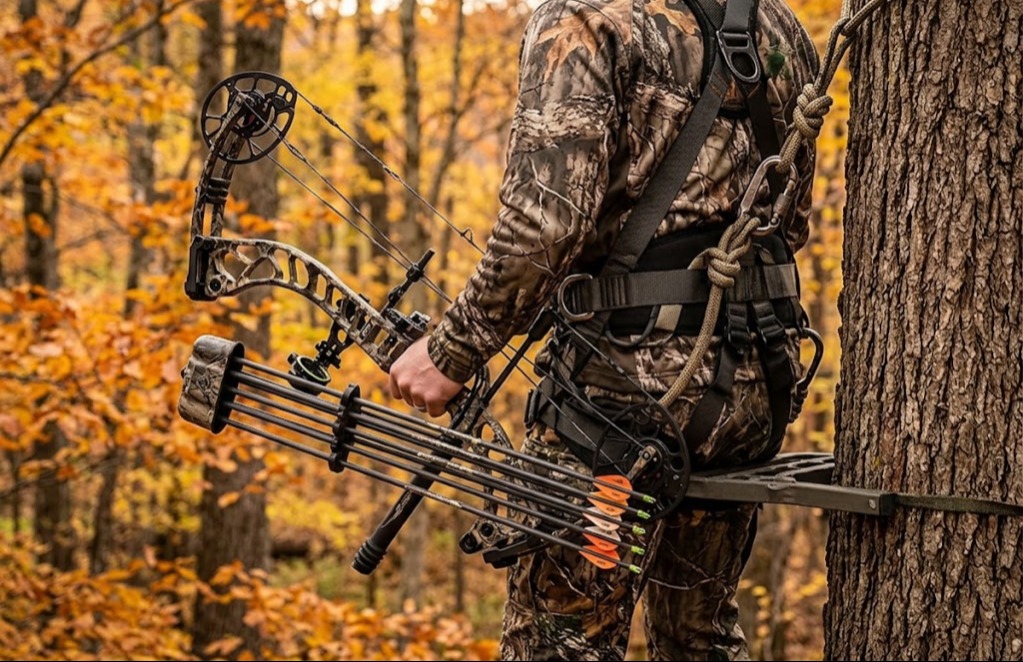
Bow hunting safety is a rigorous system of mechanical gear inspections, cutting containment protocols, and elevated fall arrest practices designed to prevent catastrophic injury. Because archery equipment relies on immense stored potential energy and razor-sharp broadheads rather than the hydrostatic shock of firearms, bowhunters must manage unique physical forces to ensure a safe, humane hunt.
Key Facts at a Glance
- Continuous Connection: You must remain 100% connected to a fall arrest system from the moment your feet leave the ground until you return.
- Harness Lifespan: Manufactured tree stand safety harnesses expire exactly 5 years from their date of manufacture, regardless of use.
- String Replacement: Bowstrings and cables require replacement every 1 to 2 years to prevent snapping under high tension.
- Tether Geometry: A tree stand safety tether must be set at a maximum 45-degree angle to minimize swing distance and impact force during a fall.
- Broadhead Lethality: Broadheads kill via massive hemorrhage, meaning they are structurally designed to slice through tissue effortlessly; they must remain covered in a protective quiver until the moment of use.
Before You Start: Prerequisites and Gear
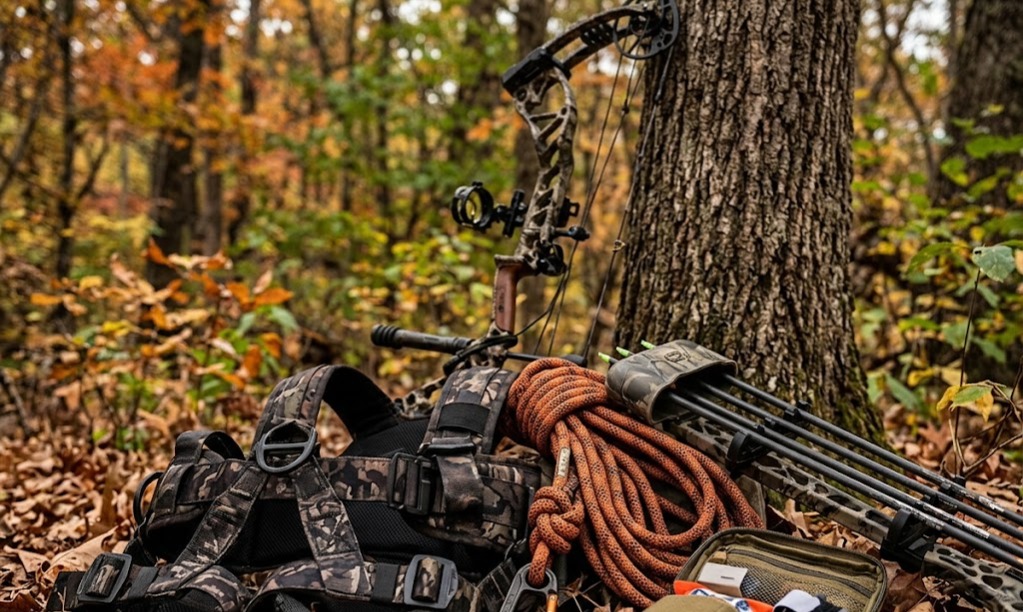
Implementing a comprehensive bowhunting safety system requires specific equipment, baseline financial investments, and pre-season time commitments. You cannot substitute makeshift gear for certified safety equipment.
- Total Setup Time: 4 to 6 weeks of pre-season practice; 20 to 30 minutes per tree for lifeline rigging.
- Difficulty: High. Requires mechanical aptitude, physical balance, and strict procedural discipline.
- Required Safety Gear: Full-body fall arrest harness (TMA-certified), continuous lifeline with Prusik knot, haul line (pull-up rope), broadhead wrench, suspension relief strap, and a dedicated hunting first-aid kit containing a tourniquet and hemostatic clotting agent.
- Estimated Safety Costs: $40–$150 for a quality harness; $35–$60 per tree lifeline; $100–$200 for routine bowstring replacement and tuning; $30–$75 for arrow inspection tools.
1. How Do You Inspect Bow Equipment?
Archery tackle operates through a violent transfer of energy. When a bow is drawn, potential energy is stored in the limbs; releasing the string converts this into kinetic energy. If the system fails, that energy explodes outward into the shooter.
Inspect the Limbs and Cams: Run a cotton ball along the edges of your compound or traditional bow limbs. If the cotton snags, you have a microscopic splinter or delamination that could cause the limb to shatter under tension. Check compound bow cams for bent tracks and ensure all module screws are torqued to the manufacturer’s specifications.
Verify String and Cable Integrity: Examine the bowstring, cables, and D-loop for fraying, fuzzy fibers, or separated serving thread. Apply specialized bow wax to dry strings, but immediately replace any string showing broken internal strands.
Flex-Test Every Arrow: Grasp each carbon or aluminum arrow near the ends and bend it away from your face while listening for cracking sounds. Roll the arrow on a flat surface to check for straightness. A structurally compromised carbon arrow will explode into carbon splinters upon release, driving debris directly into your bow hand.
Secure Your Broadheads: Never tighten a broadhead onto an arrow shaft by hand. Use a specialized broadhead wrench to lock the blades in place, preventing severe lacerations if your hand slips.
- Success Checkpoint: You will know your equipment is safe when the bow draws smoothly without clicking, the string is heavily waxed and intact, and every arrow flexes without making a sound.
- Common Mistake: Ignoring the D-loop. If a worn D-loop snaps at full draw, the hunter typically punches themselves in the face with their release aid, often breaking their nose or teeth.
2: How Should You Setup a Tree Stand?
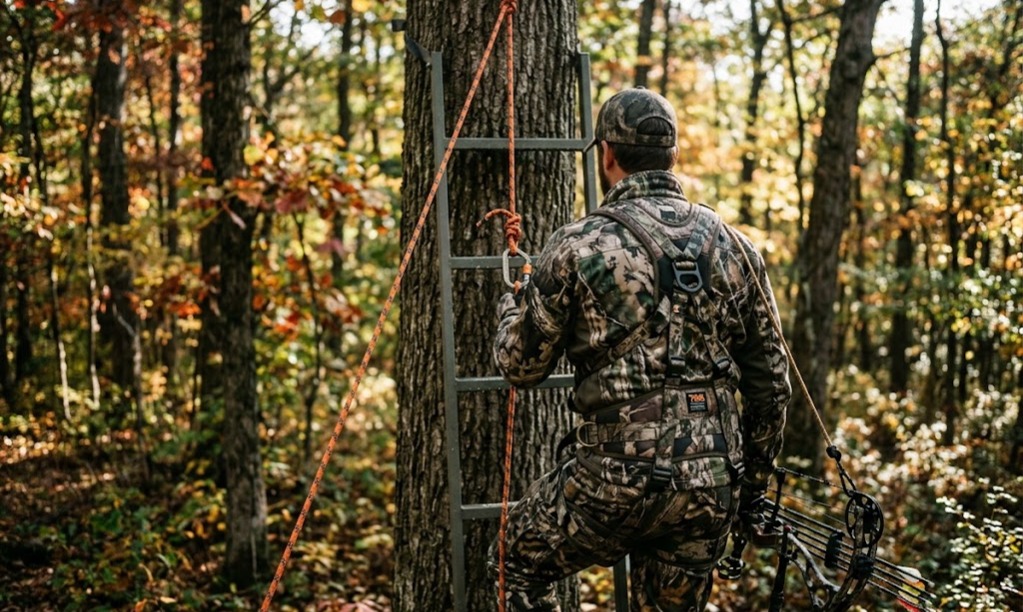
Elevated fall protection is the most statistically critical element of bow hunting safety. Most hunting fatalities are not weapon-related; they are gravity-related.
Attach Your Harness on the Ground: Put on your full-body harness before leaving your truck. Before your feet leave the ground, attach your harness tether to a lifeline system anchored above the stand. You stay clipped into this rope via a sliding Prusik knot for the entire climb.
Separate the Weapon from the Climb: Never climb a tree with your bow, arrows, or pack in your hands. Tie a pull-up rope (haul line) to your unloaded bow, ensuring the broadheads are fully enclosed in a rigid quiver.
Establish the 45-Degree Anchor: Once seated in the stand, adjust your tether so it anchors to the tree directly behind your head. The angle of the tether from the tree to your back should never exceed 45 degrees. If you fall, this short leash minimizes the physical drop distance and prevents you from swinging violently into the tree trunk.
Hoist the Bow: Only after you are fully secured and seated should you pull your bow up using the haul line.
- Success Checkpoint: You are correctly secured when you can lean forward in your stand and the tether catches you before you lose your balance, with both hands completely free.
- Common Mistake: Using a lineman’s belt as a primary fall arrest. A lineman’s belt only protects you while installing steps; it does not provide continuous top-to-bottom fall protection like a lifeline.
3: What Are the Rules for Shot Execution?
Executing a safe shot requires situational awareness of the weapon’s mechanics and the surrounding environment.
Maintain Safe Muzzle Control: Treat a nocked arrow identically to a loaded firearm. Never draw a bow unless it is pointed in a safe direction—ideally toward the ground or directly at the verified target.
Never Dry-Fire a Bow: Releasing the bowstring without an arrow nocked is known as dry-firing. Without the arrow to absorb the kinetic energy, the force dissipates violently back into the bow, instantly shattering the limbs and derailing the cams.
Verify the Target and the Background: Positively identify your target and exactly what lies beyond it. A modern compound bow firing a heavy arrow can pass completely through a deer and travel hundreds of yards into the brush behind it.
Apply Crossbow Finger Discipline: If using a crossbow, you must physically look at your lead hand before pulling the trigger. Ensure your fingers and thumb are tucked firmly underneath the flared safety guards (the flight deck). The forward rush of a crossbow string carries immense force and will instantly amputate any digits resting in its path.
- Success Checkpoint: You are executing safely when your finger remains behind the trigger until you have settled your pin on a verified target with a clear, safe backstop.
- Common Mistake: Gripping a compound bow tightly. Torquing the grip twists the riser; upon release, the string jumps out of the cam tracks, derailing the bow and whipping the cables into the shooter’s arm. Use a relaxed, open hand and a wrist sling.
4: How Do You Recover Game Safely?
The hunt does not end when the arrow is released; the recovery phase presents unique hazards involving live animals and hidden blades.
Observe the Waiting Period: Wait a minimum of 30 to 60 minutes before tracking an animal after a well-placed double-lung shot. This allows the animal to expire peacefully. If you suspect a liver or gut shot, wait 6 to 12 hours. Pushing a wounded animal forces it deeper into hazardous terrain and creates a dangerous confrontation.
Approach with Caution: Approach downed game from behind. Use a long stick or your bow limb to touch the animal’s open eye. If it blinks, the animal is still alive; back away immediately and prepare for a follow-up shot.
Locate the Broadhead: Exercise extreme caution when field dressing the animal. If the arrow did not pass completely through, the razor-sharp broadhead is still embedded inside the chest cavity. Blindly reaching into the carcass often results in severe hand lacerations. Visually locate the broadhead or follow the arrow shaft down carefully before making any internal cuts.
- Success Checkpoint: The recovery is safe when the animal is fully expired upon arrival, and you have visually confirmed the exact location of your broadhead before using your knife.
- Common Mistake: Leaving the quiver off the bow during tracking. Tripping in the dark while holding exposed broadheads in a loose quiver is a primary cause of self-inflicted puncture wounds.
Which Fall Protection System Should You Choose?
Selecting the right elevated safety system depends entirely on your hunting style, mobility requirements, and physical fitness.
| Safety Option | Best Used For | Weight Capacity Limit | Pros | Cons |
| Full-Body Harness + Lifeline | Standard hang-on or ladder tree stands. | Typically 300 lbs | Continuous 100% protection from ground to tree. Hands-free climbing. | Heavy; requires setting up a dedicated rope in every tree prior to the hunt. |
| Climbing Belt / Lineman’s Rope | Setting up new stand locations or using climbing spurs. | Typically 300 lbs | Keeps you securely attached to the tree while actively installing steps. | Only protects during installation; zero top-to-bottom continuous protection. |
| Saddle Hunting Systems | Public land hunters packing gear in and out daily. | Typically 250-300 lbs | Highly mobile. The harness acts as the seat, resulting in minimal fall distance. | Requires a steep learning curve and high core physical strength. |
The Quick Verdict
- For Beginners and Private Land: Choose the Full-Body Harness + Lifeline. It requires zero specialized coordination and provides foolproof, continuous safety for permanent stands.
- For Public Land and Mobile Hunters: Choose the Saddle Hunting System. It forces you to remain tethered at all times by design and eliminates the need to carry bulky metal stands through the woods.
What Are the Most Common Bowhunting Accidents?
Even experienced hunters fall victim to complacency. These are the most frequent, severe failure modes in the field and the exact protocols to fix them.
Neglecting the Suspension Trauma Strap
- The Failure: If you fall from a stand, your harness will save your life, but hanging suspended causes blood to pool in your legs. This cuts off oxygen to the brain, leading to unconsciousness or death within 15 to 30 minutes (suspension trauma).
- The Fix: Always carry a suspension relief strap attached to your harness. If you fall, immediately deploy the strap, drop it down, step into the loop, and stand up against it. Pushing your legs against this strap relieves pressure on your femoral arteries and buys you hours to wait for rescue.
Premature Let-Down Injuries
- The Failure: Deciding not to take a shot and attempting to let down a high-poundage compound bow smoothly. As the cams roll over the let-off valley, the sudden surge of peak weight yanks the archer’s shoulder forward, tearing the rotator cuff.
- The Fix: When letting down, keep your bow arm firmly locked out, point the bow slightly downward, and use your back muscles—not your bicep—to control the string’s return path.
Ice and Moisture on Tree Steps
- The Failure: Climbing metal tree steps or ladder rungs covered in morning frost or freezing rain wearing rubber hunting boots, resulting in a sudden slip.
- The Fix: Never wear un-treaded rubber boots on metal steps in late season. Always maintain three points of contact. Your lifeline Prusik knot must be slid up the rope above your head before you take your next step, ensuring that if you slip, you fall less than six inches.
Expert Recommendations by Hunter Type
Safety protocols vary drastically based on your weapon and environment.
For Beginners: Stick to ground blinds or heavily secured ladder stands before attempting hang-on stands. Take an official Bowhunter Education Course (often mandated by state law). Always use a mechanical release aid with a compound bow to prevent accidental string slips caused by finger fatigue.
For Public Land Hunters: Prioritize ultra-light gear certified by the Treestand Manufacturer’s Association (TMA). Because you navigate in the dark with heavy gear on unfamiliar terrain, carry a high-lumen headlamp and a backup flashlight. File a digital hunt plan with a family member and carry a satellite communicator (like a Garmin inReach) where cell service drops.
For Crossbow Users: Never attempt to manually un-cock a high-poundage crossbow by hand. Always carry a dedicated discharge target in your vehicle, or pack a specialized, heavy fiberglass un-cocking bolt. Fire the un-cocking bolt safely into soft ground at the end of the hunt to dissipate the mechanical energy.
Frequently Asked Questions (FAQ)
Can I leave my tree stand lifeline out in the woods all year?
No. UV degradation, weather, and squirrel damage severely weaken nylon ropes. Lifelines should be taken down at the end of the hunting season, stored in a dry, dark place, and fully replaced every two to three years.
What should I do if I drop my bow from the tree stand?
Do not attempt to climb down immediately if you are frustrated or rushing. Carefully descend using your lifeline. Once on the ground, do not shoot the bow. The impact likely bent the cams, knocked the sight out of alignment, or caused microscopic limb fractures. Take it to a bow shop for a full inspection.
How do you safely pack broadheads in a backpack?
Never throw loose broadheads into a pack. They must be stored in a hard-sided, foam-lined broadhead box. Even inside a box, wrap the container in a spare layer of clothing to prevent it from cracking open if you drop your pack on a rock.
Is it safe to hunt from a dead tree if it offers good cover?
Absolutely not. You should never attach a tree stand, lifeline, or saddle system to a dead or dying tree (widow-makers). High winds or the torque of your body weight can cause the tree or large branches to snap, collapsing the entire system regardless of your harness.
Why shouldn’t I use a firearm safety harness for bowhunting?
Firearm and construction harnesses are structurally different. Bowhunting harnesses are specifically designed to eliminate bulky front buckles that would interfere with a bowstring during the shot process, ensuring an unimpeded draw cycle while maintaining TMA-certified fall arrest standards.