
Hunting safety tips encompass the strict protocols, redundant equipment layers, and environmental awareness required to prevent catastrophic injury in the field. Implementing these rules ensures zero negligent firearm discharges, mitigates the risk of treestand falls, and guarantees safe recovery from remote wilderness emergencies.
At a Glance
- Treat every firearm as loaded; a standard .30-06 projectile fired at an upward angle can travel up to 3 miles.
- Keep your trigger finger exactly 0 feet from the trigger until you are 100% certain of the target and the background.
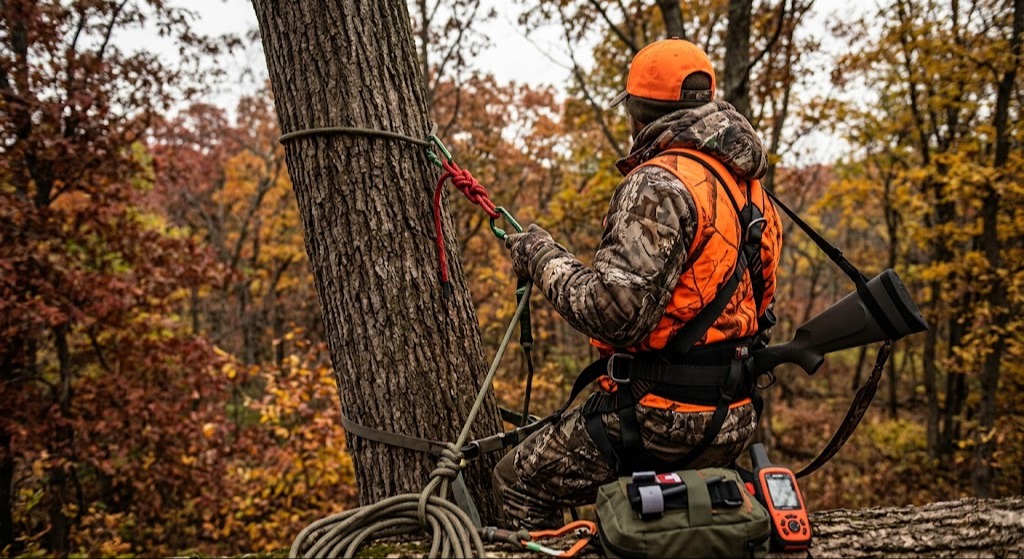
- Over 86% of treestand accidents occur while climbing or transitioning; hunters must remain connected to a lifeline at all times.
- Minimum blaze orange requirements typically range from 400 to 500 visible square inches, depending on state regulations.
- Firing a live round directly behind a muffled “squib load” will cause a catastrophic barrel rupture.
The Four Primary Rules of Firearm Safety
The entire discipline of firearm handling rests on four universal, non-negotiable rules. When hunters follow these rules without exception, negligent discharges cannot result in bodily injury.
1. Treat every firearm as if it is loaded.
Never assume a gun is empty, even if you just checked the chamber or watched a hunting partner clear it. Mechanical indicators can fail, and extractors can leave a cartridge lodged in the chamber. Verify visually and physically by touching the chamber every time a weapon changes hands.
2. Never point the muzzle at anything you do not intend to shoot.
Muzzle discipline requires conscious control of the barrel’s direction at all times. Whether using a cradle carry, shoulder carry, or two-handed carry, the muzzle must point toward a safe backstop—typically the sky or the ground, depending on the terrain and the position of your partners.
3. Keep your finger off the trigger until your sights are on the target.
Your index finger must rest flat along the receiver frame or the trigger guard while stalking, tracking, or shouldering the weapon. Moving through brush with a finger inside the trigger guard is the leading cause of branch-induced negligent discharges.
4. Be sure of your target and what is beyond it.
Bullet pass-through or a completely missed shot can travel thousands of yards. Identify the target with binoculars—never a rifle scope—with absolute certainty. Hunters must verify that no roads, buildings, livestock, or unseen partners exist in the background before removing the mechanical safety.
Phase-by-Phase Hunting Safety Protocols
A safe hunt requires deliberate planning and strict operational procedures before leaving home, during active pursuit, and after the animal is down.
Phase 1: Pre-Hunt Preparation
Before entering the woods, hunters must establish legal, mechanical, and logistical safety baselines.
- Complete Hunter Education: Obtain your state certification card. Courses typically cost $15 to $40 and require 4 to 8 hours of online study paired with a practical field day.
- Inspect and Zero Gear: Check rifle barrels for obstructions or rust, and inspect archery strings for fraying. Spend time at the range to perfectly zero optics, which guarantees precise, ethical shot placement and prevents stray bullets.
- File a Float or Hunt Plan: Leave a written itinerary with a reliable contact. Detail your exact GPS coordinates, vehicle description, parking location, and absolute latest return time before they should trigger a search and rescue response.
Phase 2: In-the-Field Navigation
Navigating unpredictable terrain with a deadly weapon requires constant situational adjustments.
- Load Only When Ready: Keep the firearm completely unloaded with the action open while traveling in vehicles or walking to the blind. Chamber a round only when securely positioned and legal hunting hours begin.
- Navigate Obstacles Unloaded: When crossing fences, steep creek beds, or slick mud, eject the chambered round and leave the action open. Pass the unloaded firearm under the fence to a partner, or lay it flat on the ground before climbing over.
- Maintain the Safe Zone of Fire: When walking in a line to flush upland birds, maintain a strict 10 to 15-degree shooting arc directly to your front. Never swing your muzzle past this arc, even if a bird flushes sideways.
Phase 3: Post-Hunt and Recovery
The highest risk of accidental self-injury occurs after the shot, during animal recovery and processing.
- Unload Immediately: The moment the hunt concludes, completely empty the chamber and the magazine. Visually verify the chamber before placing the weapon in a vehicle or slinging it for the drag out.
- Approach Game from the Rear: Approach a downed animal slowly from behind the spine. Watch the ribcage for breathing and touch the open eye with the muzzle or a long stick. A thrashing, 800-pound elk can cause lethal blunt force trauma if it is not fully expired.
- Field Dress with Cut-Resistant Gloves: Wear specialized Kevlar-woven gloves when processing game. Always cut away from your body, and never blindly reach into the chest cavity where a razor-sharp broadhead or bone fragment may be lodged.
Essential Safety Equipment and Typical Costs
Redundant equipment layers provide backup life support when primary plans fail. Never enter the backcountry without these four loadouts.
| Equipment Category | Types & Specific Standards | Average Cost & Lifespan |
| Blaze Orange / Pink | Vest, hat, or jacket. Must meet state minimums (400–500 sq inches visible 360°). Solid colors outperform camo-orange patterns for human visibility. | $15–$50. Replace when UV fading turns the garment pale yellow. |
| Treestand Fall Arrest | Full-body harness and tree tether. Must be TMA (Treestand Manufacturer’s Association) certified. | $40–$120. Manufacturer mandated replacement every 5 years. |
| Satellite Communication | Iridium network messengers (Garmin inReach, Zoleo). Send SOS and texts without cellular service. | $300–$450 upfront + $12–$60 monthly. Battery lasts 35–200 hours. |
| Trauma Kit (IFAK) | CoTCCC-approved tourniquets (CAT or SOFTT-W), chest seals, hemostatic gauze. | $50–$150. Gauze and chest seals expire every 3 to 5 years. |
Strategy-Specific Hunting Safety Considerations
Different hunting environments introduce distinct physiological and mechanical risks. Tailor your safety protocols to the specific pursuit.
Treestand Hunting
Elevated hunting offers exceptional visibility but carries severe fall risks. Never climb a ladder or hang-on stand while carrying a weapon. Connect a heavy-duty haul line to your unloaded rifle or bow on the ground. Ascend using both hands while constantly connected to the tree via a sliding Prusik knot on a lifeline. Once secured in the stand, haul your unloaded weapon up.
Spot-and-Stalk (Ground Hunting)
Covering miles of terrain removes fall hazards but drastically increases the risk of crossing another hunter’s line of fire. Wear maximum high-visibility orange. Keep a constant digital map overlay (like onX Hunt) open to verify public/private boundaries and anticipate where other hunters park.
Waterfowl and Boat Hunting
Waterfowl hunting introduces drowning and hypothermia risks. Never shoot over the heads of partners in a cramped blind. If hunting from a boat or kayak, wear a USCG-approved personal flotation device (PFD) at all times. Keep shotgun actions open until the boat is fully anchored, as sudden wakes can cause hunters to lose balance and accidentally discharge their weapons.
Common Hunting Safety Mistakes to Avoid
Experienced hunters are often the most susceptible to complacency. Avoid these specific failure modes.
Relying Blindly on the Mechanical Safety
- The Mistake: Assuming a gun cannot fire when the safety switch is engaged, leading to sloppy muzzle control.
- The Fix: Treat safeties as fragile mechanical parts that can wear, slip, or snap. Never let the presence of a safety replace perfect muzzle discipline.
Ignoring Squib Loads
- The Mistake: Firing a round that sounds muffled or produces zero recoil, then hastily cycling the bolt to fire a follow-up shot.
- The Fix: The first shot was likely a squib load, meaning the primer detonated but the gunpowder failed, leaving the bullet lodged halfway down the barrel. Stop immediately. Unload the gun and run a cleaning rod through the bore to clear the obstruction, preventing a catastrophic barrel explosion.
Negligent ATV/UTV Transport
- The Mistake: Placing loaded, un-cased rifles across the handlebars or in the passenger seat of an off-road vehicle to quickly pursue spotted game.
- The Fix: Off-road vibrations and sudden bumps frequently dislodge safeties and trigger mechanisms. Firearms must be fully unloaded, actions opened, and secured in hard-sided scabbards before moving any motorized vehicle.
Expert Recommendations by Hunter Profile
- The Youth or Novice Hunter: Prioritize in-person, mentor-led hunter education over fast-tracked online courses. Novices should start with single-shot or bolt-action rifles, which make verifying an empty chamber visually obvious, rather than complex semi-automatics.
- The Backcountry Hunter: Invest heavily in environmental survival. Carry a premium satellite communicator, bear spray on your chest (not in a backpack), and a massive hemorrhage IFAK. Know how to build an emergency fire with wet wood to stave off hypothermia.
- The Whitetail Stand Hunter: Treestand safety is non-negotiable. Buy a premium harness that accommodates heavy winter layers without restricting movement, and install a static lifeline on every single stand location before the season opens.
Applying Hunting Safety Tips to Your Next Trip
The effectiveness of these hunting safety tips depends entirely on strict, personal accountability. Before your next outing, verify your trauma kit expiration dates, test your satellite messenger subscription, and confirm your local blaze orange regulations. A successful hunt is defined solely by the safe return of every participant.
Frequently Asked Questions (FAQ)
How far can a hunting rifle bullet travel?
A standard high-powered rifle cartridge, such as a .30-06 or .270 Winchester, can travel up to 3 miles if fired at an upward angle. Even heavy shotgun slugs and muzzleloader projectiles can travel over 500 yards. Always ensure a solid earthen backstop behind your target.
What should be in a hunting first aid kit?
A hunting Individual First Aid Kit (IFAK) must prioritize massive hemorrhage and trauma over minor scrapes. It should contain a CoTCCC-approved windlass tourniquet (like a CAT), hemostatic packing gauze (like QuikClot), vented chest seals, a pressure dressing, and heavy trauma shears.
Why is blaze orange required if animals can’t see it?
Deer and elk are dichromatic, meaning they lack the photoreceptors to process red and orange wavelengths; blaze orange appears as a muted gray or brown to them. However, human eyes detect neon orange instantly, making it the perfect tool to prevent friendly-fire accidents without spooking game.
What is the safe zone of fire in upland bird hunting?
When walking in a line with other hunters, your safe zone of fire is restricted to a 10 to 15-degree arc directly in front of your body. You must never swing your muzzle outside this narrow window, even if a pheasant flushes sideways across the line.
Do I need to unload my gun when crossing a fence?
Yes. You must completely eject the chambered round and leave the action open before navigating a fence, ditch, or slick embankment. Tripping while holding a loaded firearm is a leading cause of fatal negligent discharges. Unload it, pass it safely, and reload on the other side.