
Wilderness safety for hunters is the systematic practice of risk management, survival preparation, and situational awareness required to prevent and survive life-threatening emergencies in remote environments. Unlike general outdoor recreation, hunting involves handling firearms or broadheads, packing heavy game meat over rugged terrain, and navigating off-trail, demanding specialized trauma gear and communication redundancies.
Key Facts / At a Glance
- Firearm discharges and tree stand falls account for the vast majority of severe hunting injuries, with tree stand falls sharing a nearly identical fatality rate (~10-11%) to firearm accidents.
- A hunter suspended in a tree stand harness without a relief strap can suffer fatal suspension trauma (blood pooling in the legs) in under 15 minutes.
- Personal Locator Beacons (PLBs) utilize a direct 406 MHz military satellite signal with zero subscription fees, making them the most reliable one-way SOS tools.
- Hypothermia can become fatal in just 3 hours; active sweat management during a heavy pack-out is as critical as carrying emergency shelter.
What Makes Wilderness Safety for Hunters Unique?
Hunting in the backcountry introduces operational hazards rarely encountered by standard backpackers. Hunters routinely deviate from established trail networks to track game, significantly increasing the probability of disorientation. Furthermore, the handling of lethal equipment (firearms, archery tackle, field-dressing knives) in physically exhausted states amplifies the risk of catastrophic bleeding incidents. Success in the field often culminates in hauling an extra 80 to 150 pounds of meat out of the woods, exponentially raising the likelihood of musculoskeletal injuries, sudden cardiac events, and rapid core temperature drops from excessive perspiration.
How Do You Execute the Step-by-Step Wilderness Safety Process?
Executing a disciplined, sequential plan before you leave the trailhead dramatically increases your chances of a safe return. The following protocols establish a baseline of accountability and situational awareness.
- Establish a Hard-Stop Float Plan: Leave a highly specific itinerary with a designated emergency contact. This must include exact parking GPS coordinates, intended hunting drainages, and a hard “not-returned” time that triggers an immediate call to local search and rescue or game wardens.
- Monitor Micro-Climates Continuously: Mountain weather changes faster and more violently than valley forecasts predict. Utilize specialized aviation or mountain weather applications to track barometric drops and incoming squalls up to the hour of departure.
- Conduct a Pre-Trip Gear Audit: Test every piece of life-support equipment individually. Confirm satellite messenger subscriptions are active, cycle your tourniquet mechanisms, and ensure your headlamp batteries are fresh.
- Mark a Redundant Breadcrumb Trail: Drop digital waypoints on your GPS application at your vehicle, base camp, and blood-trail origin. Simultaneously, memorize prominent physical landmarks (ridgelines, unique rock formations) to maintain spatial awareness if electronics fail or batteries freeze.
- Implement the S.T.O.P. Survival Protocol: If disorientation occurs, sit down immediately. Think about your last known location. Observe your surroundings, remaining daylight, and immediate weather hazards. Plan a deliberate course of action heavily biased toward establishing shelter and a fire before dark, rather than pushing blindly through the timber.
What Are the Essential Survival Gear and Trauma Supplies?
Carrying the correct life-saving equipment is non-negotiable. Gear must be categorized by its function in keeping you alive until extraction.
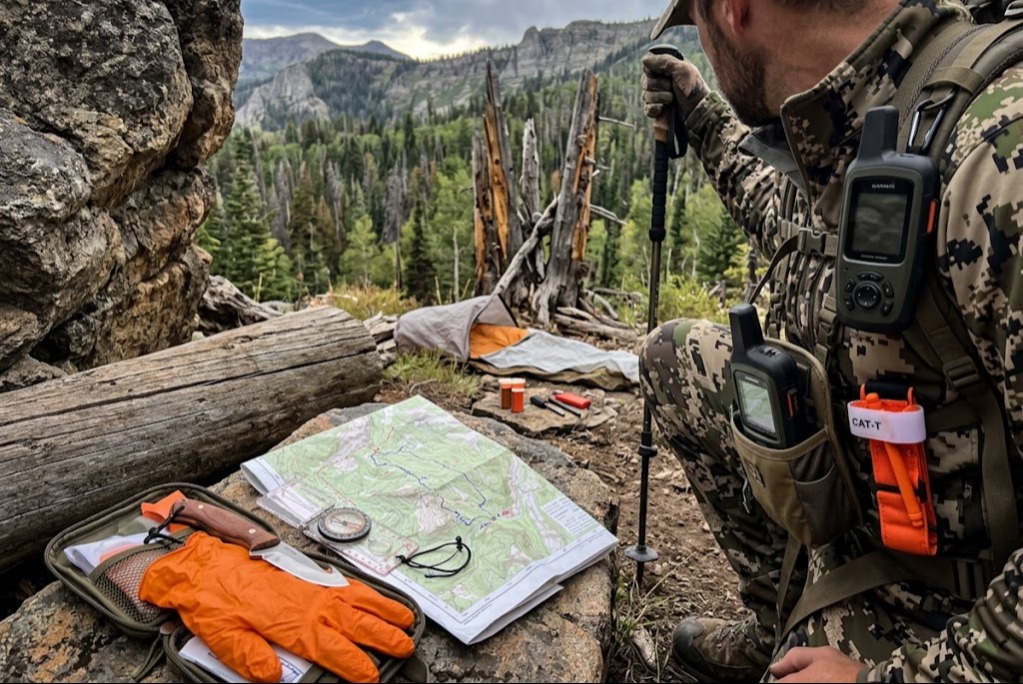
- Emergency Communication & Navigation: A standalone topographic map and baseplate compass ($15–$40) serve as the ultimate fail-safe. Modern hunters pair these with satellite technology to guarantee a lifeline beyond cellular reach.
- Medical & Field Trauma Supplies: Standard first-aid kits are insufficient for hunting wounds. You must carry a CoTCCC-approved tourniquet (CAT or SOFTT-W, $30–$40) accessible with one hand, alongside hemostatic gauze ($15–$45) for packing deep puncture wounds from broadheads or branches.
- Exposure & Environmental Protection: Hypothermia mitigation requires an ultralight emergency bivy sack ($20–$120) that reflects body heat, paired with at least three redundant fire ignition sources (e.g., stormproof matches, a ferrocerium rod, and a butane lighter).
PLBs vs. Satellite Messengers: Which Emergency Communicator is Best?
For ultimate redundancy, backcountry hunters should carry a Personal Locator Beacon (PLB). However, the best device depends on your need for two-way logistics versus guaranteed SOS signaling.
| Feature | Personal Locator Beacons (PLBs) | Satellite Messengers (e.g., inReach) | Cell Phones |
| Signal Strength | Extremely high; 406 MHz penetrates heavy canopy | Moderate; requires a relatively clear line of sight | Dependent on local tower proximity |
| Subscription Cost | $0 (Free NOAA registration required) | $12 – $65 per month | Standard cellular plan costs |
| Battery Lifespan | 5 – 7 years (On standby) | 50 – 100+ hours (Active tracking) | 12 – 24 hours (Cold degrades rapidly) |
| Primary Advantage | Powerful, direct-to-government rescue signal | Supports two-way texting for non-fatal logistics | No extra gear or configuration needed |
| Verdict | Best for fatal emergencies | Best for ongoing coordination | Unreliable in the backcountry |
Which Should You Choose?
- The Deep Wilderness Soloist: Carry both. Use the satellite messenger for daily check-ins and the PLB exclusively as a fail-safe catastrophic bailout.
- The Weekend Public Land Hunter: A satellite messenger provides the best balance of checking in with family and calling for help if a vehicle breaks down out of cell range.
What Critical Hunting Safety Hazards Did the Overview Miss?
General outdoor advice often overlooks the specific biomechanical and environmental hazards unique to the hunting process.
Tree Stand Falls and Suspension Trauma
Tree stand incidents account for roughly 24.5% of reported hunting accidents, generating severe spinal injuries and a fatality rate comparable to accidental firearm discharges. Wearing a full-body harness prevents the initial fall, but it introduces the risk of suspension trauma. Hanging motionless in a harness allows blood to pool in the lower extremities, leading to shock, brain damage, and potentially death in under 15 minutes. Hunters must carry and know how to deploy a suspension relief strap to stand in, relieving femoral artery pressure while awaiting rescue.
Sweat-Induced Hypothermia During Pack-Outs
Hauling heavy game meat out of a canyon generates massive amounts of body heat and sweat. When the hunter stops to rest or reaches the truck, the moisture trapped in base layers freezes rapidly, plummeting the body’s core temperature. Active thermal regulation—shedding layers before sweating begins and swapping a wet base layer for a dry one immediately after the pack-out—is a mandatory survival skill in cold environments.
Field Dressing Pathogens and Blade Safety
Processing an animal in the field exposes hunters to zoonotic pathogens, bacteria, and severe laceration risks. Bare-handed field dressing invites infections, especially concerning Chronic Wasting Disease (CWD) in cervids or tularemia in smaller game. Hunters should utilize shoulder-length field dressing gloves and employ a dedicated gut hook to open the abdominal cavity, drastically reducing the risk of a slipped blade severing the user’s hand or thigh in failing light.
Expert Recommendations by Hunter Type
- The Backcountry Solo Hunter (Multi-day wilderness): Prioritize a satellite messenger paired with a standalone PLB. Carry a full trauma kit with two tourniquets, a 4-season emergency bivy, a water filtration system, and bear spray if operating in grizzly territory.
- The Day Hunter (Returning to camp nightly): Never leave the vehicle without a compact survival kit containing a headlamp, fire starter, space blanket, and a basic medical kit. Treat every day hunt as if a twisted ankle will force an unexpected night in the woods.
- The Archery / Bowhunter: Keep a tourniquet attached to the outside of your bino-harness where it can be reached instantly with either hand. Broadhead cuts slice major arteries cleanly, causing rapid exsanguination without immediate, massive pressure application.
Frequently Asked Questions (FAQ)
How do you safely cross a fence or obstacle with a firearm?
Unload the chamber completely before crossing any physical obstacle. Lay the firearm flat on the ground on the opposite side of the fence, pointing the muzzle safely away from your crossing point, before climbing over. Never lean a loaded rifle against a fence post.
What is the “Rule of Three” in survival?
The Rule of Three outlines physiological limits: a human can survive roughly three weeks without food, three days without water, and three hours without shelter in extreme environments (hypothermia). In trauma scenarios, you have roughly three minutes to stop catastrophic arterial bleeding.
Should hunters carry bear spray or a sidearm for predator defense?
Bear spray is statistically proven to be more effective at deterring grizzly attacks than handguns, as it creates a wide, expanding cloud that affects the animal’s respiratory and visual systems without requiring pinpoint accuracy under extreme adrenaline.
How do I handle wet firewood during a survival situation?
In persistent downpours, surface wood becomes useless. Use a fixed-blade knife or hatchet to split dead, standing timber (not wood resting on the ground) to access the dry inner core. Shave this dry core into fine curls (feather sticks) to catch your initial spark.
Wilderness safety for hunters is an ongoing discipline of preparation and redundant systems. By acknowledging the unique hazards of the hunt and carrying the proper trauma and communication tools, hunters ensure that unexpected emergencies become uncomfortable stories rather than fatal statistics.