
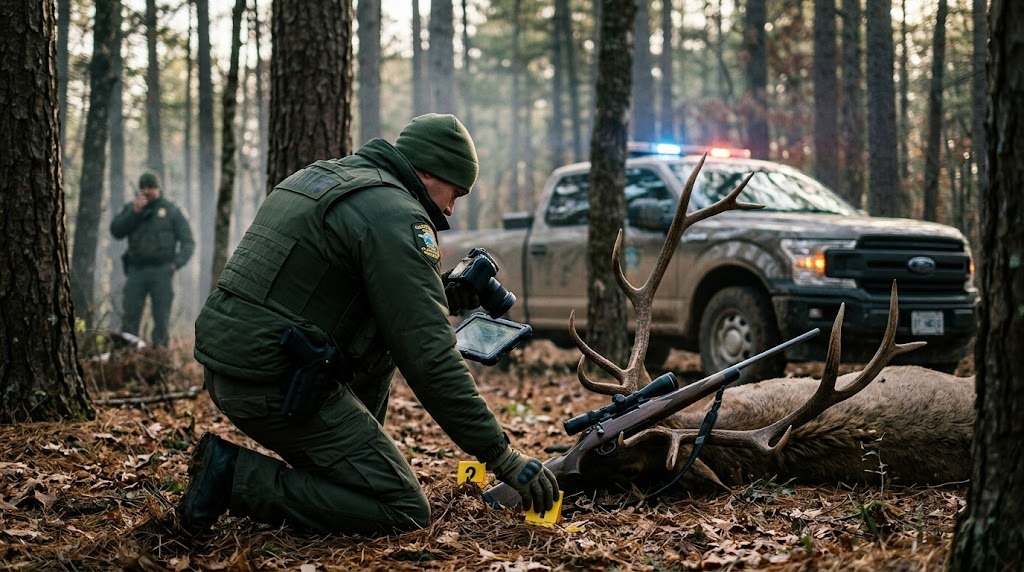
Hunting illegally triggers a chain of criminal, civil, and administrative consequences enforced by state conservation agencies and the federal government. Violators face immediate on-site equipment seizure, criminal charges ranging from class-level misdemeanors to federal felonies, punitive fines climbing past $250,000, mandatory civil restitution based on trophy scores, jail time, and multi-state hunting license revocations.
Key Facts
- Immediate Asset Forfeiture: Wildlife officers possess statutory authority to immediately impound weapons, vehicles, optics, vessels, and game meat involved in illegal harvest.
- Dual Financial Liability: Offenders pay two independent financial assessments: punitive criminal fines levied by the court and mandatory civil restitution paid directly into state wildlife conservation accounts.
- Interstate License Bans: A license revocation in one member state automatically strips hunting privileges across 49 states under the Interstate Wildlife Violator Compact (IWVC).
- Federal Felony Exposure: Transporting illegally harvested game across state lines converts local state infractions into federal felony indictments under the Lacey Act (16 U.S.C. §§ 3371–3378).
- Firearm Disenfranchisement: Any felony poaching conviction triggers a lifetime ban on owning, possessing, or using firearms under federal law (18 U.S.C. § 922(g)).
How Does Wildlife Law Enforcement Catch Poachers?
State conservation officers (game wardens) detect illegal hunting through a combination of physical field surveillance, biological forensic science, automated remote technology, and citizen intelligence networks. Unlike standard municipal police officers whose warrantless investigative access is constrained around private real estate, wildlife officers operate with specialized statutory search authority supported by the legal “open-fields doctrine.”
1. Broad Field Search Powers and the Open-Fields Doctrine
Under the long-standing Supreme Court precedent established in Hester v. United States (reaffirmed in Oliver v. United States), the Fourth Amendment’s protection against warrantless searches does not extend to open fields, agricultural acreage, or unimproved woodlands. Conservation officers can enter private hunting properties, timber tracts, and game leases without a search warrant or probable cause if they suspect wildlife activity. In many jurisdictions, game wardens have statutory authority to inspect:
- Game bags, livewells, ice chests, vehicle beds, and visible game hanging in camps.
- Firearms and ammunition to verify magazine capacity limits, non-toxic shot compliance, and plug configurations.
- State-issued digital licenses, electronic harvest reporting tags, and landowner permits on the spot.
2. Biological Wildlife Forensics
Wildlife enforcement agencies employ state-of-the-art forensic laboratories (such as the National Fish and Wildlife Forensics Laboratory in Ashland, Oregon) to analyze physical evidence recovered from harvest scenes:
- Time-of-Death Determination: Officers measure vitreous humor potassium levels in an animal’s eye, internal muscle rigor, and core carcass temperature compared to ambient air temperature to prove an animal was shot outside legal hunting hours.
- Forensic DNA Profiling: Blood in truck beds, hair on knives, or bone shavings in meat processing coolers are matched directly to gut piles, decapitated carcasses, or blood trails left in the field.
- Wildlife Ballistics: Recovered projectile fragments establish whether an animal was taken with an illegal caliber, an arrow, or centerfire ammunition during an archery-only season.
3. Digital Intelligence and Tip Hotlines
A substantial volume of poaching prosecutions originates through state-sponsored hotlines, such as Operation Game Thief (OGT) or Turn In a Poacher (TIP), which offer cash rewards for verified information. Officers also analyze digital footprints:
- Timestamp and geographic metadata embedded in social media trophy photographs.
- Cellular trail cameras recording license plates, vehicle profiles, and access times on gated roads.
- Inconsistencies within digital e-tagging systems where harvest confirmations conflict with cell tower location pings.
What Equipment Can Game Wardens Seize at the Scene?
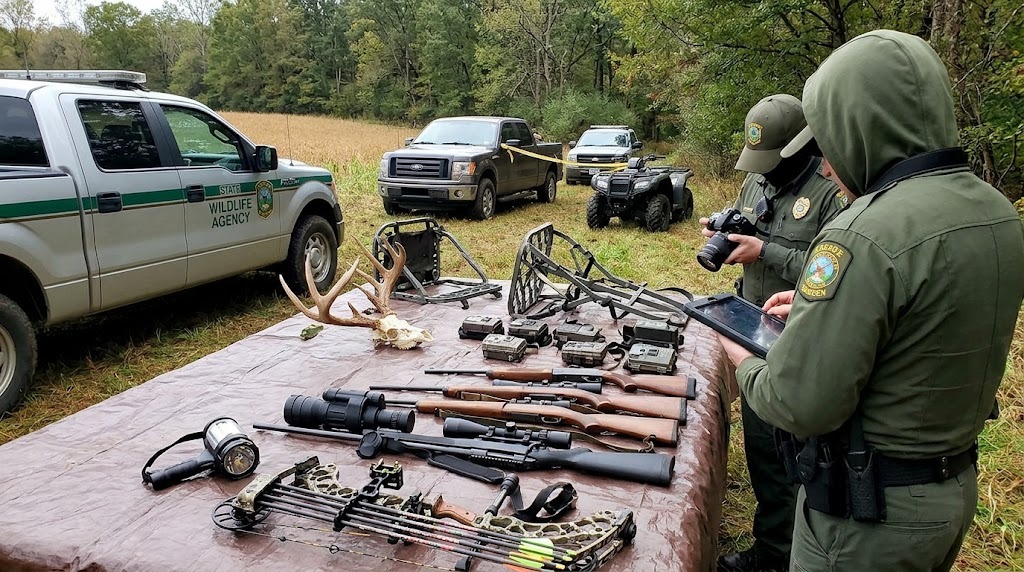
Game wardens have the legal authority to immediately seize all contraband and instrumentalities used to perpetrate an illegal harvest. Seizure occurs on-site during initial contact and does not require a prior judicial hearing.
State statutes categorize seizable items into two distinct legal classes:
- Contraband Per Se: Property that is inherently illegal to possess under the circumstances. This includes the illegally taken animal (whole carcass, cape, antlers, claws, or meat), counterfeit tags, and unauthorized equipment like night-vision scopes mounted on rifles in jurisdictions that ban nocturnal thermal optics for game animals. Contraband per se is subject to automatic, permanent forfeiture without compensation.
- Derivative Contraband (Instrumentalities of the Crime): Property that is otherwise lawful to own, but became an instrument of a criminal act. This includes centerfire rifles, shotguns, compound bows, crossbows, handheld spotlights, tree stands, trail cameras, and digital optics.
In aggravated poaching incidents-such as commercial harvest, spotlighting big game from a public roadway, or armed trespassing on private acreage-officers can impound the vehicle used to commit the offense. This includes:
- Pickup trucks and SUVs utilized to transport the poachers or the illicitly harvested carcass.
- All-terrain vehicles (ATVs) and utility-task vehicles (UTVs) driven into restricted parcels.
- Boats, outboards, and airboats used in unlawful waterfowl netting or marine resource exploitation.
- Utility trailers and heavy-duty cargo haulers used to move stolen meat or equipment.
Recovering seized non-contraband property requires either an acquittal at trial or an affirmative motion for property return following a dismissal. If the individual is convicted, the court generally orders the permanent forfeiture of all seized equipment, which is subsequently destroyed or sold at state wildlife agency public auctions.
What Are the Main Types of Illegal Hunting Violations?
Illegal hunting encompasses infractions governed by state game codes, administrative wildlife regulations, and federal conservation statutes. Penalties escalate in proportion to commercial intent, species protection status, animal maturity, and safety hazards.
                    PENALTY ESCALATION CONTINUUM
    Minor                                                      Severe
   Infraction               Misdemeanor                        Felony
───────┼─────────────────────────┼───────────────────────────────┼─────────►
- Unsigned Stamp         - Hunting Out of Season          - Interstate Lacey Act
- Blaze Orange Error     - Hunting Without License        - Armed Night Trespass
- Failure to Validate    - Baiting in Prohibited Area     - ESA Endangered Harvest
($50–$250 Fine)          ($500–$2,000 + 30–90 Days Jail)   ($100k+, Prison, Guns Lost)
The table below outlines primary statutory violations, representative state codes, typical criminal classifications, and statutory financial ranges.
| Violation Category | Statutory Mechanism / Prohibited Act | Baseline Charge Level | Typical Criminal Fines & Jail Exposures | Mandatory Civil Restitution / Trophy Surcharge |
| Hunting Out of Season | Harvesting wildlife outside dates set by administrative commission to protect reproductive periods. | Class B or A Misdemeanor | $500 – $2,500; up to 180 days in county jail. | Base replacement value ($500 – $2,000 per animal). |
| Hunting Without a License / Tag | Harvesting game without valid license, fraudulent resident permit purchase, or tag borrowing (“party hunting”). | Class C to Class A Misdemeanor | $250 – $1,500; up to 90 days in jail. | Tag purchase reimbursement plus animal base restitution. |
| Trophy Poaching | Targeting mature, record-class antlers or horns; decapitation leaving meat behind. | Class A Misdemeanor to Low-Tier Felony | $2,000 – $10,000; up to 1–2 years imprisonment. | Gross Antler Score Multiplier: $5,000 – $35,000+ per animal. |
| Spotlighting / Night Hunting | Using vehicle headlights, hand-held beams, or thermal scopes to freeze game animals (“jacking” or “shining”). | Class A Misdemeanor to Felony | $1,000 – $7,500; 30 days to 1 year jail; mandatory weapon confiscation. | Species replacement cost plus mandatory license revocation (1–5 years). |
| Trespassing on Private Land While Armed | Entering posted or painted private property to hunt without affirmative landowner authorization. | Class 1 Misdemeanor to Class 4 Felony | $1,000 – $5,000; 60 days to 3 years incarceration; vehicle impoundment. | Full civil liability to property owner for property damage/trespass. |
| Wanton Waste of Game | Killing a game animal and abandoning the edible portions, harvesting only head, horns, or hide. | Class B to Class A Misdemeanor | $500 – $3,000; up to 6 months jail; license loss. | Total animal civil value; forfeiture of all trophies. |
| Use of Prohibited Bait / Methods | Distributing grain/salt minerals in regulated disease zones (CWD) or using fully automatic weapons/silencers unlawfully. | Infraction to Class B Misdemeanor | $200 – $1,500; loss of harvest permit for 1 year. | Base restitution if an animal was shot over the unlawful bait. |
| Federal Lacey Act Violations | Transporting, selling, or buying game taken in violation of any state, tribal, or foreign law across state lines. | Federal Misdemeanor to Class D/E Felony | Felony: Up to $250,000 fine (individuals) / $500,000 (corps); up to 5 years federal prison. | Full market replacement value + federal conservation fund surcharges. |
What Legal Charges and Court Penalties Will You Face?
An individual accused of unlawful hunting faces two parallel proceedings: a criminal prosecution in state or municipal district court, and an administrative/civil action managed by the state wildlife commission.
                    ARREST OR CITATION
                            │
            ┌───────────────┴───────────────┐
            ▼                               ▼
   CRIMINAL PROCEEDING              ADMINISTRATIVE & CIVIL
  (District/County Court)         (Wildlife Board / State Agency)
            │                               │
    ┌───────┴───────┐                       ├─ Civil Restitution Invoices
    ▼               ▼                       ├─ License Suspension / Revocation
Misdemeanor       Felony                    └─ IWVC Reciprocal Ban Transmittal
($500-$5k Fines; (1-5 Yrs Prison;
Jail up to 1 yr) Firearms Lost)
Criminal Penalties: Misdemeanor vs. Felony
Prosecutors file charges based on the severity of the violation, prior criminal history, and the presence of aggravating factors.
- Misdemeanors (Class C, B, or A): Apply to the majority of hunting infractions (e.g., shooting 15 minutes past legal light, failing to validate a tag before moving an animal, harvesting one duck over the daily bag limit). Penalties include summary fines from $100 to $3,000, unsupervised or formal probation, and incarceration terms from 10 days to 12 months in county jail.
- Felonies: Triggered when specific statutory thresholds are breached. Examples include:
- Taking wildlife with a market or commercial value exceeding statutory limits (often $1,000 to $2,500).
- Criminal trespass on marked private acreage while armed with a firearm in states with aggravated trespass statutes.
- Falsifying state residency applications over consecutive years to illegally obtain non-resident tags worth thousands of dollars.
- Habitual wildlife offender statutes (three or more serious poaching convictions within a 5-year window).
Federal Wildlife Prosecutions
When a violation intersects with interstate commerce or federally protected species, federal prosecutors assume jurisdiction:
- The Lacey Act (16 U.S.C. §§ 3371–3378): Makes it a federal crime to import, export, transport, sell, receive, acquire, or purchase any fish or wildlife taken, possessed, transported, or sold in violation of any state or federal wildlife law. A felony indictment applies if the defendant knew the wildlife was taken unlawfully and the market value exceeds $350. Felony penalties carry up to 5 years in federal prison and criminal fines up to $250,000 for individuals ($500,000 for organizations).
- The Migratory Bird Treaty Act (16 U.S.C. §§ 703–712): Enforces strict liability for killing migratory waterfowl, raptors, and songbirds without authorization. Commercial taking or sale of migratory birds is a felony yielding fines up to $250,000 and 2 years imprisonment.
- The Endangered Species Act (16 U.S.C. §§ 1531–1544): Knowing violations involving endangered species (e.g., grizzly bears, wolves, whooping cranes) carry criminal fines up to $50,000 and up to 1 year in federal prison, alongside civil administrative penalties up to $25,000 per violation.
How Is Civil Restitution for Poached Wildlife Calculated?
Civil restitution is an independent financial penalty paid directly to state wildlife preservation funds to compensate the public for the economic, ecological, and recreational loss of an animal. This civil liability is ordered by the judge at sentencing or levied through an administrative agency demand, and it cannot be discharged through bankruptcy.
In the past, states charged nominal flat-rate replacement values ($200 to $500 per deer). Today, nearly every major hunting state enforces specialized statutory formulas that scale exponentially for mature or “trophy” male specimens using standard antler-scoring metrics:
The Antler Score Restitution Multiplier Formula
States such as Ohio, Texas, Montana, Kansas, and Wisconsin calculate restitution for big game species (white-tailed deer, mule deer, elk, pronghorn) based on Boone & Crockett (B&C) or Safari Club International (SCI) antler measurements.
The Ohio formula serves as the benchmark across modern wildlife jurisprudence:
$$\text{Recovery Value} = \left[ (\text{Gross Score} – \text{Baseline Threshold})^2 \times \text{Multiplier} \right] + \text{Base Value}$$
For a trophy white-tailed deer scoring above a baseline threshold (e.g., 125 inches gross B&C):
- Baseline Deer Value: $\$500$ flat base cost.
- Score Deduction Factor: If a poached buck scores 175 gross inches, the 50 inches exceeding the 125-inch threshold are squared ($50^2 = 2,500$) and multiplied by an established statutory coefficient ($M \approx \$1.65$ to $\$2.50$).
- Total Restitution: Can easily exceed $\$10,000$ to $\$25,000$ for a single deer, completely separate from any court-imposed criminal fines.
For high-demand Western big-game species, flat-rate statutory minimums apply immediately upon conviction:
- Bighorn Sheep Ram: $\$10,000$ to $\$30,000$
- Bull Elk (Branch-Antlered): $\$5,000$ to $\$12,000$
- Moose / Mountain Goat: $\$8,000$ to $\$15,000$
- Wild Turkey: $\$500$ to $\$1,500$ per bird
How Does the Interstate Wildlife Violator Compact (IWVC) Work?
The Interstate Wildlife Violator Compact (IWVC) is an interstate agreement that prevents poachers from evading the consequences of license suspensions by simply crossing state lines. The compact functions like the National Driver License Compact.
       CONVICTION IN HOME/VISITING STATE
                       │
                       ▼
      [State Wildlife Agency Suspends License]
                       │
                       ▼
      [Record Uploaded to Interstate Database]
                       │
                       ▼
  ┌────────────────────┴────────────────────┐
  ▼                                         ▼
[All 49 IWVC Member States]       [Automated Rejection]
Reciprocally honor suspension     State e-tag systems lock out
and revoke all hunting permits    violator SSN / Customer ID
Reciprocal Administrative Suspension
When a hunter’s license, tag privilege, or guiding credential is suspended, revoked, or canceled in any member state:
- That state’s wildlife enforcement division uploads the violator’s identifying records (Social Security Number, full legal name, date of birth, violation codes, and term of suspension) to the National Wildlife Violator Database.
- The licensing systems of all 49 member states cross-reference license applications and customer identification profiles against this registry.
- Every member state automatically revokes or denies hunting, fishing, and trapping privileges for the exact duration mandated by the initial convicting state.
If an individual is suspended for 5 years in Colorado for illegal elk harvest and attempts to buy an over-the-counter deer permit in Georgia, Michigan, or Pennsylvania, the terminal will lock the transaction. If that individual hunts anyway, they commit the elevated crime of Hunting While Suspended, which carries mandatory jail time and an automatic multi-year extension of the multi-state ban.
Failure-to-Appear Reciprocity
The IWVC also handles non-resident citation compliance. If an out-of-state hunter receives a citation and fails to appear in court or fails to pay the required field bond, the licensing authority of the offense state notifies the hunter’s home state. The home state immediately suspends all hunting and fishing licenses until the defendant settles the out-of-state matter.
What Collateral Consequences Follow a Poaching Conviction?
The consequences of an illegal hunting conviction extend far beyond the courtroom and state conservation boundaries, impacting constitutional rights, professional livelihoods, and personal property rights.
1. Lifetime Loss of Second Amendment Rights
Under 18 U.S.C. § 922(g)(1) of the Federal Gun Control Act, it is unlawful for any person convicted in any court of a crime punishable by imprisonment for a term exceeding one year to ship, transport, possess, or receive any firearm or ammunition.
- If convicted of an elevated poaching offense classified as a felony (such as felony armed trespass, felony Lacey Act trafficking, or commercial wildlife slaughter), the individual permanently loses the legal right to possess any firearm or modern ammunition.
- This ban covers hunting rifles, home defense shotguns, concealed carry handguns, and even antique firearms in jurisdictions that do not distinguish black-powder platforms.
2. Revocation of Professional Outfitting and Guiding Credentials
Commercial hunting guides, outfitter business owners, and charter captains face total career liquidation:
- Administrative boards instantly revoke outfitters’ licenses upon any wildlife misdemeanor or felony conviction.
- Federal land agencies (U.S. Forest Service, Bureau of Land Management) revoke special recreation permits required to guide clients on public tracks.
- Business owners face secondary civil lawsuits from clients whose guided hunts were voided due to enforcement operations against the outfitter.
3. Commercial Employment and Security Clearance Fallout
- Employment Background Screenings: Wildlife criminal convictions appear on standard FBI NCIC identity history summaries. Commercial employers frequently classify spotlighting, trespassing, or poaching as crimes of moral turpitude or dishonesty, barring candidates from corporate, law enforcement, or fiduciary roles.
- Federal Security Clearances: An arrest or conviction involving deliberate violation of environmental laws, intentional property trespass, or federal firearm charges can jeopardize existing Secret or Top Secret security clearances.
What Are the Most Common Accidental Hunting Violations?
Most wildlife citations issued by conservation officers involve otherwise lawful hunters who commit errors through carelessness, map misinterpretation, or regulatory changes rather than deliberate poaching.
                  COMMON COMPLIANCE FAILURE MODES
┌──────────────────────────────────────┬──────────────────────────────────────┐
│ Mistake                              │ Corrective Compliance Procedure      │
├──────────────────────────────────────┼──────────────────────────────────────┤
│ 1. Boundary Bleed (Crossing Lines)   │ Use GPS boundaries with offline land │
│                                      │ ownership maps (e.g., onX, HuntStand)│
├──────────────────────────────────────┼──────────────────────────────────────┤
│ 2. Unlawful Retrieval Across Borders │ Stop at property line; secure land-  │
│                                      │ owner consent or escort from warden  │
├──────────────────────────────────────┼──────────────────────────────────────┤
│ 3. Failure to Leave Evidence of Sex  │ Leave head or genitalia attached to  │
│                                      │ quarters as required by state code   │
├──────────────────────────────────────┼──────────────────────────────────────┤
│ 4. Improper Tag Validation / E-Tag   │ Validate paper tag or submit mobile  │
│                                      │ e-tag BEFORE moving the carcass      │
└──────────────────────────────────────┴──────────────────────────────────────┘
1. Inadvertent Boundary Crossing and “Corner Crossing”
Hunters frequently drift off public Bureau of Land Management (BLM) or National Forest land onto private deeded tracts.
- The Legal Reality: Hunters are strictly liable for knowing their geographic position. “I thought this was public land” is universally rejected as a legal defense.
- Corner Crossing: Stepping diagonally from one parcel of public land to another where corners touch private acreage remains a contested legal battleground. While federal court rulings in specific Western districts (such as the landmark Iron Bar Holdings v. Dalle case in Wyoming) have protected corner-crossing hunters from federal trespass liability, local county prosecutors in several states continue to cite hunters under state criminal trespass laws.
2. Crossing Property Boundaries to Retrieve Wounded Game
A widespread myth persists among hunters that they have an inherent legal right to pursue and retrieve wounded big game across property boundaries without permission.
- The Legal Reality: In almost all jurisdictions, property trespass laws supersede game retrieval ethics. If an arrowed buck or rifle-shot elk jumps a fence and expires on private land, entering that land without permission constitutes criminal trespass.
- Correct Procedure: Stop at the boundary line. Contact the landowner immediately. If permission is denied, contact your county game warden. Wardens can often facilitate contact or accompany the hunter, though in some states even wardens cannot legally compel an unwilling landowner to allow access.
3. Destruction of Species and Sex Identification in the Field
State hunting codes require hunters to retain evidence of sex and species on harvested big game and waterfowl until the animal reaches the hunter’s permanent residence or a licensed commercial meat processor.
- Big Game: Quartering an elk or deer in the backcountry and cutting away the genitalia, udder, or head before transport violates statutory proof-of-sex rules. Citations are issued even if the hunter possessed the correct tag.
- Waterfowl: Fully plucking or breasting ducks or geese in the field is illegal. Federal regulations require hunters to leave one fully feathered wing attached to each bird to allow game wardens to verify the species, sex, and age.
4. Tagging and Validation Timing Violations
Many state administrative regulations mandate that a physical paper tag be cut, notched, signed, and affixed to the carcass immediately upon harvest and before the carcass is moved or loaded onto any vehicle.
- Waiting to tag the animal until returning to a truck, hunting camp, or ATV is a common citation trigger.
- For digital “e-tagging” states, failing to initiate the mobile application’s harvest validation process before moving the carcass constitutes an unlawful transport violation.
What Should You Do If You Make an Honest Hunting Mistake?
When a hunter shoots the wrong sex, takes an animal over the legal bag limit, or misidentifies a species in the field, immediate self-reporting significantly changes how conservation officers and prosecutors handle the case.
- Cease Hunting Operations Immediately: Unload your firearm or bow, secure the harvested animal, and do not attempt to conceal, skin, or field-dress the carcass until directed.
- Flag and Document the Scene: Record GPS coordinates, take photographs of the carcass, terrain, and any obstructions that contributed to the error, and leave the carcass intact.
- Contact the Regional Wildlife Officer: Call the state department of natural resources regional dispatch office or local game warden directly before leaving the field. Explain clearly: “I have made an accidental harvest error and need an officer to meet me.”
- Preserve the Meat: Protect the carcass from spoilage and predator consumption while awaiting enforcement arrival.
- The Prosecutorial Difference: While wildlife violations are predominantly strict liability offenses—meaning lack of criminal intent does not automatically absolve guilt—judges and conservation officers almost universally mitigate penalties for self-reported errors. Self-reporters frequently receive a field diversion citation, a minimal fine, and confiscation of the meat for food bank distribution, while avoiding criminal arrests, felony filings, vehicle seizures, and license bans.
Frequently Asked Questions
Can a game warden enter your private land without a search warrant?
Yes. Under the Fourth Amendment’s “open-fields doctrine,” conservation officers do not need a warrant, probable cause, or landowner permission to enter open hunting acreage, timber plots, or pasture lands. They may inspect licenses, game bags, and blinds, though they still require a warrant to enter private residences or locked residential buildings.
Does a wildlife poaching citation show up on your criminal record?
Yes. Wildlife infractions classified as Class A, B, or C misdemeanors appear on standard criminal history checks run by law enforcement agencies, courts, and background screening companies. While minor civil infractions or equipment warnings do not create a criminal record, any formal misdemeanor or felony plea or conviction remains visible.
What is the legal definition of “wanton waste” in hunting?
Wanton waste is the intentional abandonment or failure to properly salvage the edible portions of a harvested game animal. Statutes vary by state, but hunters are legally required to field-dress, pack out, and transport all primary quarters and backstraps. Leaving salvageable meat in the field to spoil is a misdemeanor offense that triggers license revocation.
Can you go to federal prison for a state-level hunting violation?
Yes. Under the federal Lacey Act (16 U.S.C. §§ 3371–3378), if an individual commits an illegal harvest under state regulations and subsequently transports, ships, sells, or purchases that game across state lines, the infraction escalates to a federal crime punishable by up to 5 years in federal prison.
What happens to the meat and antlers from confiscated animals?
Confiscated game meat that is fresh and uncontaminated is field-dressed, inspected, and donated to local charitable organizations, homeless shelters, and food distribution programs through initiatives like Sportsmen Against Hunger. Antlers, horns, capes, and contraband items are either retained for state educational exhibits or destroyed.
Can you appeal a hunting license suspension under the Interstate Compact?
Yes, but the appeal must be filed in the original state where the conviction and administrative suspension were issued. Member states enforcing reciprocal bans through the Interstate Wildlife Violator Compact do not hold independent administrative hearings; they mirror the originating state’s ruling until the originating jurisdiction clears the record.