
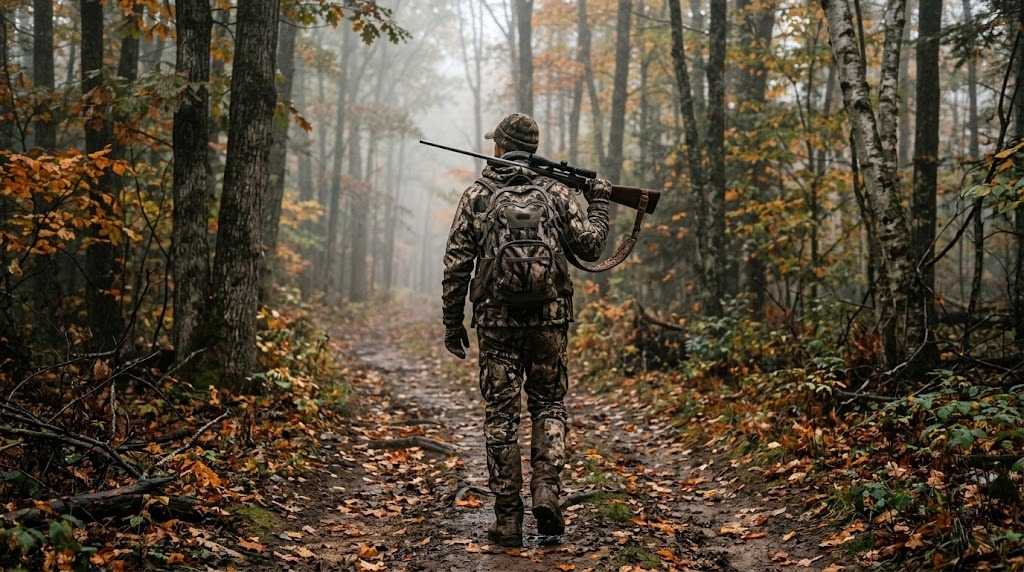
Hunting mistakes are tactical, behavioral, mechanical, or safety-related errors that reduce harvest success or compromise safety in the field. These errors typically manifest through poor wind management, unnatural movement cadences, rushed marksmanship, or fundamental safety violations. Preventing these failures requires continuous adaptation to external environmental variables.
At a Glance
- A mature whitetail deer can detect human odor up to 0.5 miles (800 meters) away under optimal, steady wind conditions.
- Hunters should sight-in centerfire rifles 2 to 4 weeks prior to opening day to avoid stressing the shooter and alerting local game with unnatural pressure.
- Hunting the exact same tree stand location more than two times per week heavily patterns you to local wildlife, dropping success rates exponentially.
- Purchasing cheap, non-insulated boots or loud, rustling nylon camouflage costs hunters an average of $100 to $400 in wasted gear replacements per season.
- The majority of close-range shot failures occur due to target panic (“buck fever”) or resting a rifle barrel directly against a hard, unyielding surface.
The Chronological Timeline of a Hunting Mistake
A hunting mistake rarely occurs as an isolated incident; errors ripple through a distinct chronological timeline, turning a minor oversight at home into a failed harvest in the woods. Game animals immediately detect human presence via acute senses the moment this operational process breaks down.
Phase 1: Pre-Hunt Preparation
Pre-hunt preparation failures happen before the hunter ever leaves the vehicle. Hunters ruin hunts early by executing lazy map scouting, ignoring atmospheric wind forecasts, or skipping pre-season equipment checks. A hunter who fails to check the morning wind direction inevitably walks upwind of a bedding area, blowing their scent directly into the exact animals they intend to hunt.
Phase 2: Ingress and Approach
Ingress blunders occur while moving from the vehicle to the hunting location. Hunters often walk straight across open agricultural fields or directly down ridge lines, visually “skylining” their silhouette against the horizon. Successful ingress requires using natural topographical features—like dry creek beds or dense pine thickets—for visual and acoustic concealment.
Phase 3: The Static Hunt
Static hunt mistakes happen once the hunter reaches their blind or tree stand. Once stationary, a hunter’s core body temperature drops, leading to fidgeting. Unnatural noises—such as metallic clicks from safety harnesses, the ripping sound of Velcro pockets, or rhythmic boot tapping—travel instantly through quiet morning woods.
Phase 4: Execution and The Shot
Shot execution failures take place in the critical seconds before the trigger pull or bow release. Adrenaline spikes dramatically, a physiological response known as “buck fever.” The hunter rushes the aiming process, misjudges the target distance without a laser rangefinder, or completely fails to follow through on the weapon’s recoil, resulting in a clean miss or a non-lethal wound.
Phase 5: Post-Shot Tracking
Post-shot tracking mistakes occur immediately after the projectile strikes the animal. The most devastating post-shot error is pushing the animal too soon. Hunters who immediately climb down from their stand and begin walking the blood trail force a wounded animal to flood its system with adrenaline and run miles away, often onto inaccessible private property.
Scent and Wind Management Errors
Ignoring Micro-Thermals and Terrain
Micro-thermals dictate how air moves based on temperature changes throughout the day. In the early morning, cool, dense air sinks aggressively down valleys and ravines (katabatic winds). In the late afternoon, warming air rises up the slopes (anabatic winds). Hunting a high ridge saddle on a crisp morning means the sinking thermals will carry human scent directly down into the lower bedding thickets. Hunters must position themselves so the natural thermal pull carries their scent away from suspected game travel corridors.
Over-Relying on Scent-Control Products
Over-reliance on scent-control products causes hunters to take unnecessary risks with prevailing winds. Trusting specialized ozone sprays, odor-neutralizing soaps, or activated carbon clothing over physical wind direction is a critical failure. A mature deer standing directly downwind will always detect human odor, regardless of how thoroughly the hunter applied chemical scent-blockers. Physical wind direction always trumps chemical suppression.
How Do Woodsmanship and Movement Mistakes Ruin Hunts?
Woodsmanship and movement mistakes ruin hunts by broadcasting a distinct human predatory signature through unnatural walking cadences, skylining silhouettes, and cumulative localized pressure. Game animals survive by mapping anomalies in their environment, and poor woodsmanship highlights those anomalies.
Unnatural Walking Cadence and Skylining
Human beings walk with a steady, rhythmic, two-legged crunching sound (step-step-step-step). Wildlife species move with an uneven, paused cadence (step-step… pause… step). Marching through dry leaves at a fast, uninterrupted pace immediately alerts every animal in the acoustic radius to a human presence. Furthermore, walking along the literal crest of a hill outlines the hunter against the bright sky—a phenomenon known as skylining. Hunters must walk just below the military crest of a ridge to keep natural vegetation behind them as a visual backdrop.
Over-Hunting a Single Stand Location
Over-hunting a single tree stand location saturates a micro-environment with residual human scent and ground disturbance. Sitting in the exact same oak tree for four consecutive days trains the local wildlife to avoid that specific 100-yard radius. Deer pattern hunters faster than hunters pattern deer. Rotating stand locations based on wind conditions and limiting sits to a maximum of two times per week keeps the hunter completely unpredictable.
The Trap of Digital Reliance
Cellular trail cameras have created a generation of reactive hunters who commit the mistake of digital reliance. Relying entirely on phone notifications causes hunters to only enter the woods when they see an animal on camera. By the time the hunter arrives, the animal has moved on. Wildlife patterns shift daily based on barometric pressure and the rut; relying solely on delayed digital data causes hunters to miss natural, unscripted animal movement.
Which Marksmanship and Ballistic Errors Cause Misses?
Marksmanship and ballistic errors cause misses when hunters fail to isolate their weapon from hard environmental rests, miscalculate trajectory drops, or allow bulky cold-weather clothing to interfere with mechanical weapon function.
Un-Padded Hard Rests for Rifles
Resting a rifle barrel directly against a hard rock, metal blind window, or wooden log disrupts barrel harmonics. The metal-on-solid contact causes the barrel to whip violently upward during powder ignition, making the bullet fly significantly higher than the intended point of aim. Hunters must place a soft barrier—such as a backpack, a gloved hand, or a purpose-built shooting bag—between the rifle’s forend stock and the hard resting surface. The barrel itself must never touch a rest.
Sleeve Slap and Torque for Bowhunters
Sleeve slap occurs when a bowhunter practices their draw cycle in a tight t-shirt during the summer, but hunts in a bulky, insulated winter jacket in November. Upon release, the fast-moving bowstring catches the thick fabric of the jacket sleeve, throwing the arrow wildly off course. Bowhunters must shoot practice arrows wearing their exact late-season clothing system, utilizing compression arm-guards to pin down loose fabric and prevent string interference.
Critical Safety Rule Violations
Target Isolation and Background Checks
Failing to isolate a target and check the ballistic background results in catastrophic safety failures. A hunter who fixates entirely on the animal’s shoulder often fails to see the second animal standing immediately behind it, or worse, the rural roadway 400 yards in the distance. Bullets from modern centerfire rifles easily pass completely through game animals with enough residual kinetic energy to kill whatever lies beyond. The trigger must not be pulled until the foreground and background are positively verified as safe.
Mishandling Firearms Around Obstacles
Crossing a wire fence, climbing a steep creek ditch, or ascending into a tree stand with a loaded, chambered firearm violates basic hunter education protocols. Tripping while holding a loaded weapon is a primary cause of accidental field discharges. Hunters must unload the chamber, place the weapon on safe, and slip the firearm under the fence or use a dedicated haul rope to pull the unloaded gun up into the stand only after being securely tied off.
How Do Strategic Hunting Approaches Compare?
Strategic hunting approaches differ wildly based on terrain, physical fitness, and target species. Selecting the wrong strategic approach for your environment is a macro-level mistake.
| Strategic Approach | Core Mechanism | Pros | Cons | Ideal User Persona | Verdict |
| Aggressive Mobile Hunting | Carrying a lightweight stand into the woods daily and hanging it on fresh animal sign. | Maximizes the surprise factor; prevents game from patterning human presence. | Requires extreme physical fitness; heavy to pack in; increases noise during early morning setup. | Public land hunters targeting mature, highly pressured animals. | The absolute best approach for public land where unpredictability is mandatory for success. |
| Patient Static Hunting | Setting up permanent blinds or ladder stands months in advance and waiting for prime conditions. | Offers dead-silent entry and exit; requires minimal physical strain; allows for shooting lane manicuring. | High risk of over-hunting the spot; leads to boredom; heavily reliant on predictable animal habits. | Private land owners, youth hunters, and archery food-plot setups. | The optimal choice for tightly managed private acreage with established food sources. |
| Spot and Stalk | Glassing vast distances from high vantage points, then closing the distance on foot. | Allows visual confirmation of the target before committing physical energy to a pursuit. | Wind changes mid-stalk will ruin the hunt; extremely difficult in thick, wooded environments. | Western backcountry hunters pursuing elk, mule deer, or pronghorn. | The mandatory tactic for open western landscapes where tree stands are mathematically unviable. |
How Can You Troubleshoot In-Field Dilemmas?
In-field dilemmas require immediate, calculated reactions. Making the wrong choice in the seconds after a variable changes guarantees a blown hunt.
- The Dilemma: The wind suddenly flips 180 degrees while you are on a stand.
- The Fix: Get down immediately and quietly pack up. Staying in a compromised stand blows your human scent into the bedding area, ruining the location for weeks. Relocate to a pre-planned backup spot that favors the new wind direction.
- The Dilemma: A metallic clank echoes when you drop a piece of gear.
- The Fix: Freeze completely for 3 to 5 minutes. Do not immediately bend over to pick it up, and do not swivel your head looking for deer. Let the woods settle down so local animals interpret the noise as a random, isolated falling branch rather than a predator.
- The Dilemma: Adrenaline spikes violently as a target animal approaches (Buck Fever).
- The Fix: Avert your eyes from the animal’s antlers. Staring at the headgear spikes the heart rate. Pick a highly specific, single tuft of brown hair in the crease directly behind the animal’s front shoulder. Take three slow, deep belly-breaths to manually lower your heart rate before drawing your bow or disengaging the safety.
- The Dilemma: You shoot, the animal runs off, and you find bright pink, frothy blood.
- The Fix: Wait exactly 30 to 45 minutes before tracking. Pink, bubbly blood indicates a lung strike—a highly lethal shot. However, if the blood is dark red (liver) or smells foul (gut), back out completely and wait 8 to 12 hours before tracking to ensure the animal expires without being pushed onto neighboring properties.
Expert Recommendations by Hunter Experience Level
For Beginners and First-Time Hunters
The top priority for beginners must be regulatory compliance and spatial awareness, not harvesting a trophy animal. The most actionable step a novice can take is downloading a GPS mapping application like onX Maps. Beginners must study property boundaries, public land borders, and entry trails digitally before stepping foot outside. Furthermore, novice hunters should always carry a laser rangefinder to eliminate distance-guessing errors, which are the number one cause of missed shots for first-timers.
For Intermediate Western and Backcountry Hunters
The top priority for intermediate hunters moving into western environments is upgrading optical quality and adopting patience. The biggest mistake is walking blindly into canyons trying to stumble across elk or mule deer. Stop letting your legs do the work. Sit on a high vantage point 30 minutes before dawn, mount high-quality binoculars (like Vortex or Leupold) to a stable tripod, and let your eyes systematically grid the landscape for two hours before executing a stalk.
For Advanced Whitetail Bowhunters
The top priority for advanced archers is mastering the absolute intricacies of low-impact ingress and gear torque. The actionable step is meticulous cold-weather preparation. Advanced hunters must practice shooting their compound bows wearing their exact heavy late-season jacket, safety harness, and thick gloves to eliminate unforeseen equipment torque or string-slap. A perfectly tuned bow shoots completely differently when the shooter’s anchor point is altered by an inch of Thinsulate face-mask material.
Frequently Asked Questions
How long should you wait after shooting a deer before tracking?
Wait at least 30 to 45 minutes for a heart or double-lung shot (indicated by bright red or pink frothy blood). If you suspect a liver or gut shot (dark red or brown fluid), wait a minimum of 8 to 12 hours before tracking to prevent pushing the animal out of the area.
Does human urine spook deer?
Current biological consensus and field testing show that human urine breaks down into basic ammonia rapidly, much like animal urine. While fresh human urine does not inherently trigger a predator-response alarm in deer, walking around your stand to urinate leaves ground-scent from your boots, which absolutely will spook them.
What is the best wind direction for hunting?
The best wind direction is one that blows consistently from where you expect the animals to appear, directly into your face. For tree stand hunters, a steady, moderate wind (5–12 mph) is ideal, as perfectly calm days allow human scent to pool and spread in all directions uncontrollably.
How do you fix buck fever?
Buck fever is fixed through forced cognitive redirection. Do not look at the animal’s antlers once you decide to shoot. Focus entirely on a quarter-sized spot on the animal’s vitals, practice tactical breathing (four seconds in, four seconds out), and rely on muscle memory built through repetitive off-season target practice.
Why do deer blow or snort at hunters?
A deer blows or snorts forcefully through its nasal cavity to clear its olfactory glands for a better smell, and to audibly warn other deer of a suspected predator. If a deer blows at you, it has smelled your scent stream or caught your silhouette skylining, and the immediate hunting area is compromised for the day.