
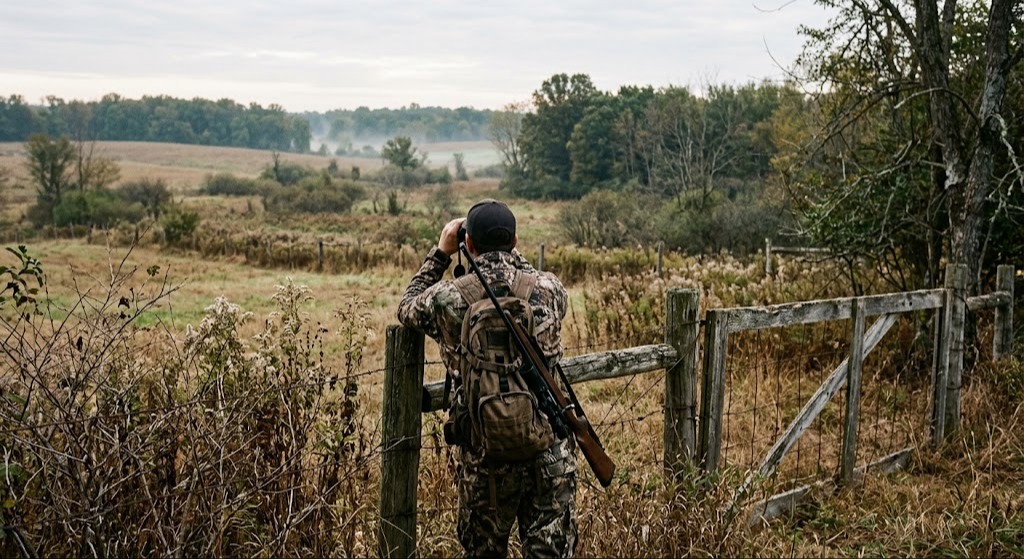
Private land hunting is the practice of pursuing game animals on real estate owned by private individuals, corporations, or non-governmental organizations rather than government entities. Because access is strictly controlled by the property owner, this hunting method requires explicit legal permission, a paid lease agreement, or a booked trip through a commercial outfitter.
Key Facts:
- Access is secured through four primary pathways: handshake permission, annual leases, land-sharing apps, or commercial outfitters.
- Hunting leases typically cost between $10 and $75 per acre annually, depending heavily on region and wildlife quality.
- Landowners retain absolute authority over weapon types, harvested species, and access dates, superseding baseline state regulations.
- Hunters leasing land must typically carry liability insurance, which averages $150 to $300 annually for a standard $1M/$2M hunting club policy.
- Recreational Use Statutes (RUS) in many states protect landowners from liability if a hunter is injured while using the land for free, but paid access changes this legal dynamic.
How Does Private Land Hunting Work?
Private land hunting operates on a system of exclusive, owner-granted privileges rather than public right. Unlike public lands where anyone with a valid state tag can hunt during open seasons, private properties are closed ecosystems where the landowner dictates the rules.
The landowner holds absolute authority over who enters the property, what specific parcels can be hunted, and which species are harvested. For example, a landowner may permit whitetail deer hunting but forbid turkey hunting, or they may allow archery equipment while banning centerfire rifles. Access requires proactive negotiation and, in most modern contexts, a legally binding contract that outlines liability, boundaries, and financial compensation.
What Are the 4 Types of Private Land Access?
Hunters secure private land access through four primary mechanisms, ranging from free verbal agreements to high-cost commercial packages.
1. Exclusive Long-Term Leases
An exclusive lease is a legal contract giving a single hunter or a small group (often organized as a hunt club) sole hunting rights to a property for a designated term, usually one to three years. Lessees treat the property as their own during the contract term, managing the habitat by planting food plots, installing semi-permanent tree stands, and enforcing anti-poaching rules. This offers the highest autonomy but requires significant financial and physical investment.
2. Commercial Outfitter Operations
Commercial outfitters operate turnkey businesses on heavily managed private acreage specifically engineered for mature game. These trips are booked as packages ranging from fully guided (a professional guide sits with you) to semi-guided (the outfitter drops you off at a pre-scouted stand). Outfitters provide maximum assistance and high success rates, but at a premium price point.
3. Modern Land-Sharing Apps
Digital land-sharing platforms like HLRBO, LandTrust, and Infinite Outdoors connect landowners directly with hunters for short-term access. Operating much like Airbnb, these apps allow hunters to book specific parcels for daily or weekly blocks. The platforms handle payment processing, background checks, and liability insurance, making them ideal for hunters who want private access without committing to an annual lease.
4. Handshake Permission (“Knock-on-Doors”)
Handshake permission is the traditional method of scouting rural land, identifying the owner, and asking for hunting access face-to-face. While increasingly rare for premium game, this method requires zero upfront cash. Instead, hunters often trade “sweat equity”—such as mending fences, clearing brush, or sharing harvested meat—in exchange for seasonal access.
Public vs. Private Land Hunting: Which Is Better?
Private land hunting is superior for hunters prioritizing safety, exclusivity, and game management, while public land is better for those who want low-cost, expansive wilderness experiences.
The table below breaks down the exact differences across five operational criteria.
| Access Type | Average Cost | Timeframe | Autonomy & Pressure | Success Rate |
| Public Land | $0 (State license/tags only) | Seasonal restrictions | High pressure; zero control over other hunters. | Low to Moderate |
| Handshake Private | $0 (Sweat equity/gifts) | Varies by owner | Low pressure; shared only with owner’s guests. | Moderate to High |
| Land-Sharing Apps | $100 – $500 per day | Daily or weekly blocks | Completely exclusive during your booked days. | Moderate to High |
| Annual Lease | $1,000 – $10,000+ annually | 1 to 3+ years | Ultimate control; manage the land yourself. | High |
| Guided Outfitter | $3,000 – $15,000+ per trip | 3 to 7 day packages | Managed pressure; maximum assistance. | Very High |
How Do You Secure Private Hunting Land?
Securing quality private acreage requires treating the process like a business acquisition. Follow these exact steps to transition from digital scouting to a signed lease.
Step 1: Digital E-Scouting and Ownership Identification
Begin by analyzing land cover, habitat diversity, and property boundaries using GPS mapping apps like onX Hunt or HuntStand. Look for favorable woods-to-water ratios and natural funnels. Once you identify a promising parcel, cross-reference the boundary data with county GIS tax assessor websites to retrieve the current landowner’s name and mailing address.
Step 2: Pitch Preparation
Create a professional “hunting resume” to present to the landowner. This one-page document must detail your identity, hunting experience, vehicle information, and a strict commitment to safety. Clearly state how you will respect their property—specifying that you will close all gates, avoid driving on wet fields, and leave no trash behind.
Step 3: Approach and Negotiation
Approach the landowner respectfully. If mailing a letter, include a self-addressed stamped envelope. If knocking on a door, dress in clean, casual clothing—never full camouflage or tactical gear. Clearly outline your desired terms: the specific cash offer per acre, the targeted game species, the exact months you wish to access the land, and the weapon types you intend to use.
Step 4: Execute Legal Documentation
Never rely on a verbal agreement for paid access. Draft and sign a formal Hunting Lease Agreement that explicitly lists all permitted activities. Simultaneously, execute a Liability Waiver to protect the landowner from lawsuits in the event of an accidental injury on the property.
Expert Insight: When negotiating, explicitly define the “guest policy.” The most common reason landowners terminate leases is when a hunter who paid for individual access shows up on opening morning with three unapproved friends. If guests aren’t in the contract, they aren’t allowed on the property.
How Much Does Private Land Hunting Cost?
Private land hunting costs range from $10 per acre for deep southern timberland to over $15,000 for elite, fully guided Midwestern outfitter packages.
- Per-Acre Lease Pricing: Annual leases vary dramatically by region. Midwest whitetail states (Iowa, Illinois, Kansas) command the highest prices, typically ranging from $30 to $75 per acre. Conversely, southern timberlands (Georgia, Alabama) often lease for $12 to $25 per acre.
- Outfitter Costs: An all-inclusive, five-day guided hunt for western elk or midwestern whitetail typically costs between $4,500 and $8,500. High-fence or strictly trophy-managed properties routinely exceed $12,000.
- Liability Insurance: If you lease land, the owner will require insurance. A standard $1,000,000 per occurrence / $2,000,000 aggregate hunting club liability policy costs roughly $150 to $300 annually for the entire group.
Pros, Cons, and Common Pitfalls
Private land hunting offers unparalleled control over your environment, but it comes with significant financial and ethical trade-offs.
The Advantages:
Safety is the paramount benefit; knowing exactly who is on the property virtually eliminates the risk of accidental shootings from strangers. Furthermore, exclusive access allows for genuine game management. Hunters can let young bucks mature, plant specific food sources, and cultivate a healthy resident wildlife population without fear that a neighboring hunter will harvest the animals.
The Limitations:
The primary drawback is the high financial barrier to entry, which prices many hunters out of the sport. Additionally, maintaining a lease requires heavy labor; landowners expect lessees to help maintain dirt roads, mend broken fences, and actively police the property boundaries for trespassers. Finally, heavily manipulated tracts or high-fence properties can compromise the “fair chase” wilderness experience that purists seek.
Common Mistakes and How to Fix Them:
- Mistake: Assuming “Yes” covers everything. Hunters often assume that permission to hunt deer also means they can hunt turkeys, camp overnight, or use ATVs.
- The Fix: Get a specific, itemized list of approved species and activities in writing. If an activity is not explicitly permitted, you must assume it is forbidden.
- Mistake: Neglecting property lines when tracking wounded game.
- The Fix: Mark boundaries clearly on your GPS app. If a wounded animal crosses a fence line into a neighboring private tract, leave your weapon behind, walk to the neighboring landowner’s house, and request recovery permission face-to-face. Trespassing to recover game is illegal in almost all states.
Landowner Liability and Legal Considerations
If a hunter is injured on private land, liability depends entirely on the hunter’s legal status and whether money exchanged hands.
All U.S. states have enacted Recreational Use Statutes (RUS), which provide “recreational immunity” to landowners who allow the public to hunt on their land for free. Under RUS, if you grant a hunter free handshake permission, you generally have no legal duty to inspect the property for hazards, and you cannot be sued for natural accidents (like a hunter falling from a dead tree).
However, the moment a landowner accepts money—whether through a lease, an app, or an outfitter fee—the hunter’s legal status upgrades from a “Licensee” to an “Invitee.” Recreational immunity is immediately stripped away. The landowner now owes the highest duty of care and can be held liable if they fail to warn the paying hunter about known, concealed dangers, such as an abandoned, uncovered well or a dilapidated bridge. This is why commercial hunting leases strictly require comprehensive liability insurance and signed waivers.
Frequently Asked Questions
What is the difference between high-fence and free-range private hunting?
High-fence hunting takes place on private properties enclosed by 8- to 10-foot fences that prevent animals from leaving, meaning the game is entirely captive. Free-range private hunting takes place on unfenced or standard-fenced land where native wildlife can freely migrate on and off the property.
Can a landowner legally enter the property while I am leasing it?
Yes, unless your contract explicitly states otherwise. The landowner retains the right to inspect their property, conduct agricultural work, or cut timber. A well-drafted lease should stipulate that the landowner will notify you before conducting disruptive work during the hunting season.
Do I still need a state hunting license on private land?
Yes. Wildlife is held in public trust by the state, even when it resides on private property. You must possess a valid state hunting license, follow all state season dates, and adhere to state bag limits, regardless of whether you own or lease the land.
How do I find a landowner’s contact information?
Use digital mapping apps like onX, HuntStand, or BaseMap to view parcel boundaries and the registered owner’s name. You can then search that name in public directories or cross-reference it with the local county tax assessor’s online database to find a mailing address.
Is it legal to track a wounded deer onto a neighbor’s private property?
No. In almost all jurisdictions, you must obtain explicit permission from the neighboring landowner before crossing the property line to recover an animal. Doing so without permission constitutes criminal trespassing, even if your intentions are purely for game recovery.