
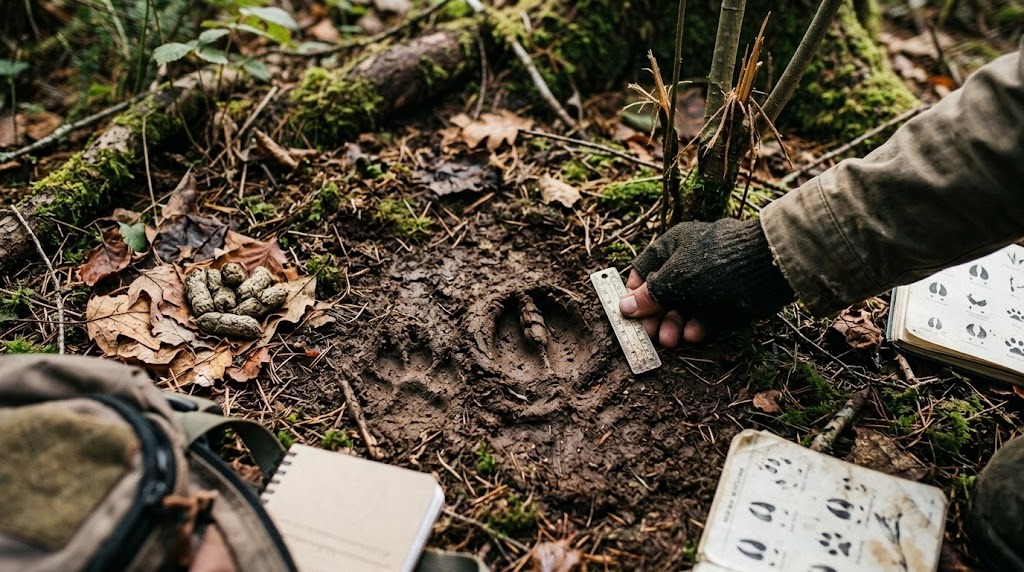
Animal signs, collectively known as spoor, encompass all physical evidence and structural disturbances left by wildlife in their environment. While ichnology focuses strictly on footprints, sign tracking decodes the other half of wilderness clues-including scat, feeding marks, trails, and territorial scrapes-to reverse-engineer an animal’s identity, behavior, and physical state.
At a Glance:
- Energy transfer: Every moving animal alters its environment through kinetic (tracks), chemical (scent), or biological (scat) energy transfer.
- Non-footprint spoor: Makes up more than 50% of the actionable tracking data in the wilderness.
- Decomposition rate: Fresh signs degrade into aged signs within 12 to 48 hours depending on humidity, wind, and substrate.
- Direct registration: Perfect walkers (felines, wild canines) place their rear foot exactly inside their front footprint to minimize noise.
- Safety baseline: Feline tracks lack claw marks due to retractable claws; canine tracks clearly display non-retractable nail tips.
What Are Animal Signs?
Animal signs are structural, biological, or chemical alterations made to a landscape by the presence of a living creature. Trackers use these environmental changes to determine what species passed through, how fast they were moving, their gender, and their current health status without ever making visual contact.
The Principle of Energy Transfer
The mechanics of tracking rely entirely on the Principle of Energy Transfer. Every moving animal absorbs and exerts energy into its surroundings. A 600-pound elk hoof exerts kinetic energy that compresses soil outward. A porcupine uses kinetic energy to shear cellulose fibers from a hemlock twig. A dominant male coyote deposits chemical energy via lipid-based scent markers on a boundary bush. By evaluating these exact physical and chemical alterations, an observer reconstructs the specific event that caused them.
Expert Insight: The most common mistake novice trackers make is looking down continuously. True sign tracking requires “cutting the track” at a 45-degree angle to the ground, scanning 10 to 20 feet ahead to catch the subtle shadow lines of compressed vegetation and broken twigs.
The 6 Main Categories of Animal Signs
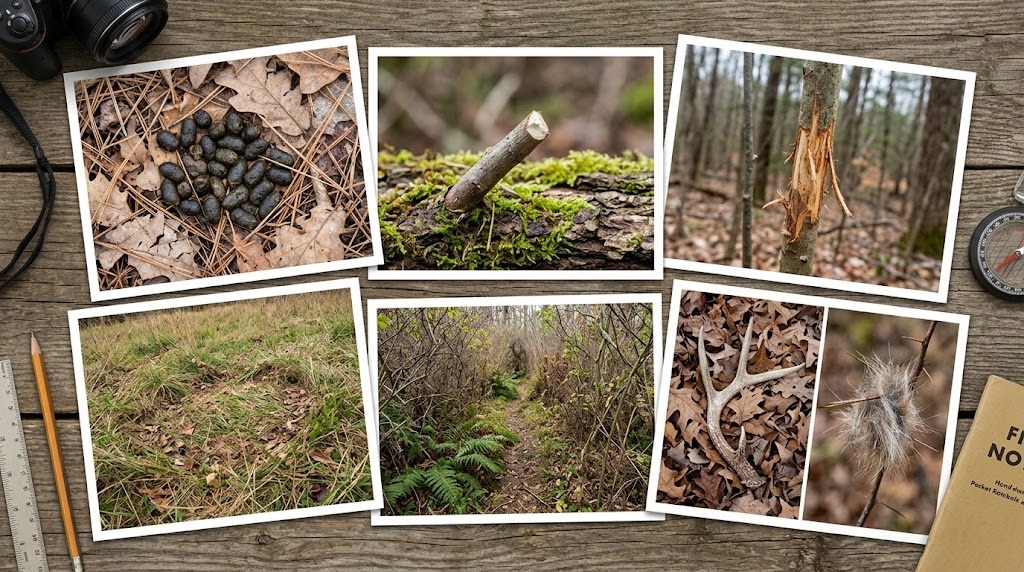
The six fundamental categories of non-footprint wildlife evidence include scat, feeding signs, territorial markings, architecture, trails, and body discards. Identifying these structural changes allows trackers to understand species behavior, diet, and habitat utilization.
Scat and Droppings
Fecal matter provides immediate species identification and highly accurate dietary data. Scat morphology changes based on the animal’s digestive tract and seasonal food availability.
- Carnivores: Produce tubular, tapered, and highly dense scats often packed with fur, bone fragments, or feathers. Coyote scat tapers to a sharp point due to hair passing through the sphincter.
- Herbivores: Produce small, uniform, round pellets (deer, rabbits) or large, fibrous clumps (moose, elephants) composed entirely of masticated vegetation.
- Omnivores: Produce highly variable, irregular piles. Bear scat drastically shifts from uniform vegetation plugs in spring to loose, seed-filled piles during the late-summer berry harvest.
Feeding Signs and Foraging Marks
The precise structural mechanics of how an animal consumes food leaves species-specific patterns on flora and fauna.
- Browsing and Grazing: White-tailed deer lack upper incisors; they yank plants upward against their hard palate, leaving a jagged, frayed edge on twigs. Conversely, lagomorphs (rabbits) feature sharp incisors that cleanly slice stems at a precise 45-degree angle.
- Kill Sites: Felines carefully pluck feathers or strip fur from prey before consuming muscle tissue, leaving clean bone surfaces. Canines crush bones open to access marrow, scattering bone fragments chaotically in a 10-foot radius.
- Gleaning and Stripping: Red squirrels leave stripped pinecone cores known as “kitchen middens” on elevated stumps. Woodpeckers hammer rectangular, clean-edged cavities into decaying trunks to extract grubs.
Territorial and Scent Markings
Animals execute communicative actions to mark boundaries, establish mating hierarchy, or ward off competitors.
- Rubs: Ungulates (deer, elk, moose) scrape bark off small saplings using their antlers to strip velvet and deposit chemical secretions from their forehead glands.
- Scrapes and Wallows: Animals scratch depressions into soil or mud to urinate, defecate, or roll. Wallows serve dual purposes: coating the animal in mud for thermoregulation and casting their scent across a dominant territory.
- Glandular Deposits: Bobcats and foxes leave waxy secretions or urine sprays on prominent rocks, utilizing elevation to carry the scent further on wind currents.
Architecture, Homes, and Bedding
Wildlife modifies the physical structure of the landscape for survival, reproduction, or thermal regulation.
- Beds: Oval-shaped, depressed zones of flattened grass, leaves, or snow. A tracker can determine an animal’s size by measuring the internal diameter of the flattened vegetation.
- Burrows and Dens: Excavated underground tunnels or hollowed logs. Active dens show freshly packed, damp soil at the entry threshold; abandoned dens accumulate spiderwebs and leaf litter.
- Nests and Lodges: Constructed structures made of twigs, leaves, and mud. Beavers build aquatic lodges requiring hundreds of felled saplings, severely altering the riparian zone.
Trails, Runs, and Escape Routes
Geographic pathways highlight how heavily local wildlife utilizes specific topographic features.
- Highways (Trails): Multi-species structural corridors through dense vegetation. These primary arteries frequently link higher-elevation bedding zones to lower-elevation water sources.
- Runs: Low, narrow, highly specific tunnels carved through brush by small mammals like voles or snowshoe hares.
- Push-Throughs: Distinct gaps broken through fence-lines, snowbanks, or thick briars where heavier animals forcibly pushed their mass through an obstacle.
Body Part Discards
Animals incidentally cast off physical remnants during their natural life cycles or during predator-prey conflicts.
- Hair, Fur, and Wool: Strands snagged on barbed wire, thorns, or rough bark.
- Feathers: Lost via natural seasonal molting or violent struggles. A feather plucked by a mammalian predator has a chewed, crushed quill; a feather plucked by a bird of prey features a clean, bent quill.
- Antlers: Bony structures cast off naturally by deer, elk, or moose in late winter or early spring as testosterone levels drop.
How Do You Interpret Animal Signs?
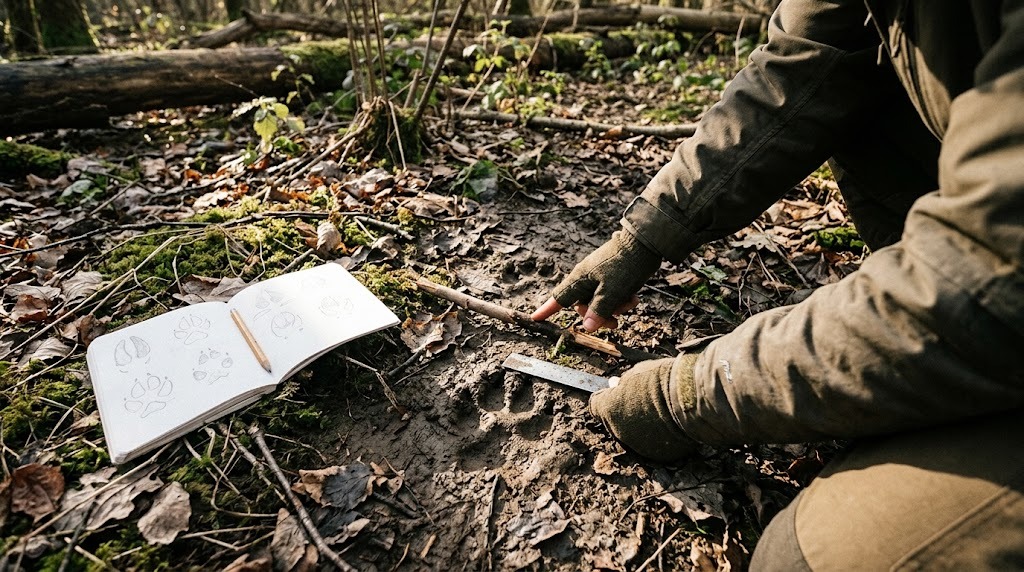
You interpret animal signs by executing a strict, four-step clinical evaluation routine: isolate the track, measure the physical details, assess the temporal decay, and contextualize the surrounding pattern. Bypassing any of these steps leads to severe misidentifications.
Step 1: Isolate the Sign
Approach the sign from the side to prevent contaminating neighboring tracks or microscopic evidence with your own boots. Position your body so the sun sits entirely in front of you. This technique, known as “cutting for sign,” forces the sun to cast micro-shadows directly into the impression or sign crevices, highlighting depth and texture that remain invisible from a top-down view.
Step 2: Measure and Record Details
Use a rigid pocket ruler to document the exact length, width, depth, and vertical height of the sign. Count the specific morphological details. For example, note the toe count: felines and canines display four toes, while bears, raccoons, and mustelids (weasels) display five toes. Measure the stride (distance from the heel of one print to the heel of the next) to determine if the animal was walking, trotting, or bounding.
Step 3: Assess Temporal Decay (Age)
Evaluate the freshness of the sign by analyzing its structural integrity against current weather conditions.
- Fresh Signs (Minutes to Hours): Track walls feature sharp, rigid edges. Scat features a moist, dark interior and a glossy exterior. Severed twigs have wet, bright white, unoxidized internal wood.
- Aaged Signs (Days to Weeks): Track edges turn crumbly and dull, slowly infilling with wind-blown debris, dust, or moisture spots. Scat becomes dry, bleached, and visibly cracking. Sheared wood oxidizes into a gray or brown color.
Expert Insight: Micro-climates drastically alter temporal decay. A deer track left in a shaded, humid ravine may look “fresh” for three days, while the exact same track left on an exposed, arid ridgeline will desiccate and look “old” in four hours. Always establish a control mark by pressing your own thumb into the soil to compare fresh moisture levels.
Step 4: Contextualize the Pattern
Move your focus outward from the micro-sign to the macro-environment. An isolated sign rarely tells the full story. Look for matching, corroborating evidence. If you find a cleanly sliced sapling at a 45-degree angle, scan the ground for spherical, fibrous scat to confirm the presence of a rabbit or hare.
Key Baseline Specifications for Tracking
Understanding the exact physical scale of these signs prevents costly field misidentifications. Relying on baseline specifications allows you to eliminate incorrect species immediately.
| Metric Type | Animal Group | Baseline Specification | Diagnostic Significance |
| Track Dimensions | Large Felines (Cougar) | 8 – 11 cm wide; round shape | Lacks claw marks; features a double-lobed heel pad. |
| Track Dimensions | Wild Canines (Wolf/Coyote) | 7 – 12 cm long; oval shape | Persistent claw marks; single-lobed upper heel pad. |
| Track Dimensions | Ungulates (White-tailed Deer) | 5 – 8 cm long; heart-shaped | Two symmetrical cleat marks (hooves). |
| Gait Measurement | Perfect Walkers (Fox, Bobcat) | Stride length matches body length | Direct registration (rear foot steps exactly inside front print). |
| Browse Height | White-tailed Deer | 0.5 – 1.8 meters from ground | Establishes species via absolute vertical reach limits. |
| Browse Height | Moose / Elk | 1.8 – 2.7 meters from ground | Differentiates large, heavy ungulates from smaller deer. |
What Equipment Do You Need to Track Signs?
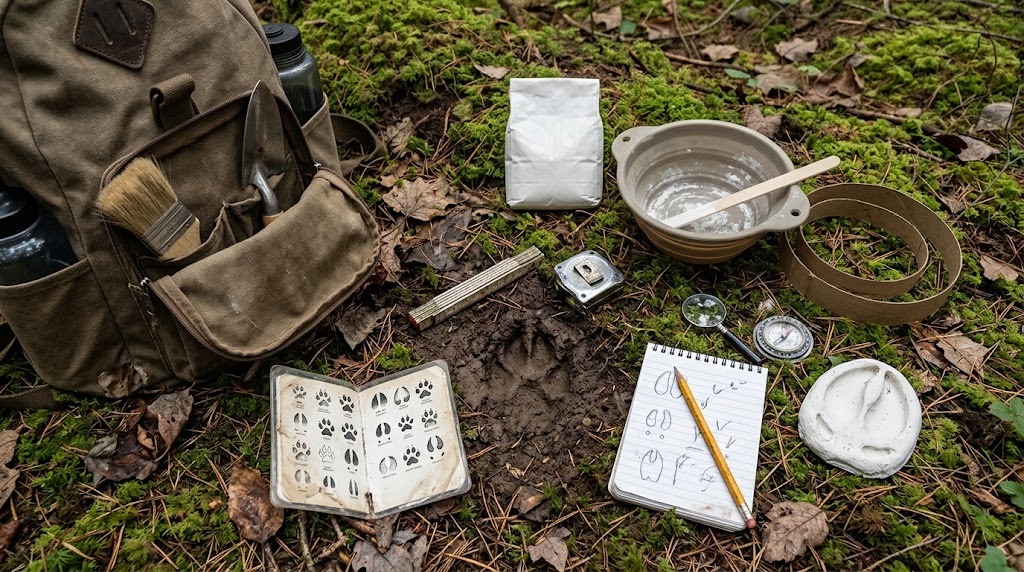
Sign tracking requires minimal initial capital, relying primarily on reference knowledge and a few lightweight measurement tools.
- Waterproof Laminated Field Cards: Field guides featuring 50 to 70 common species alongside built-in rulers. These survive rain and mud and cost between $7 and $10.
- Definitive Desk Handbooks: Deep-reference textbooks like Mark Elbroch’s Mammal Tracks & Sign offer hundreds of detailed illustrations, behavioral contexts, and tracking stories. These cost between $15 and $30 and serve as post-field verification tools.
- Casting Kits: Plaster of Paris (dental plaster), a flexible mixing bowl, and retaining rings used to permanently preserve physical impressions. While plaster costs roughly $15, advanced trackers utilize modern alginate for sub-millimeter detail in wet mud.
Training timeframes vary significantly. Achieving basic familiarity requires 10 to 15 hours of field practice to reliably separate scat types and major gaits. Reaching professional mastery-such as passing a CyberTracker Evaluation Certification-requires 2 to 5 years of regular field immersion across multiple seasons, weather shifts, and terrain variations.
Manual Tracking vs. Modern Tech
Sign tracking provides non-invasive behavioral context that modern GPS technology cannot replicate, though it sacrifices real-time location pinpointing.
| Methodology | Pros | Cons | Ideal For |
| Sign Tracking (Spoor) | Zero battery dependencies; reveals exact diet and behavior; fully non-invasive. | Requires immense upfront training; heavy rain or wind rapidly erases evidence. | Naturalists, ethical hunters, baseline population monitoring. |
| GPS / Cellular Collars | Pinpoint accuracy; real-time remote updates; tracks across hundreds of miles. | Expensive hardware; batteries eventually die; requires traumatic capture and sedation. | Intensive academic research, livestock management, missing pet recovery. |
The physical spoor provides the “why” behind an animal’s movement, while the GPS collar only provides the “where.” Biologists frequently combine both, using GPS to find the general territory and sign tracking to verify what the animal was actually doing in that location.
Common Tracking Pitfalls and Troubleshooting
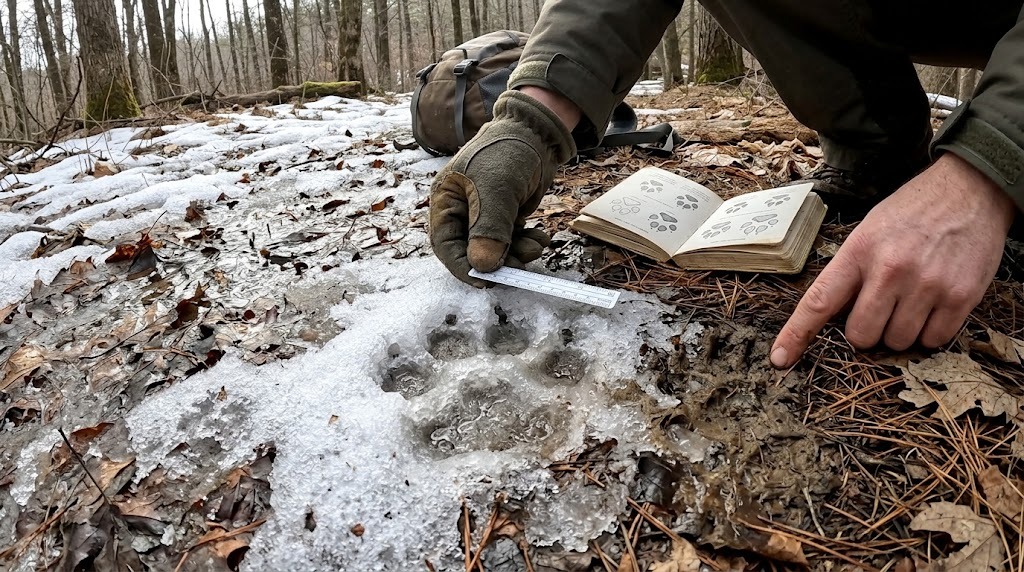
Field environments constantly degrade physical evidence, creating natural illusions that trick inexperienced observers.
The Size Illusion Error
Prints left in deep snow, slush, or loose mud expand as the medium melts or shifts outward. A common 4-centimeter house cat track deposited in morning snow can melt and expand by afternoon to resemble an 8-centimeter bobcat or mountain lion print.
- The Fix: Never rely on footprint dimensions alone in soft, melting, or shifting terrain. Check the structural gait patterns-such as the total stride length-to verify the animal’s true biological size.
Canine vs. Feline Misidentification
Mistaking large domestic dog prints for cougars, or coyotes for bobcats, is the most prevalent tracking error in North America.
- The Fix: Look for claw indicators and pad lobes. Felines keep their claws retracted while walking, leaving no claw marks in the dirt. Canines leave clear, non-retractable nail tips. Furthermore, a canine heel pad features a single lobe at the top, whereas a feline heel pad features a distinct, bi-lobed top edge.
Misinterpreting Old Marks as Fresh
Rain, heavy morning dew, or frost heave can wash loose dirt crumbs out of an old track, creating a deceptively crisp, clean look that mimics a fresh impression.
- The Fix: Find a fresh control point. Step heavily on the identical soil nearby and compare how crisp your fresh footprint edges look against the animal sign. If your track casts sharp micro-shadows and the animal’s track looks smooth or rounded, the animal track is highly aged.
Which Tracking Approach is Best for Your Goals?
Different user personas require different levels of detail and specialized focus when analyzing wildlife signs.
Beginners and Families
Beginners should focus entirely on pattern recognition and high-contrast environments. Focus your efforts on “track traps” like damp mud puddles, sandy riverbanks, or fresh morning snow. Avoid dense, leaf-littered forest floors where signs are heavily obscured. Carry a waterproof pocket guide to immediately verify toe counts and scat shapes on the go.
Hunters and Backcountry Explorers
Hunters must determine the travel direction, age, and routine habits of game. Prioritize surveying transition zones-the borders where thick timber opens into valleys or agricultural fields. Analyze feeding signs and bedding sites to map out daily routines, and rely on temporal decay assessment to know if an animal passed through ten minutes ago or ten days ago.
Scientific Researchers and Conservationists
Academics must gather standardized, repeatable data for population counts, diet analysis, and habitat mapping. Combine manual sign tracking with digital tools like infrared trail cameras and GPS mapping software. Researchers should pursue official evaluation certifications to ensure their data collection holds up under academic peer review.
Frequently Asked Questions
How long do animal tracks last in the wild?
Track longevity depends entirely on weather and substrate. A track in wet clay can dry and harden, lasting for several months. Conversely, a track in dry sand or powdery snow may be completely erased by moderate wind in less than 30 minutes.
Can you identify the gender of an animal from its signs?
Yes, in certain species. For example, a male white-tailed deer will leave wider straddle metrics (the width between the left and right feet) due to a broader chest, and they create territorial antler rubs. Female ungulates urinate directly between their hind legs, while males urinate farther forward.
What is the difference between a track and a spoor?
A track refers specifically to the physical impression left by an animal’s foot or hoof. Spoor is the overarching term that includes tracks, but also encompasses all other physical evidence, including scat, broken branches, hair snags, and territorial scent markings.
Do all predators leave tracks with claws?
No. Felines (mountain lions, bobcats, lynx, domestic cats) have retractable claws that do not touch the ground during a normal walking gait. Canines (wolves, coyotes, foxes, dogs) and bears have non-retractable claws that consistently leave visible indentations in soft substrates.
Why is it important to measure the stride of an animal?
Measuring the stride-the distance between the heel of one print and the heel of the subsequent print-reveals the animal’s speed and physical size. A tracker can determine if an animal was casually foraging (short stride), stalking (careful, direct registration), or fleeing from danger (extended, erratic bounding stride).