
State hunting regulations are legally binding frameworks enforced by individual state wildlife agencies—such as the Department of Natural Resources (DNR)—to manage animal populations and ensure public safety. These rules dictate who can hunt, permissible weapon types, specific season dates, and the required licenses for both resident and non-resident participants.
Key Facts / At a Glance:
- Public Trust Doctrine: Wildlife in the U.S. is not owned by private landowners; it is held in the public trust and managed by the state.
- Interstate Compact: All 50 U.S. states now participate in the Interstate Wildlife Violator Compact, meaning a hunting suspension in one state automatically applies nationwide.
- Residency Bias: State agencies typically allocate 80% to 90% of highly coveted big game tags to residents, charging non-residents up to 1,000% more for the same licenses.
- Federal Overlap: While states manage resident game, the U.S. Fish and Wildlife Service dictates federal frameworks for migratory birds and endangered species.
- CWD Restrictions: Crossing state lines with an intact deer or elk carcass is now illegal in most jurisdictions due to strict Chronic Wasting Disease (CWD) transport laws.
How Do State Hunting Regulations Work?
State hunting regulations work by utilizing biological data to establish sustainable harvest quotas, which are then enforced through a tiered system of licenses, geographic boundaries, and weapon-specific seasons. Biologists determine carrying capacities for specific game management units (GMUs) and restrict hunter numbers accordingly.
The regulatory framework rests on four distinct pillars:
- Jurisdiction and Funding: State agencies manage the wildlife within their borders. License sales and excise taxes on firearms (via the federal Pittman-Robertson Act) directly fund these conservation efforts, meaning hunters bear the primary financial burden for state wildlife management.
- The Interstate Wildlife Violator Compact (IWVC): While legacy data often cites 49 members, all 50 U.S. states are members of this compact as of 2025. Committing a major game violation in Colorado means your license privileges will be revoked in your home state of Pennsylvania.
- Residency Status Requirements: Establishing residency requires proving continuous physical presence in the state (usually 180 to 365 days) and establishing intent to remain (obtaining a state driver’s license, registering vehicles, and registering to vote). Buying a resident tag prematurely constitutes criminal license fraud.
- Weapon-Specific Frameworks: Game seasons are segregated by technology. Archery seasons typically occur first (during the reproductive rut), followed by muzzleloader seasons, and finally modern centerfire rifle seasons, which have the highest success rates but the shortest durations.
Step-by-Step Process to Hunt Legally
Navigating state hunting systems requires completing a sequential administrative process long before opening day. Failing to secure the right paperwork in the proper order leads to stiff financial penalties or confiscation of equipment.
Step 1: Complete Hunter Safety Education
Every state requires a certified Hunter Education Certificate for hunters born after a specific cutoff date (usually ranging from 1960 to 1980). Courses cover firearm safety, ethical shot placement, and wildlife identification. Most states accept out-of-state certificates through mutual reciprocity, and many offer temporary “Apprentice Licenses” allowing newcomers to hunt alongside a certified mentor before passing the exam.
Step 2: Establish Residency and Target Species
Verify your legal residency status and select your target species. The regulatory pathway for small game (rabbits, squirrels) or waterfowl is vastly different and much simpler than the pathway for limited-quota big game (elk, bighorn sheep, moose).
Step 3: Secure Licenses and Tags
A base hunting license permits you to hunt small game. To hunt big game, you must acquire a species-specific “tag” (see the allocation table below). You must carry these documents on your person in the field; while digital apps are increasingly accepted, a physically signed paper tag is still mandatory in many jurisdictions for harvest validation.
Step 4: Review Unit Boundaries and Harvest Rules
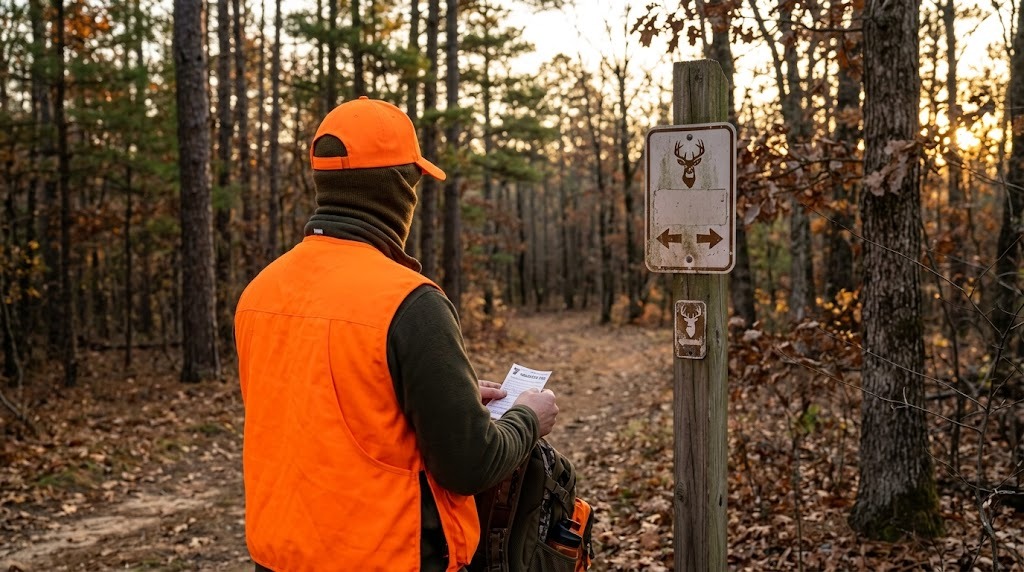
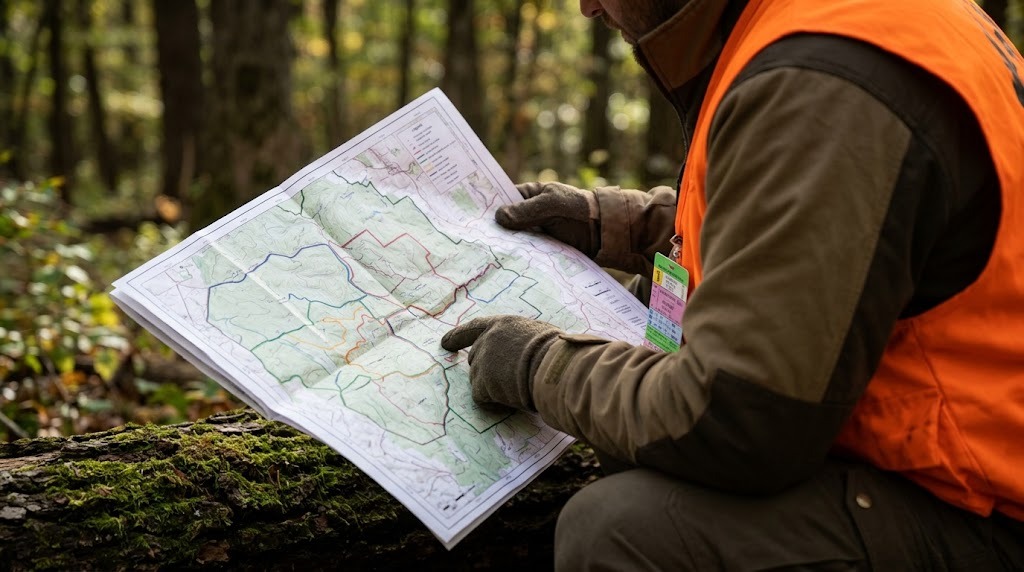
State lands are divided into Wildlife Management Areas (WMAs) or GMUs. You must memorize your specific unit’s boundaries, the legal shooting hours (usually 30 minutes before sunrise to 30 minutes after sunset), and antler point restrictions (e.g., harvesting only bucks with three or more points on one side).
Step 5: Tag and Report the Harvest
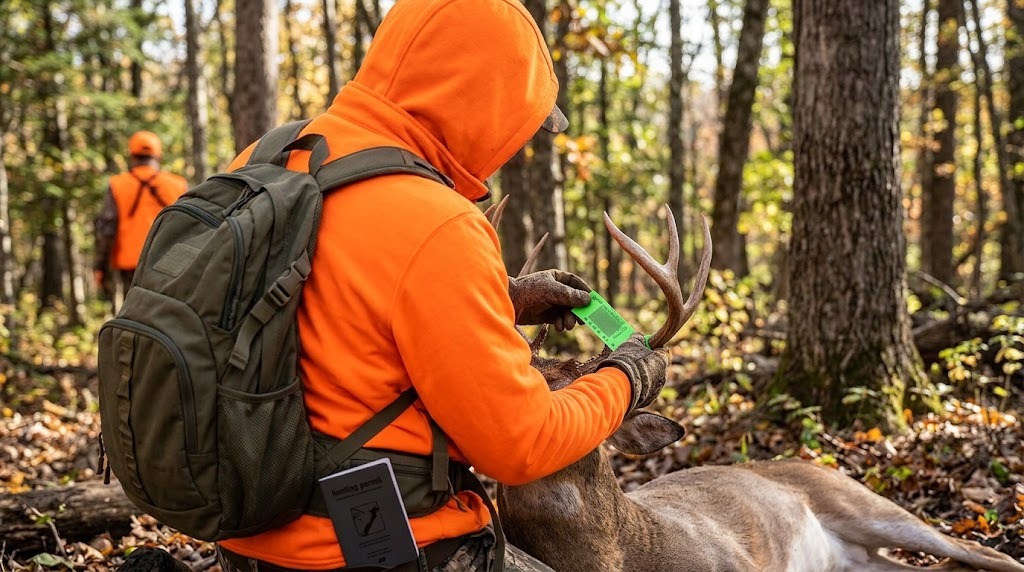
Immediately upon recovering a harvested animal, you must validate your tag by permanently cutting out the month and day, and physically attaching it to the carcass. Most states now mandate reporting the harvest online or via an automated phone system within 24 to 72 hours.
Tag Allocation Systems Compared
State wildlife agencies distribute hunting opportunities using four distinct allocation models, balancing public access against herd quality and overcrowding.
| System Type | Pros | Cons | Best Suited For |
| Over-the-Counter (OTC) | Guaranteed immediate access; low upfront planning required. | Heavy public land crowding; lower harvest success rates. | Beginners; hunters wanting guaranteed yearly access. |
| Preference Points | Predictable timelines; guarantees a tag to the highest point holder. | Point creep makes top-tier units mathematically impossible for new entrants. | Strategic planners focused on high-quality trophy units. |
| Bonus Points | Everyone has a mathematical chance; extra points act as extra lottery tickets. | High unpredictability; you could draw year one or year twenty. | Hunters willing to gamble on premium states like Nevada. |
| Pure Random Draw | True equality; a first-year applicant has the exact same odds as a 20-year applicant. | Zero predictability; no reward for long-term loyalty to the state system. | Hunters targeting New Mexico or Idaho big game. |
What Are the Most Common Legal Mistakes?
The most common legal mistakes hunters make involve improper tagging procedures, accidental mechanical trespassing, and failing to understand interstate transport laws. State game wardens operate under strict liability codes—ignorance of the regulation is never a valid legal defense.
- The “Shoot and Scoot” Error: Moving a harvested animal even a single foot before physically validating and attaching your tag is legally classified as poaching in many states. Tag the animal immediately upon walking up to it.
- Mechanical Trespassing & Corner Crossing: Assuming public land is clearly fenced is a critical error. Hunters must use GPS applications like onX Maps to navigate. Furthermore, “corner crossing”—stepping from one piece of public land to another diagonally across a private corner—remains a highly contentious and often illegal act in western states like Wyoming.
- CWD Transport Violations: Transporting an intact deer or elk carcass across state lines is illegal in nearly all of North America. To prevent the spread of Chronic Wasting Disease, hunters must completely debone the meat and remove all brain and spinal tissue before driving home.
- Party Hunting: “Party hunting”—the act of shooting an animal to fill a friend or family member’s tag—is a felony in most states, though a small minority (like Wisconsin for deer) explicitly allow it under strict proximity rules. Always assume the person who pulls the trigger must own the tag.
Typical Financial Costs and Application Timeframes
State hunting costs vary wildly depending on your residency status and the species pursued. Federal taxes and state surcharges further increase the final checkout price.
Standard Cost Ranges:
- Hunter Safety Course: $15 to $35 (or free via state DNR facilities).
- Base Hunting License: $15 to $45 (Resident) / $150 to $300 (Non-Resident).
- Big Game Tag (Deer/Elk): $30 to $60 (Resident) / $400 to $1,200 (Non-Resident).
- Federal Duck Stamp: $25 (Mandatory nationwide for migratory waterfowl).
Crucial Timeframes:
Western big game draw applications open as early as January and close by May for autumn hunts. Over-the-counter licenses typically go on sale in July or August. The licensing cycle generally follows either the calendar year or a fiscal year from April 1 to March 31.
How Should Different Hunters Navigate the Rules?
Different hunters require different regulatory strategies to maximize their time in the field while staying strictly within the law.
For the Absolute Beginner:
Do not start by navigating complex western draw systems. Purchase an OTC resident small game license, complete your hunter safety course, and hunt squirrels or spring turkeys on local public land. This builds foundational fieldcraft with minimal financial risk.
For the Out-of-State DIY Hunter:
Build a multi-state portfolio. Apply for bonus points in states with high-quality genetics (like Utah or Nevada) knowing it may take a decade to draw, while actively buying OTC tags in states like Idaho or Colorado to guarantee you are hunting every single autumn.
For the Private Land Hunter:
Owning private property does not exempt you from state wildlife laws. You still need a state-issued hunting license, must respect strict season dates, and are subject to the same bag limits as public land hunters. However, many states offer “Landowner Tag” programs, granting property owners guaranteed, sometimes transferable, tags that bypass the public draw.
Frequently Asked Questions
Can game wardens enter private property without a warrant?
Yes. Under the federal “Open Fields Doctrine,” state game wardens and federal wildlife officers can enter private, undeveloped land without a warrant or probable cause to check hunting licenses and ensure compliance with wildlife regulations.
What happens if you accidentally shoot the wrong animal?
If you accidentally harvest an illegal animal (e.g., a doe instead of a buck), field dress it, tag it, and immediately call the local game warden to self-report. Wardens frequently issue minor warnings or reduced fines for honest, self-reported mistakes, but abandoning the carcass is a major felony.
Do senior citizens or military veterans get license discounts?
Most states offer heavily discounted or entirely free lifetime hunting licenses to resident senior citizens (typically over age 65) and resident disabled veterans. Non-resident veterans occasionally receive price reductions, but this is less common.
Can you legally hunt with a sound suppressor (silencer)?
Hunting with a legally registered sound suppressor is currently legal in over 40 U.S. states. However, hunters must carry their federal ATF tax stamp paperwork in the field, and states like California, New York, and Illinois strictly prohibit their use for any purpose.