
Animal tracks are physical impressions left by wildlife in substrates like mud, snow, or sand. Tracking is the science of identifying these footprints by analyzing toe counts, claw marks, pad morphology, and gait patterns to determine species, behavior, and movement without directly disturbing the animal.
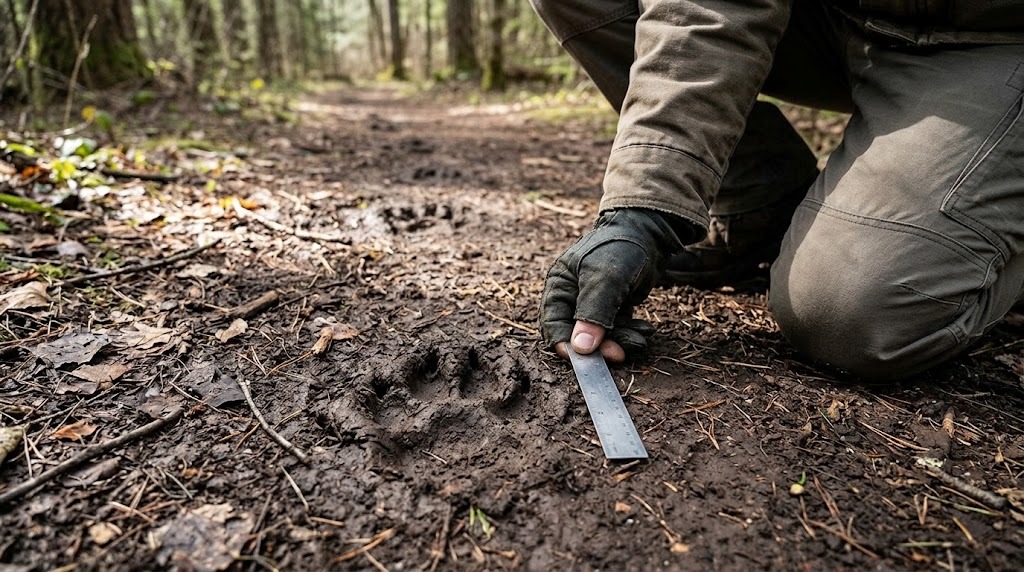
Key Facts:
- Canine tracks (dogs, coyotes) display four toes, visible claws, and an X-shaped negative space between the pads.
- Feline tracks (bobcats, cougars) feature four toes, a three-lobed heel pad, and typically lack claw marks due to retractable claws.
- Track size is relative to substrate: Snowmelt can stretch a 2-inch track into a 4-inch track within hours.
- Double registering occurs when an animal’s hind foot lands inside its front footprint, creating a deceptively large, multi-toed track.
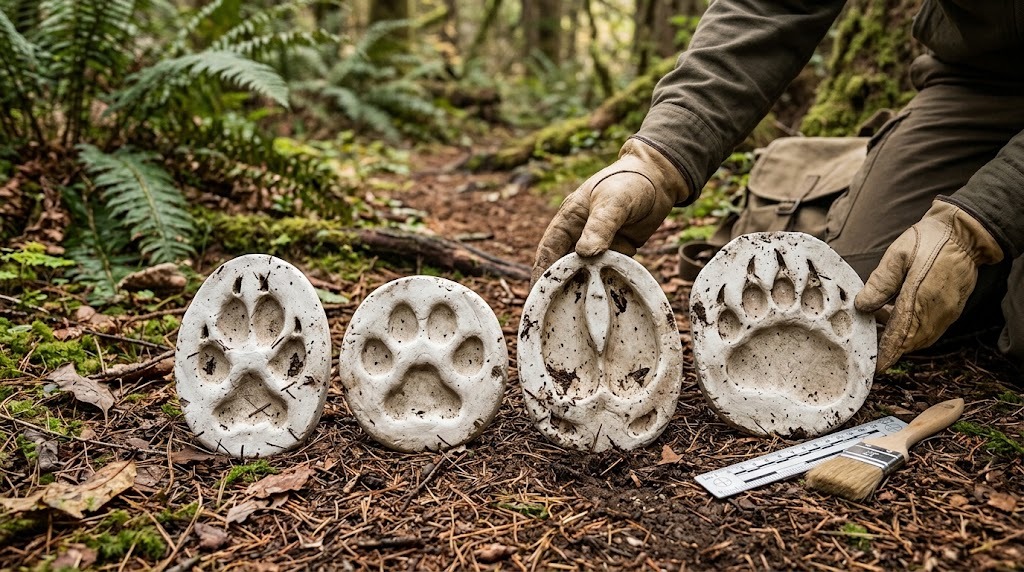
- Plaster casting remains the most accurate 3D preservation method, taking 30–60 minutes and costing $5–$20 per cast.
What Are the Four Fundamentals of Animal Tracking?
Tracking relies on analyzing four distinct environmental variables to build a complete picture of animal movement. Interpreting these fundamentals prevents misidentification caused by isolated, poor-quality footprints.
Track Morphology
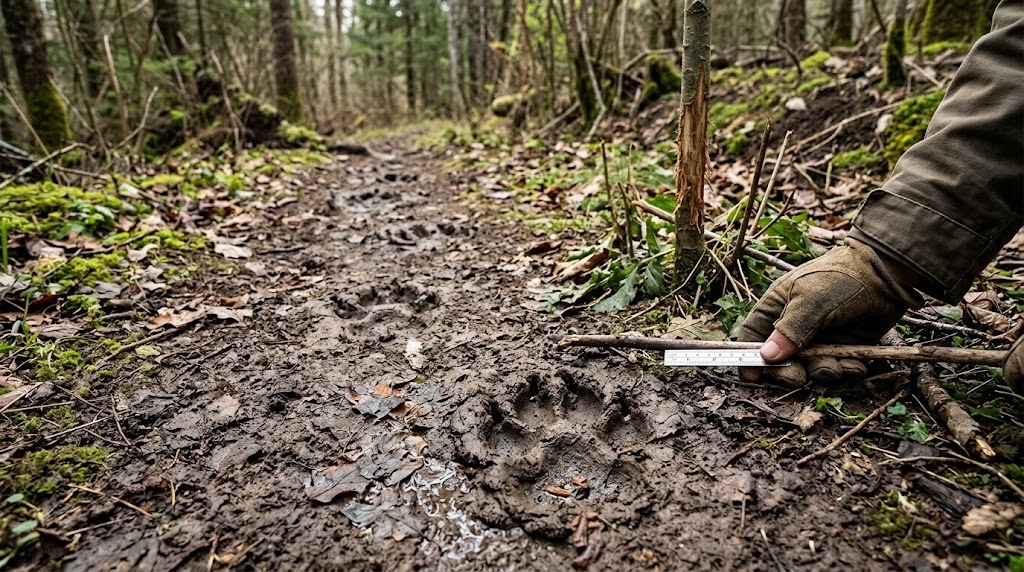
Track morphology refers to the specific anatomical structure of the footprint. Identifiers include the number of toe pads, the presence or absence of claw marks, webbing, and the geometric shape of the heel (metacarpal/metatarsal) pad. Morphology dictates the broad animal family.
Gait Patterns
Gait patterns describe the spatial arrangement of multiple tracks relative to one another, revealing the animal’s speed and body mechanics. The four primary gaits are walking, trotting, bounding (common in weasels), and galloping. Gaits separate animals with similar footprints, such as distinguishing a domestic dog’s sloppy walk from a coyote’s energy-efficient, straight-line trot.
Sign and Signposts
Signs represent indirect physical evidence of an animal’s presence outside of footprints. Examples include scat (droppings), browse (chewed vegetation), rubs (antler marks on trees), beds, and burrows. Combining track morphology with contextual sign confirms identification when prints are degraded.
Substrate Interaction
Substrate interaction dictates how a track is compressed into mud, snow, sand, or forest debris. Heavy animals walking in deep mud exhibit “toe splay,” making the track appear wider than the actual foot. Substrate physics also dictate track aging; wet mud holds crisp edges for days, while dry sand collapses immediately.
How Do You Identify Animal Tracks Step-by-Step?
Identifying animal tracks requires a systematic reduction process. Attempting to match a single track to a field guide photograph often fails due to soil distortion. Follow this exact sequence to narrow down the species.
Step 1: Count the Toes and Lobes
Examine a single, clear print and count the visible toe pads. Two toes indicate an ungulate (deer, boar). Four toes indicate a canine or feline. Five toes indicate a plantigrade (bear, raccoon, badger). Next, count the lobes on the bottom of the main heel pad; three lobes at the base strongly indicate a feline.
Step 2: Check for Claw Marks
Note whether sharp puncture marks appear ahead of the toe pads. Visible claws generally point to canines (wolves, foxes) or digging plantigrades (badgers, bears). An absence of claws points to felines (lions, leopards, domestic cats), whose retractable claws stay hidden. Exception check: Cheetahs have semi-retractable claws that often register, and foxes walking on hard surfaces may not leave claw marks.
Step 3: Measure Track Dimensions and Stride
Measure the exact length and width of the individual track from the highest toe to the base of the heel. Measure the “stride” (distance from the heel of one footprint to the heel of the next on the same side) and the “straddle” (the total width of the trail). A 2.5-inch feline track with an 18-inch stride belongs to a bobcat, not a domestic house cat.
Step 4: Analyze the Gait Pattern
Analyze the repeating sequence of prints along the trail. Notice if the animal is a direct registerer (placing the hind foot exactly in the front footprint), a waddler, or a bounder. Coyotes and foxes utilize a “direct register trot” to conserve energy in snow, leaving what looks like a single line of tracks.
Step 5: Assess Track Age and Weathering
Determine how long ago the animal passed by evaluating track degradation. Look at the crispness of the track walls. If loose dirt has fallen inside, or if small insect tracks cross over the footprint, it is hours or days old. A track with sharp, vertical walls holding standing water that has not yet seeped away is fresh.
What Are the Main Animal Track Categories?
Animals are broadly grouped into distinct morphological categories based on their skeletal structure. These classifications allow trackers to instantly narrow a footprint down to a specific family tree.
Canines (Dogs, Wolves, Coyotes, Foxes)
Canine tracks feature an oval shape, four prominent toes, and a symmetrical layout where you can draw an “X” through the negative space between the toe pads and the heel pad. They feature visible, non-retractable claw marks.
- Wolves: Massive (4-5 inches long), splayed toes for snow travel.
- Coyotes: Compact (2.5-3 inches), oval, middle toes point straight forward.
- Domestic Dogs: Asymmetrical, blunt claws, rounder overall shape with splayed toes.
Felines (Cats, Cougars, Bobcats)
Feline tracks present a round shape, four toes, and an asymmetrical layout where the leading toe sits higher than the others (similar to a human hand). They leave no claw marks and feature a distinctive three-lobed trapezoidal heel pad.
- Cougars (Mountain Lions): Large (3-4 inches), prominent three-lobed heel.
- Bobcats: Medium (2 inches), distinct roundness, often found near dense cover.
Ungulates (Deer, Elk, Moose, Wild Boar)
Ungulate tracks are heart-shaped or split-hoof impressions made by two prominent toes. In deep mud or snow, two smaller rear toes (dewclaws) may register behind the main track.
- Deer: Heart-shaped, 2-3 inches long, tips point inward.
- Wild Boar: Rounder, wider, with dewclaws that register wider than the main hooves.
- Large Mammal Exceptions: Rhinoceros tracks show three toes; hippopotamus tracks show four blocky toes.
Plantigrades (Bears, Raccoons, Opossums)
Plantigrade animals walk with the entire sole of their foot touching the ground, leaving a large, flat, hand-like impression with five toes on both front and hind feet.
- Black Bears: Hind tracks (6-8 inches) resemble human bare feet with large claws.
- Raccoons: Front tracks resemble small human hands (2-3 inches); hind tracks are longer.
Birds, Waterfowl, and Small Mammals
Tracks that do not fit mammalian profiles often belong to birds or specialized semi-aquatic creatures.
- Birds (Duck, Quail, Penguin): Long, three-toed prints. Ducks and penguins display clear webbing between toes.
- Semi-Aquatic (Beaver, Platypus): Five toes with distinct, wide webbing and dragging tail marks.
Track Measurements and Identification Specifications
| Animal Group | Number of Toes | Typical Track Width | Primary Gait | Key Identifier |
| Felines | 4 (Front & Rear) | 1.5 in – 4.5 in | Trot / Direct Register | Asymmetrical, no claws, 3-lobed heel |
| Canines | 4 (Front & Rear) | 1.25 in – 5.0 in | Trot / Straddle | Symmetrical, claws visible, X-space |
| Ungulates | 2 (Hooves) | 1.0 in – 6.0 in | Walk / Trot | Heart-shaped, split hoof, dewclaws |
| Plantigrades | 5 (Front & Rear) | 2.0 in – 7.0+ in | Waddle / Bound | Hand-like, large flat sole, 5 toes |
| Avian / Waterfowl | 3 to 4 | 1.0 in – 4.0 in | Walk / Hop | Thin toes, optional webbing |
Field Documentation Methods for Animal Tracks
Capturing field data accurately is essential for post-hike identification. Trackers utilize three primary methodologies based on time constraints and required accuracy.
| Method | Description | Pros | Cons | Cost & Time |
| Photography | Capturing high-resolution photos with a scale object (ruler/coin) next to the track. | Non-destructive, instant, highly shareable. | Distorts 3D depth, heavily dependent on lighting angles. | $0 / Instant |
| Plaster Casting | Pouring Plaster of Paris or dental stone directly into a walled track impression. | Creates a perfect, permanent 3D physical replica. | Messy, heavy to carry, destroys the original track upon removal. | $5 – $20 / 30–60 mins |
| Sketching & Tracing | Drawing the track to scale on graph paper or clear acetate sheets using a pencil. | Forces deep observation of track structure and pad layout. | Relies on artistic skill, time-consuming in bad weather. | $2 – $5 / 5–15 mins |
Expert Limitation Note: Plaster of Paris fails in freezing temperatures and snow. For winter tracking, professionals use specialized sulfur casts or fast-setting dental stone mixed with warm water.
What Are the Most Common Tracking Mistakes?
Misidentifying tracks usually stems from environmental distortions rather than biological anomalies.
- The “Double Register” Illusion: Many animals (especially felines and canines) place their hind foot directly inside the print left by their front foot. This can make a four-toed animal look like a massive six-toed mutant. How to Fix: Look further down the trail for a single, isolated print where the animal broke its stride to step over an obstacle.
- Size Distortions from Melting: Snow tracks expand significantly as they melt in the sun. A 1.5-inch domestic house cat print can stretch to the size of a 3-inch cougar print by mid-afternoon. How to Fix: Check the bottom of the track for actual pad compression, and look for shaded tracks under trees that haven’t melted.
- Assuming Claws Always Mean Canine: While felines have retractable claws, they will extend them when running, leaping, or navigating extremely slippery mud. How to Fix: Rely on the shape of the heel pad (three lobes for cats, two lobes for dogs) rather than the presence of claws alone.
- The Substrate Splay: A 150-pound deer walking in soft mud will splay its hooves wide to displace weight, making the track appear identical to a 500-pound elk. How to Fix: Measure the depth of the track impression relative to your own footprint to gauge true animal weight.
Expert Recommendations by Experience Level
Tracking proficiency scales with field time. Applying the right focus based on your current knowledge prevents overwhelm.
- For Beginners and Hikers: Start by focusing on photography and substrate interaction. Carry a small 6-inch pocket ruler to place next to tracks. Focus strictly on learning your local wildlife species and mastering the difference between domestic dogs and wild coyotes.
- For Educators and Families: Utilize plaster casting in damp environments. It provides a tactile, hands-on activity that yields a tangible artifact. Focus on clear tracks in heavy mud or wet sand along riverbanks for the highest success rate.
- For Biologists and Advanced Trackers: Master gait analysis and ecological sign. Do not look at single tracks; look at the entire landscape trail. Read changes in the animal’s speed, stride length, energy conservation, and intent to understand why the animal was moving, not just what it was.
Frequently Asked Questions About Animal Tracks
How long do animal tracks last in the wild?
Track longevity depends entirely on weather and substrate. A footprint in wet mud can last several weeks if it dries and solidifies. Conversely, tracks in dry sand or powdery snow may disappear in minutes due to wind erosion.
What is the difference between a dog track and a coyote track?
Coyote tracks are highly symmetrical, compact, and oval-shaped, with the two front toes pointing straight ahead. Domestic dog tracks are rounder, often asymmetrical, feature splayed toes, and have blunt claw marks compared to a coyote’s sharp claws.
Why don’t feline animal tracks show claw marks?
Felines, including bobcats, cougars, and domestic cats, have retractable claws that rest inside protective sheaths while walking to keep them sharp for hunting. Because the claws do not touch the ground, feline tracks only show toe pads.
What animal leaves a track that looks like a human hand?
Raccoons, opossums, and bears leave tracks resembling human hands. Raccoon front tracks look remarkably like miniature human hands with long, thin fingers, while black bear hind tracks look like flat human feet with large claws attached.