
Identifying animal tracks is a four-step forensic process that combines substrate evaluation, millimeter-scale print measurement, anatomical pad analysis, and biomechanical gait interpretation to classify wildlife species. The complete identification workflow takes 12 to 15 minutes in the field, requires basic measuring and low-angle lighting tools, and relies on analyzing consecutive trackways rather than isolated footprints.
Key Facts / At a Glance
- Primary Diagnostic Rule: Never identify a species from a single footprint; examine a sequence of 4 to 6 consecutive tracks to account for terrain distortion and missing toes.
- Canine vs. Feline Pad Ratio: Canines exhibit a triangular heel pad with 1 anterior lobe and 2 posterior lobes, whereas felines display a trapezoidal heel pad with 2 anterior lobes and 3 posterior lobes.
- Standard Measurement Protocol: Measure track length from the posterior edge of the metapodial (heel) pad to the anterior tip of the longest digital (toe) pad, strictly excluding claw marks and sediment push-piles.
- Baseline Gait Conservation: Wild predators conserve metabolic energy by traveling in direct-register walks or tight side-trots with near-zero straddle gaps, whereas domestic animals meander with wide, inconsistent trail widths.
- Verification Standard: Professional wildlife biologists use the CyberTracker International evaluation system, which grades trackers on reconciling micro-morphology with ecological habitat constraints.
Before You Start: Field Kit and Prerequisites
Systematic track identification requires five specific field instruments to capture accurate morphometric data before wind, solar radiation, or precipitation degrades the impression.
- Time Required: 12–15 minutes per trackway analysis.
- Difficulty Level: Beginner to Intermediate (requires basic familiarity with mammalian foot anatomy).
- Estimated Kit Cost: $25–$65 USD.
- Required Tools and Quantities:
- 1 Clear Rigid Metric/Imperial Ruler (15 cm / 6 in) or ABFO No. 2 Photomacrography Scale: Prevents parallax error during top-down photography and provides millimeter precision.
- 1 Retractable Steel Tape Measure (3 m / 10 ft): Measures full trackway stride lengths and trail widths (straddle).
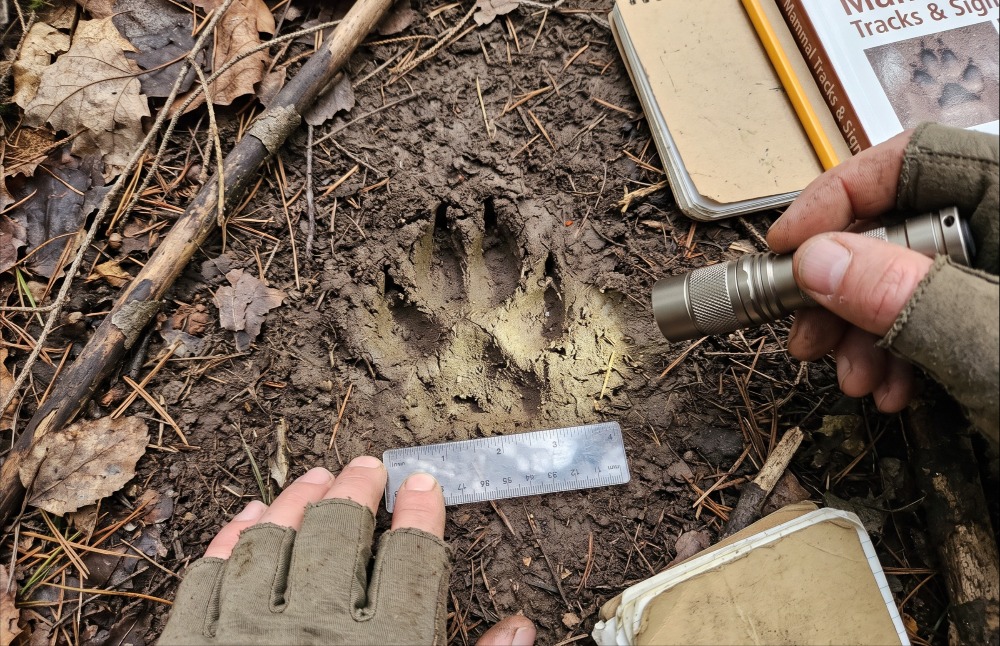
- 1 High-Lumen Tactical Flashlight (300–500 lumens) or Compact Pocket Mirror: Generates artificial raking light at a 10-to-15-degree angle to expose shallow micro-topography.
- 4 Wooden Toothpicks or Surveyor Flags: Marks individual heel-to-heel footfalls across dense leaf litter or hardpan dirt to visualize the overall gait geometry.
- 1 All-Weather Field Notebook, Mechanical Pencil, and Smartphone Camera: Logs GPS coordinates, substrate viscosity, and orthogonal images.
- 1 Authoritative Reference Manual: Mammal Tracks & Sign: A Guide to North American Species (2nd Edition, 2019) by Mark Elbroch and Casey McFarland, or the iNaturalist mobile application for regional range verification.
- Prerequisites: Disable your smartphone’s wide-angle (0.5x) lens before photographing prints; wide-angle optics introduce barrel distortion that warps the negative space and toe symmetry at the edges of the frame.
How Do You Identify Animal Tracks Step-by-Step?
Step 1: Assess the Substrate, Habitat, and Track Age
Evaluate the surrounding ecological zone and soil mechanics for 2 minutes before touching or measuring the footprint. Identify the immediate habitat (riparian mudflat, coniferous forest, arid wash, suburban edge) to eliminate species outside their geographic or seasonal range, then test the substrate plasticity by pressing your booted heel into the ground parallel to the animal’s trail.
SUBSTRATE COMPRESSION & WALL ANATOMY (CROSS-SECTION)
Direction of Travel ───►

      Rear Ejecta                   Anterior Push-Pile (Soil Lip)
       \   ___                     ___   /
────────\_/   \                   /   \_/────────  Ground Surface
               \                 /
                \_______________/  ◄── True Track Floor (Measure Here)
Compare the structural sharpness of your fresh boot impression against the target animal track to establish a baseline age and distortion factor:
- Inspect the Track Walls for Gravity Crumble: A track made within the last 1 to 4 hours in moist silt or loamy sand exhibits razor-sharp vertical walls, compressed specular “shines” on the floor, and intact micro-ridges between the toes. As moisture evaporates, soil particles lose cohesion and cascade into the basin of the print (gravity crumble), rounding the edges within 6 to 12 hours.
- Locate the Direction of Force: Look for the elevated soil lip or snow push-pile (throw) around the perimeter of the track. An animal pushes backward against the earth to propel itself forward, meaning the highest wall of compressed earth sits at the posterior (rear) or postero-lateral edge of the print, while loose ejecta scatters forward in the direction of travel.
- Check for Environmental Weathering Markers: Look for nocturnal dew webs spun across the depression, frost crystal accumulation, wind-blown detritus, or rain-drop cratering inside the heel pad. If pine needles or oak leaves lie flat under the compressed floor, the animal stepped over them; if leaves rest loosely on top of the toe impressions, they fell after the animal passed, allowing you to time the track against the last local wind event or precipitation window.
- Success Checkpoint: You have isolated the best-preserved print in the sequence, established whether the substrate expanded or contracted the impression, and confirmed the animal’s direction of travel.
- Common Mistake at This Step: Stepping onto the trackway line while leaning in to examine a single print, which destroys the trailing gait sequence needed in Step 4. Always approach a trail from the side at a 90-degree angle.
Step 2: Measure Print Dimensions and Capture Low-Angle Photographs
Place your metric scale flat on the ground directly beside the print—aligned parallel to the long axis of the foot—and take two photographs before recording length and width measurements. Complete this documentation in 5 minutes to establish a permanent, distortion-free record.
MORPHOLOGICAL TRACK MEASUREMENT BOUNDARIES

       +--------- OVERALL WIDTH ---------+
       |         _             _         |  ───┬─── Anterior Tip of Longest
       |       ( 3 )         ( 4 )       |     |    Digital Pad (Exclude Claws)
       |   _                         _   |     |
       | ( 2 )                     ( 5 ) |   TRUE
       |         \   Negative  /         |  LENGTH
       |          \  Space X  /          |     |
       |           )_________(           |     |
       |          /           \          |     |
       |         (  Metapodial )         |     |
       |          \___     ___/          |  ───┴─── Posterior Edge of
       +--------------\___/--------------+          Metapodial (Heel) Pad
Execute the measurement protocol using these exact boundaries:
- Position the Scale Plane: Rest your ruler or ABFO scale at the exact depth of the track floor (not perched on top of a 3-centimeter snow crust) so the camera lens focuses on the scale and the pad details on the same focal plane.
- Apply 15-Degree Raking Illumination: Hold your 300-lumen flashlight (or angle a pocket mirror toward the sun) 2 to 5 centimeters above the ground at a 10-to-15-degree grazing angle relative to the soil surface. Sweep the beam around a 180-degree arc until the micro-shadows clearly delineate the edges of the toe pads and the interdigital negative space.
- Shoot Orthogonal (90-Degree) Photographs: Hold your camera directly perpendicular (90 degrees) to the track floor using the standard 1x or 2x optical lens. Capture one frame with natural lighting and a second frame illuminated by your 15-degree raking light.
- Measure True Morphological Length: Measure from the rearmost edge of the plantar/metapodial (heel) pad to the foremost tip of the longest digital (toe) pad in millimeters and inches. Exclude claw marks, hair drags, and sliding entry/exit troughs unless you are specifically recording “overall impression length” for deep-snow comparison.
- Measure Overall Morphological Width: Measure perpendicular to the length axis across the widest spread of the outer digital pads (Toe 2 to Toe 5 in four-toed tracks, or Toe 1 to Toe 5 in five-toed tracks).
- Success Checkpoint: You have recorded exact millimeter/inch values for both a front (manus) and hind (pes) print, and your photographs clearly display the ruler hashes alongside crisp shadow boundaries inside the pad basin.
- Common Mistake at This Step: Measuring from the bottom of the sunken crater wall to the top of the upper soil lip (“wall-to-wall measurement”). In soft mud or wet snow, wall-to-wall measurements inflate a print’s dimensions by 15% to 35%, turning a 6.5 cm (2.5 in) coyote print into an apparent 9 cm (3.5 in) wolf print.
Step 3: Audit Foot Morphology, Toe Count, and Pad Geometry
Inspect the internal anatomy of the footprint for 3 minutes to classify the animal into its taxonomic family. Examine five structural variables in strict order: digital pad (toe) count, claw mark registration, metapodial (heel) pad lobe geometry, overall symmetry, and negative space architecture.
CANID (SYMMETRICAL, 1-TOP/2-BOTTOM)    FELID (ASYMMETRICAL, 2-TOP/3-BOTTOM)
          (3)   (4)   ◄─ Even Leading Toes       (3)         ◄─ Leading Toe (Inner)
      (2)    \ /    (5)                              (4)
        \     X     /   ◄─ "X" Negative        (2)  /   \  (5) ◄─ "C" Negative
         \   / \   /       Space                 _ /_____\ _      Space
          ( Top 1 )     ◄─ 1 Anterior Lobe      (  Top 2    )  ◄─ 2 Anterior Lobes
         /         \                           /             \
        (  L1   L2  )   ◄─ 2 Posterior        (  L1  L2   L3  )◄─ 3 Posterior
                           Lobes                                  Lobes
Compare your field observations against this diagnostic anatomical classification matrix:
| Taxonomic Group | Visible Toes (Front / Hind) | Claw Registration | Heel Pad Lobe Geometry | Symmetry & Negative Space | Representative Species |
| Canidae (Dogs, Wolves, Coyotes, Foxes) | 4 Front / 4 Hind (Thumb dewclaw sits high on leg) | Present: Blunt or sharp triangular dots ahead of toes | Triangular: 1 anterior (top) lobe; 2 posterior (bottom) lobes | Oval & Symmetrical: Distinct “X” in negative space between toes and heel | Gray Wolf, Coyote, Red Fox, Gray Fox, Domestic Dog |
| Felidae (Cats, Cougars, Bobcats, Lynx) | 4 Front / 4 Hind (5th medial toe does not touch ground) | Absent: Retracted in sheaths (except during steep mud slips) | Trapezoidal (M-shaped): 2 anterior lobes; 3 posterior lobes | Round & Asymmetrical: Inner middle toe (Toe 3) leads; “C” or arch negative space | Mountain Lion (Cougar), Bobcat, Canada Lynx, Domestic Cat |
| Ursidae (Bears) | 5 Front / 5 Hind | Present: Long, curved punctures (1.5–10 cm ahead of toes) | Wide Kidney (Front) vs. Full Human-like Heel (Hind) | Asymmetrical Arc: Largest toe is on the outside (lateral edge); smallest toe is on the inside | American Black Bear, Grizzly (Brown) Bear, Polar Bear |
| Mustelidae & Mephitidae (Weasels, Otters, Badgers, Skunks) | 5 Front / 5 Hind (Note: Toe 1 often fails to register, showing only 4) | Present: Short pins (weasels/otters) or massive digging blades (badgers/skunks) | Chevron or Segmented C-Shape: Often accompanied by proximal carpal pads | Wider than Long: Fan-shaped toe spread; interdigital webbing in river otters | River Otter, Fisher, Pine Marten, American Badger, Striped Skunk, Mink |
| Procyonidae & Didelphidae (Raccoons, Opossums) | 5 Front / 5 Hind | Present (Raccoon) / Variable (Opossum lacks claw on hind thumb) | Flat Plantigrade Palm: Fused, boxy palm pad (Raccoon) or bubbled pad (Opossum) | Hand-Like: Elongated finger digits; opossum hind track displays a 90°–180° opposable thumb | Northern Raccoon, Virginia Opossum |
| Rodentia (Squirrels, Beavers, Porcupines, Mice) | 4 Front / 5 Hind (Exception: Beavers & Porcupines have 5/5) | Present: Sharp climbing points or sturdy digging nails | Multilobed: 3 metacarpal pads + 2 posterior wrist (carpal) pads on front feet | Star-burst or Boxy: Middle three hind toes (Toes 2, 3, 4) often grouped tightly together | Eastern Gray Squirrel, North American Beaver, Yellow-bellied Marmot, Deer Mouse |
| Lagomorpha (Rabbits, Hares) | 5 Front (Often registers 4) / 4 Hind | Present: Distinct claw tips poking through dense foot fur | Obscured by Hair: Dense pelage covers pads, leaving blurry oval depressions | Asymmetrical Front / Triangular Hind: Hind feet are 2x to 3x longer than front feet | Eastern Cottontail, Snowshoe Hare, Black-tailed Jackrabbit |
| Artiodactyla (Hoofed Ungulates) | 2 Main Cleaves + 2 Posterior Dewclaws (Digits 2 & 5) | Absent: Keratinous hoof wall surrounds the terminal phalanges | Subunguligrade Pad: Fleshy bulb at rear transitions into concave vault forward | Split-Heart or Blocky Oval: Symmetrical paired cleaves tapering toward the front | White-tailed Deer, Mule Deer, Rocky Mountain Elk, Moose, Wild Boar, Bighorn Sheep |
- Success Checkpoint: You have verified the toe count across at least three separate prints, identified the front-to-hind pad morphology, and narrowed the candidate down to a single taxonomic family.
- Common Mistake at This Step: Ruling out five-toed animals because you only count four toes in the mud. In mustelids (fishers, martens, mink, river otters), the inner first digit (Toe 1 / pollex and hallux) is reduced and sits slightly elevated on the medial side of the foot. On firm mud or shallow snow, Toe 1 fails to make contact, leaving a four-toed print that beginners misclassify as a small cat or fox. Look for an asymmetrical gap on the inside edge of the heel pad where the missing fifth toe belongs.
Step 4: Measure the Trackway Gait, Stride, and Straddle
Step back from the individual footprint and examine a continuous line of 4 to 6 consecutive tracks for 5 minutes. An animal’s skeletal proportions and baseline traveling gait provide a secondary biometric signature that resolves any ambiguity left by damaged or distorted individual prints.
FOUR PRIMARY QUADRUPED GAIT PATTERNS (Direction of Travel ───►)

1. DIRECT-REGISTER WALK / TROT (Cats, Foxes, Coyotes, Deer)
   [LH/LF]               [LH/LF]               [LH/LF]
              [RH/RF]               [RH/RF]
   ├───── Stride ────────┤                     ┬ Straddle (Trail Width)
                                               ┴

2. PACING / OVERSTEP WALK (Bears, Raccoons, Badgers, Skunks, Beavers)
   [LF] [LH]             [LF] [LH]             [LF] [LH]
             [RF] [RH]             [RF] [RH]

3. 2x2 BOUND (Weasels, Mink, Martens, Fishers, River Otters)
   [LF] ── [LH]                  [LF] ── [LH]
   [RF] ── [RH]                  [RF] ── [RH]
   (Hind feet land directly inside or just behind front tracks)

4. GALLOP / HOP (Rabbits, Hares, Tree Squirrels, Mice)
          [LH]                          [LH]
   [RF]  [LF]                    [RF]  [LF]    (Rabbits stagger fronts: [RF]..[LF])
          [RH]                          [RH]   (Squirrels pair fronts side-by-side)
   (Larger hind feet swing past and land AHEAD of smaller front feet)
Measure and interpret the trackway using these three biomechanical parameters:
- Identify the Foot Posture Class:
- Plantigrade (Full-Heel Walkers): The animal walks on its entire foot sole, including the tarsals and carpals. Produces elongated hind prints and wide, slow-moving trails (Ursidae, Procyonidae, Castoridae, Mephitidae).
- Digitigrade (Toe Walkers): The animal walks on its digital and metapodial pads with the wrist and ankle (hock) elevated off the ground. Produces compact, circular or oval prints built for quiet stalking or high-efficiency trotting (Felidae, Canidae).
- Unguligrade (Tip-Toe Hoof Walkers): The animal walks on the modified keratinous nails of its central digits, maximizing stride length and cursorial speed (Cervidae, Bovidae, Equidae).
- Measure Stride (Group Interval) and Straddle (Trail Width):
- Stride: Measure from the posterior heel of one foot (e.g., Left Hind) to the posterior heel of the next impression made by that exact same foot (or measure from the back of one bound group to the back of the next bound group).
- Straddle (Trail Width): Place two straight sticks parallel to the direction of travel along the outer left edge and outer right edge of the trackway. Measure the perpendicular distance between the two sticks.
- Classify the Movement Pattern:
- Diagonal Walkers & Trotters (Canids, Felids, Ungulates): Move opposite limbs together (right front with left hind). In a Direct-Register Walk (typical of cats, foxes, and deer), the hind foot lands precisely inside the impression just vacated by the front foot on the same side, minimizing noise and energy expenditure. In a Side-Trot (typical of coyotes and wolves), the animal angles its body slightly sideways so the hind foot passes to the left or right of the front foot without clipping its own ankle, leaving pairs of oblique tracks along a straight line.
- Pacers & Amblers (Bears, Raccoons, Badgers, Porcupines, Beavers, Skunks): Wide-bodied mammals move both limbs on the same side of the body simultaneously or nearly simultaneously. Raccoons famously leave a 2×2 Pacing Walk, where the smaller front foot sits directly beside the longer, human-like hind foot from the opposite side in paired rows across the mud.
- Bounders & Lopers (Mustelids — Weasels, Mink, Martens, Fishers, Otters): Long-bodied, short-legged carnivores leap forward off their hind legs, plant both front feet, and pull their hind feet Directly into or immediately behind the front footprints before springing forward again. This creates tight, boxy 2×2 twin-print clusters or staggered 3×4 lope groups separated by long airborne gaps.
- Gallopers & Hoppers (Lagomorphs & Rodents — Rabbits, Hares, Squirrels, Mice): When bounding forward, the large hind feet swing completely outside and land ahead of the smaller front feet. Diagnostic Rule: Tree squirrels (arboreal climbers) evolved symmetrical shoulder girdles and place their two front feet side-by-side behind the hind feet (forming a boxy 4-print rectangle). Rabbits and hares (terrestrial runners) stagger their two front feet one behind the other behind the paired hind feet (forming a classic “Y” or “J” shape).
- Success Checkpoint: Your individual foot morphology assessment from Step 3 matches the baseline evolutionary gait and straddle width measured in Step 4, confirming your species identification.
- Common Mistake at This Step: Misreading the direction of travel in a rabbit or squirrel gallop. Because the larger hind feet land in front of the smaller front feet during a leap, beginners often assume the animal was traveling toward the smaller prints. Always remember: in gallopers, the large paired hind prints point toward the destination.
How Do You Distinguish Look-Alike Species by Track Size and Gait?
When foot morphology places a print inside a broad family (such as Canidae or Felidae), exact morphometric dimensions and trail geometry separate wild predators from domestic animals and closely related congeners.
Master Look-Alike Species Comparison Matrix
| Species Pair / Group | Front Track Length (Excl. Claws) | Front Track Width | Stride / Group Interval (Normal Gait) | Straddle (Trail Width) | Definitive Diagnostic Separator |
| Coyote (Canis latrans) | 5.7–7.6 cm (2.25–3.0 in) | 4.1–5.4 cm (1.6–2.1 in) | 33–45 cm (13–18 in) walk; 60–90 cm trot | 8–13 cm (3.1–5.0 in) | Oval, compact foot; outer toes (2 & 5) tuck tightly inward; inner toes show larger claw tips; laser-straight side-trot line. |
| Domestic Dog (Canis familiaris) | 3.0–11.5 cm (1.2–4.5 in) | 2.5–10.0 cm (1.0–4.0 in) | Variable (20–85 cm) | 12–28 cm (4.7–11.0 in) | Splayed, round toe spread; thick, blunt nails on all 4 toes; heel pad posterior edge is concave or bilobed; chaotic, meandering trail. |
| Gray Wolf (Canis lupus) | 9.5–12.7 cm (3.75–5.0 in) | 7.3–10.8 cm (2.9–4.25 in) | 65–95 cm (25–37 in) walk/trot | 13–20 cm (5.0–8.0 in) | Massive front palm pad (>3.5 in long excluding claws); direct-register or tight side-trot through remote habitat; packs often step in single file. |
| Red Fox (Vulpes vulpes) | 5.0–6.4 cm (2.0–2.5 in) | 3.8–4.8 cm (1.5–1.9 in) | 28–40 cm (11–16 in) walk/trot | 6–10 cm (2.4–4.0 in) | Dense winter fur obscures pads; heel pad exhibits a raised transverse V-bar (chevron ridge) across the center; tiny, pin-like toe pads. |
| Bobcat (Lynx rufus) | 4.1–5.7 cm (1.6–2.25 in) | 4.1–5.7 cm (1.6–2.25 in) | 25–40 cm (10–16 in) walk | 8–13 cm (3.1–5.0 in) | Cleanly stamped, round print; 3 posterior heel lobes; no claws; heel pad width is typically 2.5–3.5 cm (1.0–1.4 in). |
| Canada Lynx (Lynx canadensis) | 7.6–10.8 cm (3.0–4.25 in) | 7.6–11.4 cm (3.0–4.5 in) | 33–50 cm (13–20 in) walk | 14–22 cm (5.5–8.5 in) | Snowshoe-like expansion; heavy fur blurs wide-splayed toes and tiny heel pad; looks like a cougar-sized print in boreal snow but sinks less deeply. |
| Mountain Lion / Cougar (Puma concolor) | 7.6–10.2 cm (3.0–4.0 in) | 8.3–11.4 cm (3.25–4.5 in) | 45–65 cm (18–26 in) walk | 15–23 cm (6.0–9.0 in) | Sharp, un-furred pad borders; pronounced 3-lobed posterior heel pad measuring >4.8 cm (1.9 in) wide; occasional tail drag in deep snow. |
| American Black Bear (Ursus americanus) | 9.5–14.0 cm (3.75–5.5 in) Front / 14.0–19.0 cm (5.5–7.5 in) Hind | 8.9–13.3 cm (3.5–5.25 in) | 45–75 cm (18–30 in) overstep walk | 22–35 cm (8.5–14.0 in) | Strongly curved toe arc; short, curved climbing claws situated close to digital pads (1.5–3.0 cm gap); failed straight-line toe test. |
| Grizzly / Brown Bear (Ursus arctos) | 12.7–17.8 cm (5.0–7.0 in) Front / 21.5–30.5 cm (8.5–12.0 in) Hind | 12.7–20.3 cm (5.0–8.0 in) | 60–95 cm (24–37 in) overstep walk | 30–48 cm (12.0–19.0 in) | Straight-across toe alignment; massive excavation claws registering 4.5–10.0 cm (1.75–4.0 in) ahead of front toes; wedge-shaped hind heel. |
Expert Diagnostic Rule: The Bear Straight-Line Toe Test
To separate an American Black Bear front track from a Grizzly (Brown) Bear front track when claw marks fail to register on firm soil, draw a straight line across the anterior (top) edge of the palm pad, directly beneath the middle three toes (Toes 2, 3, and 4):
- Grizzly Bear Verdict: Because a grizzly’s toes are aligned in a tight, flat row, your straight line will pass cleanly beneath the lowest outer toe (Toe 1) without intersecting it.
- Black Bear Verdict: Because a black bear’s toes curve sharply around the palm pad to grip tree bark, your straight line will slice right through the center or upper half of the inner toe (Toe 1).
Common Mistakes and How to Fix Them
Even seasoned naturalists misidentify footprints when environmental variables warp the substrate or overlapping footfalls alter the apparent toe count. Use these six recovery protocols to troubleshoot anomalous field data.
1. Counting Indirect or Direct Registers as a Single “Monster Track”
- The Error: A walking animal places its four-toed hind foot partially on top of its four-toed front footprint (an imperfect direct register or sloppy overstep), creating an elongated, 14-centimeter impression with six or seven visible toes.
- The Recovery Fix: Inspect the floor of the depression for a faint ridge of compressed dirt slicing diagonally through the center of the palm pad. This internal ridge is the posterior edge of the hind foot cutting into the older front print. Follow the trail for 5 to 10 meters until the animal turns a corner or steps over a branch, forcing its front and hind feet to separate into distinct, single prints.
2. Misclassifying “Clawless” Canines as Mountain Lions or Bobcats
- The Error: Assuming a 9-centimeter (3.5-inch), four-toed print lacking claw marks must belong to a cougar. On hardpan clay, sun-baked silt, or coarse sand, a dog or coyote’s claws often ride high above the substrate penetration plane and leave zero nail punctures.
- The Recovery Fix: Ignore claw presence and audit the heel pad geometry and negative space. If the heel pad has a single narrow lobe at the top, two lobes at the bottom, and the negative space forms a clean “X” between symmetrical toes, the print is 100% canine regardless of missing claws.
3. Falling for Thermal “Snow Melt-Out” and Mud Expansion
- The Error: Measuring a print in afternoon slush or thawed mud and concluding a juvenile black bear or gray wolf walked through your yard. Solar radiation ablates the dark edges of a track faster than the surrounding white snowpack, expanding a 4-centimeter domestic cat track into a 10-centimeter crater within 4 hours.
- The Recovery Fix: Never rely on individual print dimensions in melting snow. Measure the stride and straddle across 6 consecutive prints. While sun-melt inflates the diameter of each hole, the center-to-center distance between the footprints (stride) remains locked at the exact physical scale of the animal that made them. A house cat with melted, cougar-sized footprints will still exhibit a tiny 22-centimeter (8.5-inch) walking stride.
4. Abandoning Faint Tracks on Hardpan Dirt (“Blind Tracking”)
- The Error: Giving up on a trackway when an animal leaves a muddy creek bank and steps onto dry, compacted gravel or forest hardpan where no deep indentations exist.
- The Recovery Fix: Drop your head to within 30 centimeters of the ground, look into the direction of the sun (or sweep your flashlight at a 5-degree angle), and scan for compression shines and stone bruising. Where an animal’s pad presses down on dry soil, it crushes the microscopic soil aggregates flat, creating dull, reflective patches (“shines”) that glow against the rough, matte texture of undisturbed dirt.
5. Confusing Forefoot and Hindfoot Asymmetry Inside the Same Trail
- The Error: Measuring a front print and a hind print without realizing mammalian front and back feet serve different biomechanical functions, leading you to assume two different animals traveled the path.
- The Recovery Fix: Account for anatomical specialization. In carnivores (dogs, cats, bears, badgers), the front feet (manus) support the heavy head, neck, and thoracic cavity and capture prey, making front prints 10% to 30% wider and rounder than the narrower, propulsion-focused hind feet (pes). Conversely, in herbivores and bounding/hopping prey species (rabbits, squirrels, kangaroos, mice, beavers), the hind feet provide explosive escape thrust and are 50% to 200% longer than the delicate front paws.
Variations: Adapting Your Technique by Substrate and Taxa
Tracking Across Difficult Substrates (Sand, Snow, and Leaf Litter)
- Dry Eolian Sand (Dunes and Desert Washes): Dry sand lacks moisture cohesion, causing track walls to avalanche inward immediately upon foot withdrawal. You will rarely see distinct toe pads or claws. Rely on the geometric outline of the crater (circular vs. oblong), the directional sand throw kicked forward by the toes, and the gait pattern. Track early between 6:00 AM and 8:30 AM when overnight condensation binds the surface grains and low solar angles cast deep shadows.
- Deep Powder Snow (>15 cm / 6 in): Individual pad anatomy is buried at the bottom of a vertical shaft and sheared away by the animal’s leg dragging in and out of the hole. Identify the animal by examining the entry and exit trough angles, measuring the body trough width (chest drag), checking for tail drag marks (e.g., mountain lion, otter, opossum, mouse), and looking into the snow tunnel with a flashlight without breaking the snow crust.
- Forest Leaf Litter: Look for “dull spots” where the oxidized, sun-bleached top layer of dead leaves has been kicked over to expose the dark, moist, decomposing humus layer underneath. Use wooden toothpicks to flag each disturbance until the animal’s stride rhythm appears.
Identifying Non-Mammalian Tracks: Birds, Reptiles, and Amphibians
When a trackway lacks mammalian heel pads and exhibits thin, linear digits or continuous belly drags, switch to avian and herpetofauna diagnostic rules:
- Avian (Bird) Foot Classifications:
- Anisodactyl (3 Toes Forward, 1 Hallux Backward): The most common bird configuration, found in songbirds (Passeriformes), herons, and raptors. Gait Clues: Arboreal forest songbirds (robins, jays, sparrows) move on the ground by hopping (leaving paired, side-by-side tracks), whereas terrestrial ground-foragers (crows, ravens, pigeons, grackles, herons) move by walking (leaving alternating left-right steps).
- Gamebird / Incumbent (3 Forward, Reduced/Elevated Rear Toe): Turkeys, pheasants, grouse, and quail exhibit three thick, splayed forward toes while the rear toe (hallux) leaves only a tiny pinprick dot or fails to register entirely.
- Zygodactyl (2 Toes Forward, 2 Toes Backward): Forms a distinct “K” or symmetrical “X” shape on mud or snow; diagnostic of woodpeckers, ospreys, owls (which can pivot their outer fourth toe backward), and cuckoos.
- Palmate & Totipalmate (Webbed): Ducks, geese, and gulls display three forward toes connected by triangular interdigital webbing (palmate), while cormorants and pelicans exhibit webbing connecting all four toes (totipalmate).
- Reptiles and Amphibians: Snakes leave sinusoidal S-curves (lateral undulation) where raised soil push-piles accumulate on the outside back edge of each curve, or straight accordion-like ridges (rectilinear locomotion in heavy-bodied pit vipers). Lizards and salamanders leave tiny five-toed hand prints straddling a continuous, undulating central tail drag, while frogs and toads leave four-toed, in-turned front prints paired with five-toed, webbed hind prints in a hopping cluster.
Limitations of Morphological Track Identification
Field track identification is not infallible, and honest practitioners recognize when substrate conditions prohibit a 100% species-level confirmation. In coarse gravel, wind-scoured snow crusts, or sun-baked clay, morphological features degrade below the threshold required to separate sympatric species with overlapping foot sizes—such as distinguishing a female Fisher (Pekania pennanti) from a large male American Marten (Martes americana), or separating a small Coyote from a Red Fox in deep snow without visual access to the heel pad.
When physical print clarity fails, professional biologists do not guess. Combine trackway analysis with secondary wildlife sign (spoor) before logging a formal research record:
- Scat Analysis: Collect or photograph fecal droppings along the trail (evaluating diameter, tapered ends, bone/hair content for carnivores vs. woody fibrous pellets for herbivores).
- Hair Snags and Scent Marking: Check barbed wire fences, trail pinch-points, and overhanging branches for guard hairs, claw rakes on tree bark, or scraped urine mounds.
- Plaster Casting and eDNA: For permanent archival verification, spray fragile prints with a fine mist of shellac or water, surround the print with a 5-centimeter cardboard collar, and pour a pancake-batter mixture of Dental Stone (Gypsum) or Plaster of Paris (mixed at a roughly 2:1 plaster-to-water ratio by volume, setting in 20–30 minutes). For endangered predator surveys (such as lynx, wolverine, or wolf monitoring), wildlife agencies scrape frozen snow directly from the footprint basin to extract environmental DNA (eDNA) shed from sloughed epithelial footpad cells.
Frequently Asked Questions (FAQ)
How do you tell the difference between a dog track and a coyote track?
Coyote tracks are oval, compact (5.7–7.6 cm long), and exhibit an unmistakable “X” in the negative space, with the outer two toes angled inward and tighter than the middle toes. Domestic dog tracks are rounder with splayed toes, thick blunt claw marks on all four digits, and follow a wide, meandering trail rather than a coyote’s laser-straight side-trot.
Which animal tracks have five toes vs. four toes?
Four-toed tracks belong to canines (dogs, wolves, coyotes, foxes), felines (mountain lions, bobcats, house cats), and the front feet of most rodents (squirrels, mice, chipmunks). Five-toed tracks belong to bears, raccoons, opossums, skunks, beavers, porcupines, and the weasel family (otters, fishers, badgers, mink), plus the hind feet of rodents.
Why do some five-toed animals leave four-toed footprints?
Members of the weasel family (Mustelidae)—including river otters, fishers, martens, mink, and weasels—possess five anatomical toes on every foot, but their inner first digit (Toe 1) is reduced and set slightly higher on the footpad. In firm mud or shallow snow, Toe 1 fails to touch the ground, producing an asymmetrical four-toed print.
How can you tell which direction an animal was moving from its tracks?
In walking and trotting animals, examine the soil displacement: the animal pushes backward against the ground to move forward, leaving a compressed vertical wall or raised soil lip at the back of the print and throwing loose dirt or snow particles forward. In bounding rabbits and squirrels, the two larger hind feet land ahead of the smaller front feet, pointing toward the direction of travel.
What is the best field guide or app for identifying animal tracks?
The gold-standard print reference for North America is Mammal Tracks & Sign: A Guide to North American Species (2nd Edition) by Dr. Mark Elbroch and Casey McFarland, which follows CyberTracker International evaluation standards. For digital verification, use the iNaturalist app to cross-reference geotagged track photographs with regional wildlife biologists and verified range maps.