
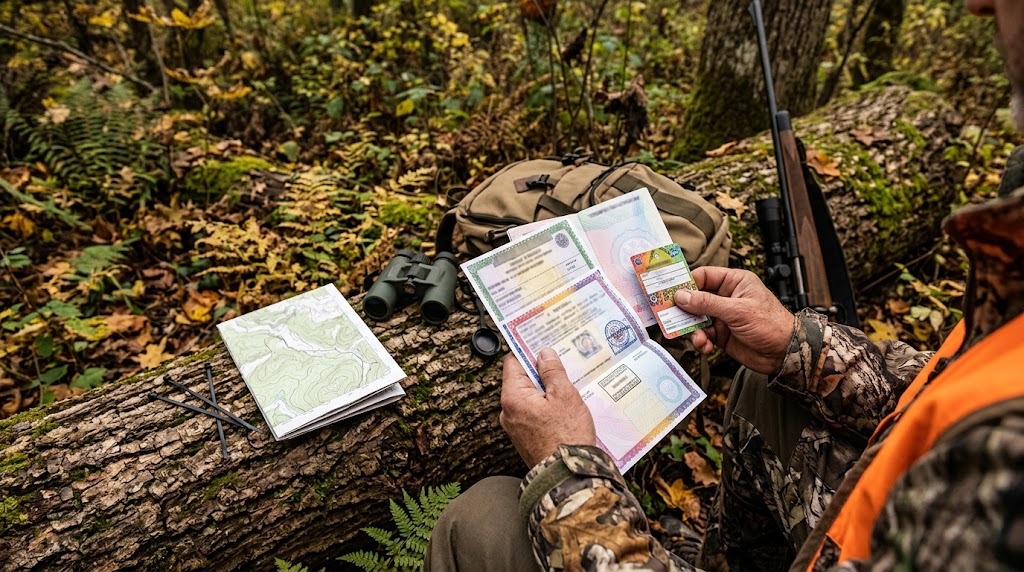
A hunting license is a government-issued legal document that grants an individual the privilege to pursue, harvest, or possess specified wild game within a designated jurisdiction. State wildlife agencies issue these licenses to regulate animal populations, enforce ethical harvesting limits, and fund conservation efforts through the North American Model of Wildlife Conservation.
Key Facts:
- State Jurisdiction: Hunting regulations and licenses are controlled by individual states, not the federal government (excluding migratory bird frameworks).
- Layered System: A base license rarely permits big game hunting; most hunters require a base license, a species-specific tag, and a method-of-take permit.
- Hunter Education: Anyone born after a state’s cutoff date (typically 1960–1980) must pass a certified hunter safety course before purchasing a license.
- Residency Rules: Claiming resident hunting privileges in multiple states simultaneously is a federal violation under the Lacey Act.
- Funding Mechanism: 100% of license fees, coupled with Pittman-Robertson excise taxes on gear, directly fund state wildlife management and habitat restoration.
What Is a Hunting License and How Does It Work?
A hunting license functions as a conditional legal privilege, subject to strict adherence to season dates, bag limits, and geographic boundaries. The license system operationalizes the public trust doctrine, which dictates that wildlife is owned by the public but managed by the state for sustainable use.
How Does the Jurisdictional System Work?
State wildlife agencies—such as the Pennsylvania Game Commission or Colorado Parks and Wildlife—hold exclusive authority over hunting licenses. Federal agencies manage federal public lands (like National Forests or BLM land), but the state dictates the hunting laws on that land. You must purchase a license for the specific state where your boots touch the ground. Crossing state lines requires a non-resident license for the new state, even if tracking a wounded animal.
What Is the Layered Authorization System?
Hunting authorizations require stacking specific privileges. A foundational base license generally covers small game (squirrels, rabbits) and upland birds. To hunt specialized or large game, hunters must add endorsements to that base license. A complete authorization package usually consists of three layers:
- The Base License: The overarching permit proving you have met residency and safety requirements.
- The Stamp or Permit: An additional fee granting permission to hunt a specific category of game (e.g., Waterfowl Stamp, Archery Permit) or use a specific Wildlife Management Area (WMA).
- The Carcass Tag: A physical or digital identifier issued for a single, specific animal (e.g., one Antlerless Whitetail Deer). Once the animal is killed, the tag must be invalidated (notched) and attached to the carcass.
What Are the Main Types of Hunting Licenses and Average Costs?
License costs depend entirely on the applicant’s residency status and the species targeted. State legislatures set these prices, heavily subsidizing resident licenses while using non-resident fees to generate bulk revenue.
| License / Privilege Type | Average Resident Cost | Average Non-Resident Cost | Validity Timeframe |
| Annual Base / Small Game | $15 – $35 | $80 – $200 | 1 Year (Season or Calendar) |
| Combination (Hunt + Fish) | $40 – $70 | $150 – $300 | 1 Year |
| Over-the-Counter Deer Tag | $20 – $45 | $250 – $600 | Specific Season (e.g., Fall) |
| Premium Big Game Tag (Elk/Moose) | $45 – $75 | $600 – $1,200+ | Specific Season |
| Federal Duck Stamp | $25 | $25 | July 1 – June 30 (Annual) |
| Lifetime Comprehensive License | $500 – $1,500 | Rarely Available | Lifetime |
How Do Resident and Non-Resident Licenses Differ?
Resident licenses offer substantial financial discounts and over-the-counter (OTC) availability for species that non-residents must win through a lottery. To qualify as a resident, applicants must present a valid state driver’s license, voter registration, and proof of physical domicile for a minimum of 6 to 12 consecutive months prior to application. Active-duty military personnel stationed in a state typically qualify for resident pricing regardless of their home of record.
Are Lifetime Licenses Worth It?
Lifetime licenses offer the best return on investment for dedicated sportsmen who plan to reside in a state for more than a decade. The breakeven point typically arrives between years 8 and 12 of continuous hunting. Crucially, most states honor the resident privileges of a lifetime license even if the holder subsequently moves out of state, making it a powerful hedge against future non-resident fee hikes.
How Do You Get a Hunting License?
The process requires completing safety prerequisites, verifying legal status, and selecting the correct spatial and biological permits. Total time investment ranges from 15 minutes for a returning adult to several weeks for a beginner needing safety certification.
Before You Start:
- Prerequisites: State-issued ID, Social Security Number (required by federal law for child support enforcement tracking).
- Cost: Varies ($15 to $1,000+).
- Tools Needed: Smartphone or computer, printer (for E-tags), or access to an authorized local retailer.
Step 1: Complete Hunter Education
Check your state’s birth date cutoff requirement. If born after the cutoff, complete a state-approved Hunter Education course. Most states accept online completion via platforms like Hunter-Ed.com. Keep the physical card or digital certification number; thanks to reciprocity agreements, a hunter education certificate from any U.S. state or Canadian province is valid nationwide.
Step 2: Create a State Wildlife Agency Profile
Navigate to the official state wildlife agency licensing portal. Create a unique customer profile. The system will issue you a permanent lifetime identification number (e.g., a DNR Number or WILD ID). This number tracks your preference points, harvest reports, and license history across your lifetime.
Step 3: Purchase the Base License and Add Tags
Select the appropriate annual base license. Add all necessary species-specific tags (e.g., Spring Turkey Tag) and method-of-take permits (e.g., Muzzleloader Privilege) to your digital cart.
Step 4: Complete the HIP Survey (If Applicable)
If hunting migratory game birds (doves, woodcock, ducks), you must complete the Harvest Information Program (HIP) survey during checkout. The system will ask how many birds you harvested the previous year. You cannot legally hunt migratory birds without “HIP Certified” printed on your license.
Step 5: Print, Download, or Wait for Mail
Download the digital PDF of your license. While many states allow you to carry your base license on a smartphone app, carcass tags often require physical printing. If hunting big game, you must carry the physical tag, a pen, and zip-ties into the field to legally notch and attach it to the animal immediately upon harvest.
What Are Specialty Tags, Permits, and Validations?
Standard licenses rarely authorize the pursuit of highly regulated species. Wildlife agencies use specialized tags and validation stamps to tightly control harvest quotas on sensitive or highly sought-after populations.
Big Game Tags and Lottery Systems
Big game tags authorize the harvest of one specific animal (e.g., Antlered Elk, Unit 4). In western states, high-demand tags are not sold over the counter; they are distributed via lottery. Hunters apply in early spring. If unsuccessful, they earn a “Preference Point” or “Bonus Point,” which increases their statistical odds of drawing the tag in subsequent years. Accumulating enough points for a premium tag can take 5 to 20 years.
Migratory Bird and Federal Duck Stamps
Waterfowl hunting mandates dual jurisdiction compliance. Hunters must purchase a state waterfowl stamp and the physical Federal Migratory Bird Hunting and Conservation Stamp (Federal Duck Stamp). The Duck Stamp must be signed in ink across its face by the hunter. E-stamp purchases grant a 45-day digital grace period, after which the hunter must possess the physical stamp mailed by the U.S. Fish and Wildlife Service.
Which License Strategy Should You Choose?
License strategies vary wildly based on geographic location, hunting frequency, and target species. Match your purchasing strategy to one of the following personas.
1. The Absolute Beginner
Quick Verdict: Buy an Apprentice License or a Base Resident Small Game License.
If you have never hunted, avoid purchasing big game tags and specialized gear. Take the hunter education course, and utilize your state’s Apprentice/Mentored Hunter program. This allows you to hunt for one season under the direct arm’s-length supervision of a licensed adult. Focus strictly on small game (squirrels, rabbits) to learn woodsmanship with minimal upfront financial risk.
2. The Western Big Game Out-of-State Hunter
Quick Verdict: Buy Preference Points annually, even if you do not plan to hunt that year.
Western big game hunting requires a multi-year strategy. Identify states like Wyoming, Colorado, or Utah that utilize preference point systems. Pay the annual $50-$100 fee to accumulate points for Elk or Mule Deer. By building seniority over 3 to 5 years, you guarantee access to a high-quality hunting unit rather than settling for overcrowded, low-success Over-the-Counter units.
3. The Dedicated Local Sportsman
Quick Verdict: Purchase the Lifetime Combination License immediately.
If you hunt and fish in your home state every year, calculate the combined annual cost of both licenses. A $750 Lifetime Combination License pays for itself in exactly 10 years (assuming a $75 annual cost), but effectively pays off sooner by immunizing you against inevitable legislative price increases.
What Are the Most Common Licensing Mistakes?
Ignorance of wildlife regulations is never an accepted legal defense. Game wardens issue citations for strict liability offenses, meaning intent does not matter.
- Triggering the Interstate Wildlife Violator Compact (IWVC): The IWVC is a reciprocal agreement between 49 states (all except Hawaii). If your hunting privileges are suspended in one state due to poaching, trespassing, or tagging violations, they are automatically suspended in the other 48 member states.
- Failing to Notch and Attach Tags Immediately: The most common big game citation is moving an animal before tagging it. The moment an animal expires, you must physically cut (notch) the month and day on the carcass tag and affix it to the animal. Moving the animal even ten yards without a notched tag constitutes illegal possession of wildlife.
- Hunting Without a Signed Duck Stamp: Possessing a Federal Duck Stamp is insufficient; federal law mandates the stamp be signed in ink across the face. An unsigned stamp is legally invalid.
- Misunderstanding Boundary Lines: Hunting licenses are strictly bound by Wildlife Management Unit (WMU) borders. Shooting an animal in Unit B with a Unit A tag is poaching. Use GPS applications like onX Hunt to ensure you remain within your legally authorized zone.
Who Qualifies for License Exemptions and Discounts?
State legislatures offer specific exemptions to reduce barriers for distinct populations and to reward private land conservation.
Landowner Exemptions
Many states allow private landowners (and their immediate resident family members) to hunt small game on their own deeded property without a base license. For big game, states frequently offer “Landowner Tags” at a steep discount, acknowledging that private agricultural land provides critical habitat and winter feed for public wildlife.
Senior, Military, and Disabled Veterans
Nearly all states offer heavily discounted or free hunting licenses to 100% service-connected disabled veterans. Active-duty military stationed within a state generally receive resident pricing. Senior citizens (typically aged 65 or older) often qualify for lifetime senior licenses for a nominal fee, though they must still acquire free or low-cost tags to ensure wildlife biologists can track harvest data.
Frequently Asked Questions (FAQ)
What happens if I lose my physical hunting license or carcass tag?
Do not hunt without it. You can instantly reprint a lost base license from your state’s digital portal, often for free or a nominal $5 reprint fee. However, if you lose a physical carcass tag, you cannot reprint it at home. You must visit an authorized state agency office or retail agent to swear an affidavit and purchase a duplicate carcass tag.
Can I hunt on my own land without a hunting license?
It depends on the state and the species. Most states allow landowners to hunt small game on their own property without a license. However, hunting highly regulated big game (like deer or elk) or migratory birds always requires state-issued tags or federal stamps, regardless of land ownership.
If I move to a new state mid-season, is my resident license still valid?
Generally, no. The moment you surrender your driver’s license and establish residency in a new state, your resident hunting privileges in your former state terminate immediately. The only exception is if you purchased a Lifetime License in your former state prior to moving.
Does my hunter education certificate expire?
No. Hunter education certificates do not expire. Furthermore, under reciprocity agreements, a certificate earned in any U.S. state or Canadian province is valid for purchasing a license anywhere in North America.
What is the difference between a preference point and a bonus point?
A preference point guarantees the tag goes to the applicant with the highest number of points; you wait in a strict line. A bonus point functions like a raffle ticket; it gives you extra chances in a random draw, meaning a first-year applicant can mathematically beat a 20-year applicant, though the odds favor the person with more points.