
A hunting gear checklist is a systematic inventory framework used to select, organize, and inspect essential field equipment. It prevents critical omissions across five functional layers: legal compliance, environmental survival, target acquisition, harvest management, and navigation, ensuring operational efficiency and safety during a hunt.
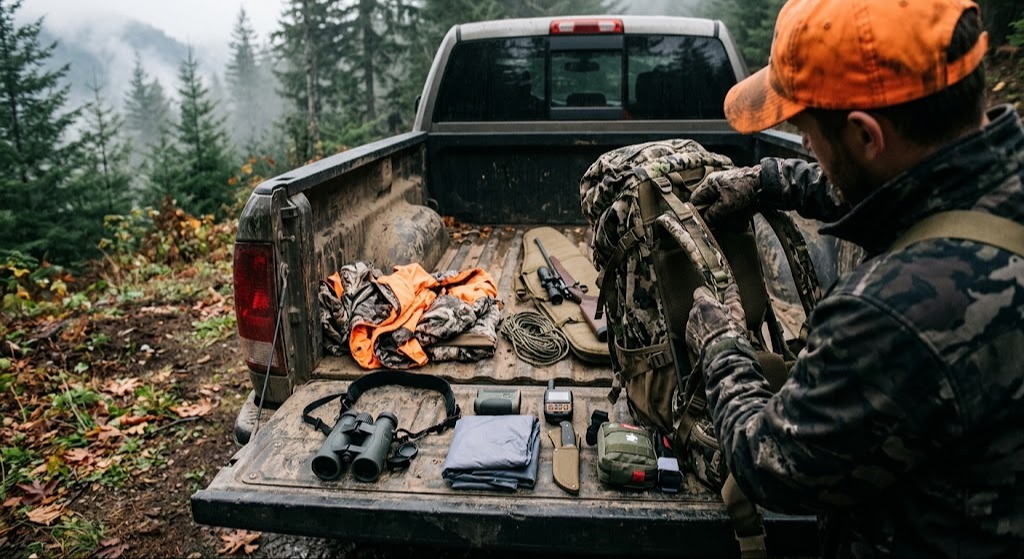
Key Facts
- The Cotton Rule: Cotton retains moisture and accelerates heat loss; baseline layers must consist exclusively of merino wool or synthetics.
- Boot Conditioning: Hunting boots require a minimum of 20 to 30 miles of pre-hunt wear to prevent immobilizing blisters.
- Optics Standards: An 8×42 binocular configuration is optimal for dense timber, while 10×42 is standard for western mountain terrain.
- Battery Degradation: Lithium-ion batteries lose up to 50% capacity in freezing conditions and must be stored against body heat.
- Pack Weight Limit: A standard day-pack should weigh 15–25 pounds, while multi-day backcountry packs often exceed 45 pounds before meat hauling.
How Does a Hunting System Work?
A hunting gear system functions as an integrated survival and lethality matrix divided into distinct functional layers. By categorizing equipment into specific operational goals, hunters avoid redundant weight while guaranteeing no critical capabilities are left at the trailhead.
The system relies on five independent but overlapping layers. The Regulatory and Legal Layer guarantees compliance with local wildlife laws. The Environmental and Core Survival Layer regulates human body temperature and provides emergency life support. The Target Acquisition and Lethality Layer delivers the kinetic energy required for ethical game harvesting. The Harvest Management Layer prevents meat spoilage in the field. Finally, the Navigation Layer ensures spatial orientation and emergency extraction capabilities in zero-connectivity environments.
What Is on the Complete Hunting Gear Checklist?
The complete hunting gear checklist requires specific, purpose-built items categorized by their functional application in the field. Every item carried must justify its physical weight through utility, safety, or legal necessity.
What Legal and Safety Gear Is Required?
Legal compliance and physical safety form the non-negotiable foundation of any hunt. Missing a single item in this category often results in heavy fines or dangerous delays.
- Hunting License & Tags: Physical or validated digital permits specific to the species, management zone, and date.
- Hunter Education Validation: A physical certification card, mandated for all hunters born after state-specific cutoff dates.
- Blaze Orange or Pink Apparel: Outerwear meeting local minimums, typically ranging from 400 to 500 contiguous square inches above the waist.
- Individual First Aid Kit (IFAK): Must include a TCCC-approved tourniquet, hemostatic gauze (QuikClot), pressure bandages, and blister treatment (Leukotape).
Weaponry and Ammunition
The lethality layer dictates your effective range and dictates how much practice is required before the season opens.
- Primary Weapon System: A centerfire rifle, shotgun, compound bow, or crossbow matched to the targeted species.
- Projectiles: Bonded soft-point or monolithic copper bullets for firearms; carbon arrows matched by spine weight with fixed or mechanical broadheads for archery.
- Field Maintenance Kit: A pull-through barrel snake, hex wrenches for optic or bow adjustments, and a microfiber lens cloth.
- Transport Protection: A padded, airline-approved hard case for transit, and a lightweight sling or bow-hook for active field carry.
What Are the Best Apparel Layers?
Apparel serves as active life-support equipment. The modern layering system manages perspiration during high exertion and retains thermal energy during prolonged stationary periods.
- Base Layer: Moisture-wicking tops and bottoms. Use 150g merino wool for warm weather and 250g+ for freezing conditions.
- Insulating Mid-Layer: Highly breathable grid fleece or compressible goose down designed to trap dead air space against the body.
- Protective Outer Shell: Windproof and waterproof garments featuring a durable water repellent (DWR) coating and a terrain-matched camouflage or drab colorway.
- Footwear: Waterproof boots with aggressive traction. Uninsulated models excel in early seasons; 400g to 1200g Thinsulate insulation is required for late-season tree-stand hunting.
Optics and Navigation Systems
Locating animals and navigating complex topography requires reliable glass and mapping technology.
- Primary Optics (Binoculars): Fully multi-coated binoculars mounted on a chest harness. 8×42 models provide a wider field of view; 10×42 models provide better identification at long distances.
- Laser Rangefinder: A handheld unit featuring angle-compensation algorithms to account for steep uphill or downhill trajectories.
- Digital Mapping: A smartphone running offline GPS software (e.g., onX Hunt) with pre-downloaded topographic and public land boundary maps.
- Illumination: A headlamp pushing a minimum of 300 lumens, explicitly featuring a red-light mode to preserve natural night vision.
Harvest and Field Processing Tools
Once an animal is secured, the priority immediately shifts to rapid cooling and meat preservation.
- Field Dressing Knife: A surgically sharp replaceable-blade knife (e.g., Havalon, Tyto) or a high-carbon fixed blade with a drop-point profile.
- Game Bags: Breathable, durable synthetic bags that allow airflow while preventing blowflies from depositing eggs on exposed meat.
- Sanitary Gear: Heavy-duty latex or nitrile gloves to prevent the transmission of zoonotic pathogens during field dressing.
- Breakdown Tools: 50 feet of high-visibility paracord for hanging meat, and a compact bone saw for severing the pelvis or skull plate.
How Do You Choose Between Core Gear Options?
Selecting gear requires balancing weight, effective kinetic range, and terrain restrictions against your physical capabilities and budget. The choices made here dictate exactly how you will hunt.
Weapon Systems
| Weapon Type | Effective Range | Primary Advantage | Primary Limitation | Typical Cost |
| Centerfire Rifle | 300+ Yards | Maximum kinetic energy and margin for error. | Loud report; illegal in densely populated management zones. | $500 – $2,500 |
| Compound Bow | 30–60 Yards | Grants access to early, less-crowded rut seasons. | Requires year-round muscle conditioning and form practice. | $700 – $2,000 |
| Crossbow | 40–80 Yards | Rifle-like mechanics with archery-season legality. | Heavy, cumbersome to maneuver in tight brush. | $400 – $1,500 |
Navigation Systems
| Navigation Tool | Connectivity Dependency | Primary Advantage | Primary Limitation | Typical Cost |
| Satellite Messenger | Zero cellular required. | Two-way SOS emergency communication via Iridium satellite. | Requires an ongoing monthly subscription fee. | $300 – $500 |
| Smartphone App | Needs cell for live updates. | Rich, intuitive interface detailing precise property lines. | Vulnerable to extreme cold and rapid battery drain. | $30 – $100/yr |
How Should You Adjust Gear by Hunter Profile?
Gear selection scales dramatically based on the distance from the vehicle, the targeted game, and the physical exertion required by the hunt.
The Beginner or Budget Hunter
The budget-conscious beginner focuses on versatile, high-margin-of-safety equipment that works across multiple species. This profile utilizes a 12-gauge shotgun or .30-06 bolt-action rifle, both capable of harvesting anything in North America. Apparel relies on affordable synthetic layers paired with standard 400g insulated waterproof boots. Navigation is handled strictly by smartphone mapping apps backed by a rugged 10,000 mAh power bank, and the hunt generally stays within one to two miles of the vehicle.
The Backcountry Public Land Hunter
The backcountry hunter prioritizes absolute weight reduction, extreme durability, and total self-reliance. This profile carries a lightweight carbon-fiber barrel rifle or a premium compound bow to shave ounces. Apparel consists of premium technical layering systems (like Sitka or KUIU) built for high-exertion vertical climbs. The defining piece of gear is a heavy-duty internal frame pack featuring a load-shelf capable of hauling 80 to 100+ pounds of quartered meat. A standalone satellite messenger is mandatory for this profile.
What Are the Most Common Gear Failures?
Most gear failures stem from untested equipment, poor moisture management, and rapid battery depletion in extreme environments. Addressing these vulnerabilities before opening day prevents ruined hunts.
- Hunting in Unbroken Boots: Blisters will completely immobilize a hunter within 24 hours. Fix: Log at least 20 to 30 miles in hunting boots, carrying a weighted pack, before the hunt begins.
- Wearing Cotton Layers: Cotton traps sweat against the skin, rapidly accelerating hypothermia when the hunter stops moving in cold weather. Fix: Wear exclusively synthetics or merino wool, which retain insulating properties even when wet.
- Forgetting to Check Zero: Assuming a rifle remains perfectly sighted-in after a turbulent flight or bumpy dirt-road drive frequently results in missed or wounded animals. Fix: Always fire a confirmation group at 100 yards upon arriving at hunting camp.
- Fogged or Scratched Optics: Wiping a fogged binocular lens with a dusty shirt permanently degrades the microscopic optical coatings. Fix: Utilize a dedicated microfiber cloth and apply anti-fog paste prior to deployment.
- Dead Electronics: Sub-freezing temperatures sap lithium-ion batteries rapidly. Fix: Store your smartphone and GPS inside an internal chest pocket close to your core body heat.
Frequently Asked Questions
How heavy should a hunting day pack be?
A fully loaded day pack for hunting typically weighs between 15 and 25 pounds. This weight accounts for three liters of water, daily caloric requirements, field dressing tools, a first aid kit, extra insulating layers, and emergency shelter materials.
Do I need camouflage for all hunting?
No. Ungulates like deer and elk lack the retinal cones to see the color red, perceiving the world in shades of yellow, blue, and gray. While camouflage breaks up the human silhouette, drab earth tones and stillness are equally effective for avoiding detection.
What is the best base layer material for hunting?
Merino wool is the universally preferred base layer material. It regulates body temperature, naturally neutralizes odor-causing bacteria (crucial for scent control), and provides thermal insulation even when completely saturated with sweat.
How many game bags do I need for an elk?
Processing a mature elk requires a minimum of five heavy-duty game bags. Four large bags are used for the four quarters (front and hind legs), while a fifth, slightly smaller bag holds the loose “meat parts” (backstraps, tenderloins, and neck meat).
How do you keep hunting gear scent-free?
To minimize your olfactory footprint, wash all apparel in detergent completely free of UV brighteners and artificial fragrances. Store the dried clothing in airtight plastic totes, avoid pumping gas while wearing hunting gear, and always hunt with the wind blowing in your face.