
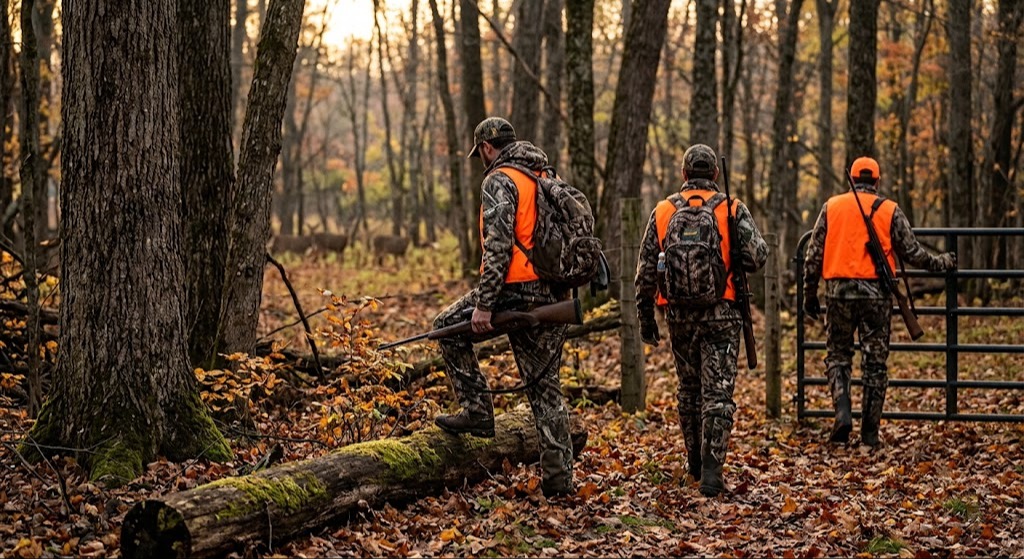
Hunting etiquette encompasses the unwritten social and ethical rules of conduct that govern behavior in the field, often referred to as fair chase or the hunter’s code. While hunting regulations dictate strict legal boundaries, hunting etiquette dictates moral responsibility—ensuring safe practices, wildlife conservation, landowner respect, and a positive public image.
At a Glance:
- Private land access: Request permission 2 to 3 months prior to opening day and provide a $25–$100 thank-you gift to the landowner.
- Public land buffers: Maintain a minimum distance of 200 to 300 yards in dense timber and 500+ yards in open country from other hunters.
- Tracking timelines: Wait at least 30 minutes after a double-lung rifle shot, or 1 to 2 hours for an archery shot, before beginning blood trailing.
- Field arrivals: Arrive at your tree stand or blind 45 to 60 minutes before legal shooting light to minimize noise disruption.
- The First-Come Rule: If another hunter beats you to a public land spot, they own that specific area for the day; back out quietly and use a backup location.
Core Pillars of the Hunter’s Code
Hunting etiquette operationalizes abstract ethical values into concrete field actions. The entire framework rests on three interdependent pillars that separate ethical sportsmen from opportunistic shooters.
- Respect for Landowners: Private land access is a privilege, not a right. Ethical hunters act as stewards of the property, leaving gates exactly as found, packing out all trash, and actively looking for ways to improve the land (such as mending fences or clearing deadfall).
- Respect for Wildlife: The concept of “fair chase” mandates that animals have a reasonable opportunity to escape. This requires taking only high-percentage, lethal shots within your practiced effective range, committing to exhaustive game recovery efforts, and treating harvested animals with dignity.
- Respect for Other Hunters: Public resources demand shared consideration. Ethical hunters minimize their footprint, yield to early arrivals, communicate quietly, and actively avoid ruining another person’s hunt, even if it means sacrificing their own setup for the day.
What Are the Unwritten Rules for Public vs. Private Land?
Hunting environments dictate distinctly different behavioral expectations. Applying public land aggression to private land will get your access revoked, while applying private land territoriality to public ground will cause conflicts.
Private Land: Stewardship and Access Rules
Private land etiquette requires absolute deference to the property owner’s specific rules, property boundaries, and privacy. Secure permission in writing at least 2 to 3 months before the season opens. Never assume that access granted last year automatically rolls over to the current season.
A customary token of appreciation—ranging from $25 to $100 in value, such as a high-quality knife, local goods, or processed game meat—should be offered to the landowner annually. While hunting, park vehicles exactly where instructed to avoid damaging pastures, and never bring uninvited guests or dogs onto the property without explicit prior consent.
Public Land: The First-Come, First-Served Doctrine
Public land etiquette operates on the principle of equal access and first-in-time rights. If you discover a vehicle parked at a small trailhead or observe a headlamp moving into your intended unit, you must yield the area.
Hunters must maintain vast spatial buffers: 200 to 300 yards in thick woodlands (like Eastern whitetail habitats) and upward of 500 to 1,000 yards in open Western environments. If you can clearly see or hear another hunter without optics, you are setting up too close. Never place a tree stand within sight of another hunter’s existing stand, and never claim a spot on public land by leaving equipment out overnight unless local regulations explicitly allow it.
Direct Comparison: Public vs. Private Expectations
| Category | Private Land Etiquette | Public Land Etiquette |
| Core Focus | Absolute respect for owner’s rules and property. | Equal sharing, de-escalation, and spatial fairness. |
| Access Acquisition | Requires months of relationship building and permission. | Free or low-cost access open to all licensed citizens. |
| Territorial Rights | Exclusive to the hunter with permission. | First-come, first-served on a daily basis. |
| The Golden Rule | Leave the property better than you found it. | Give vast space; if you see them, you are too close. |
| Primary Risk | Losing access instantly due to a single mistake. | Crowding, ruined setups, and safety hazards from overlap. |
The Chronological Timeline of In-Field Conduct
Ethical hunting behavior follows a strict timeline. The hunter’s code applies long before a weapon is loaded and extends well after the animal is tagged.
Pre-Season Preparation and Scouting
Scouting early ensures you do not push game out of an area immediately before the season begins. Conduct on-the-ground scouting weeks or months in advance, and rely heavily on digital mapping and distant glassing as opening day approaches. Never walk through known animal bedding areas within two weeks of the season opener. Furthermore, sighting in weapons is a moral imperative; taking an un-zeroed rifle or un-tuned bow into the field virtually guarantees a wounded animal and violates the core tenet of wildlife respect.
Opening Day and In-Field Conduct
Morning arrivals require stealth and punctuality. Plan to be settled in your spot at least 45 to 60 minutes prior to legal shooting light. When navigating in the dark, use a red or green headlamp to preserve night vision and minimize disturbance. Avoid slamming truck doors, racking firearm actions loudly at the truck, or talking above a whisper. If you accidentally walk into another hunter’s setup in the dark, do not shine your light directly at them; apologize softly, turn around, and vacate the area immediately.
The Harvest and Post-Shot Ethics
Executing a clean shot requires waiting for a broadside or quartering-away presentation that exposes the vital organs. Once the shot breaks, mandatory waiting periods apply. Hunters must wait at least 30 minutes after a double-lung rifle shot, and 1 to 2 hours for an archery shot, before beginning to track. Pushing an animal too early drastically reduces recovery odds.
Post-harvest etiquette demands respectful handling. Clean blood from the animal’s hide, tuck the tongue back into the mouth, and position the animal respectfully before taking photographs. When transporting the carcass home, cover it with a tarp or keep it enclosed; displaying a bloody carcass on the highway provokes public distaste and actively damages the future of hunting.
What Are the Modern Rules for Digital and Camp Etiquette?
The digital age and commercial outfitting have introduced new layers of required etiquette that older generations of hunters never had to navigate.
Social Media and GPS App Ethics
Digital etiquette prohibits “burning spots” on the internet. Never share exact GPS coordinates, trailcam backgrounds that reveal specific public land landmarks, or OnX/HuntStand waypoints on public forums. When posting harvest photos on social media, provide a trigger warning for non-hunters, refrain from using inflammatory or disrespectful captions, and ensure the animal looks as pristine as possible.
Lodge, Camp, and Outfitter Conduct
Hunting camp etiquette requires pitching in without being asked. Offer to cook, chop firewood, wash dishes, and clean the skinning shed. Maintain strict control over alcohol consumption; excessive drinking the night before a hunt is a severe safety liability. When hunting with a commercial outfitter, listen explicitly to your guide’s instructions regarding when to shoot and how to move. Finally, tip your guide appropriately—industry standard is 10% to 20% of the total hunt cost, regardless of whether you harvest an animal, as the tip compensates their grueling labor and expertise.
Common Hunting Etiquette Mistakes and Troubleshooting
Even experienced hunters make errors in judgment. The difference between an ethical hunter and a nuisance is how quickly they recognize and correct these mistakes.
- Mistake: Skylining on Ridges. Walking directly along the top of a ridge line makes your silhouette highly visible, ruining the area for hunters below.
- The Fix: Drop 20 to 30 yards below the military crest of the ridge when hiking to remain concealed against the hillside.
- Mistake: Leaving Livestock Gates Open. Leaving a closed gate open, or an open gate closed, on leased or private land can result in escaped or dehydrated livestock.
- The Fix: The universal rule is to leave every gate exactly as you found it, unless explicitly instructed otherwise by the landowner.
- Mistake: Encroaching on an Active Blood Trail. Moving in on or cutting off an animal that another hunter is actively tracking.
- The Fix: If you cross paths with a tracker, unload your weapon, offer to help them track or pack out the meat, and never claim an animal you did not shoot.
- Mistake: Yelling at Novice Hunters. Berating a beginner who accidentally wanders too close to your setup on public land.
- The Fix: Whistle quietly to alert them to your presence. Once they notice you, wave them through safely and use it as a moment for patient mentorship rather than gatekeeping.
Frequently Asked Questions About Hunting Etiquette
How do you handle a confrontation with another hunter on public land?
When encountering a hostile hunter on public land, de-escalate immediately by remaining calm and lowering your weapon. Apologize for the overlap, even if you arrived first. If they refuse to share the area reasonably, prioritize safety, retreat quietly, and relocate to your pre-planned secondary hunting spot.
What is the proper etiquette for handling a wounded animal that crosses property lines?
If a wounded animal crosses onto private property, you must stop tracking immediately at the property line. Contact the landowner to request permission to retrieve the game. If the owner refuses access, contact local game wardens to mediate, but never trespass to recover a harvested animal.
How should waterfowl hunters manage calling when setting up near other groups?
Waterfowl hunters should maintain at least 400 yards of separation in marshes. Never call at birds actively working another group’s decoy spread. If a neighboring group is actively working a flock, remain silent and let them finish the sequence to avoid ruining the shared flyway.
Do you tip a hunting guide if you do not successfully harvest an animal?
Yes, you should tip your hunting guide 10% to 20% of the total hunt cost, regardless of a successful harvest. Guides invest massive effort into scouting, calling, and logistics. Tipping rewards their professional labor, field expertise, and hospitality, not the unpredictable behavior of wild game.
What is the etiquette for hunting with a dog around other hunters?
When hunting upland birds or waterfowl with a dog, keep the animal under strict verbal or electronic command at all times. Never allow your dog to run through another hunter’s decoy spread, flush birds in their immediate zone, or approach unfamiliar hunting dogs without prior permission.